
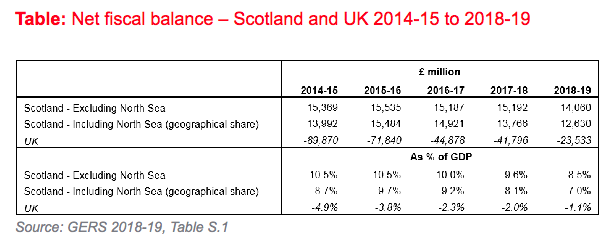
The GERS report shows a net fiscal balance (including a geographical share of North Sea oil) in Scotland of -£12.6bn or –7.0% of Scottish GDP for 2018-19. This compares with a UK balance of -£23.5bn or –1.1% of UK GDP.
This is an improvement on the figures for 2017-18 when Scotland’s net fiscal balance was -8.1%. This improvement has been driven by a larger increase in revenues per head than expenditure per head, which is also largely reflected at the UK level.
How does this link to devolved powers?
Most of the today’s coverage will concentrate on the headline numbers and what this all means for the independence debate.
However, there are also some interesting implications from the increased devolution of powers to the Scottish Parliament. As we flagged in our blog last week, new data from HMRC is the last two years has indicated that the number of higher and additional rate income taxpayers in Scotland is lower than was previously estimated using survey data.
This has now been reflected in the most recent years of the GERS figures, leading to a worsening of the income tax revenue figures and in turn the net fiscal balance for 2016-17 and 2017-18 in particular. Interestingly though, this data has not been used to adjust earlier years of the GERS estimates. These revisions also feed through to weakening National Insurance Contributions.
These revisions have been offset somewhat to upward revisions of VAT data. A new model has been developed by HMRC as part of the proposed assignment of VAT to the Scottish Budget. Although the approach is similar to previous estimates produced for GERS, it is giving slightly higher estimates of Scottish VAT. Some of the issues with this model, including the potential volality of the results, has led to the Scottish Government requesting a delay to the implementation of VAT assignment.
All of these issues are discussed in boxes 1.1 and 1.2 of GERS.
Overall, Scottish onshore revenues remain at 7.8% of the UK, similar to last year.
Final thoughts
GERS is an annual publication that sparks off a debate about Scotland’s public finances. As we say regularly in our blogs: it is a statistical publication produced by the Scottish Government; it contains some elements which are estimated but that does not mean it should be discredited; and altering any assumption made does not really change the overall picture.
It is always important to remember that GERS takes the current structure of UK Government reserved taxation and spending as given. If the very purpose of independence is to take different choices about the type of economy and society that we live in, then a set of accounts based upon the current constitutional settlement and policy priorities will tell us little about the long-term finances of an independent Scotland.
But GERS does provide a pretty accurate picture of where Scotland is in 2019. So in doing so, today’s numbers set the starting point for a discussion about the immediate choices and challenges that need to be addressed by those advocating new fiscal arrangements.
First published by the Fraser of Allander Institute
Some more thoughts
Every year when GERS is published, there is a new angle that seems to gain traction and ignite a debate about the accuracy of the figures.
This year’s is a rather misguided interpretation of the notional net fiscal balance produced in GERS.
These have been variations on:
- How can 8% of the UK population be responsible for more than 50% of the deficit?
- And/or how can the Welsh and Scottish deficits add up to more than the UK?
The easiest way to think about this is to consider all 12 areas of the UK together. ONS produces GERS style figures for all 12 “NUTS 1” areas (so Wales, Scotland, Northern Ireland and the 9 regions of England).
The latest ONS figures are for 2017-18, so they are not quite the same as the 2018-19 GERS figures, but it illustrates the key error when pulling together a ratio of the Scottish figure vis-à-vis the UK as a whole.
The ONS figures show that:
- 3 areas contribute positively to the UK net fiscal position (that is, they contribute more in taxes than they spend on public services)
- 9 areas contribute negatively to the UK net fiscal position (that is, they contribute less in taxes than they spend on public services).
The UK net fiscal balance is therefore a sum of these surpluses and deficits, as shown below.
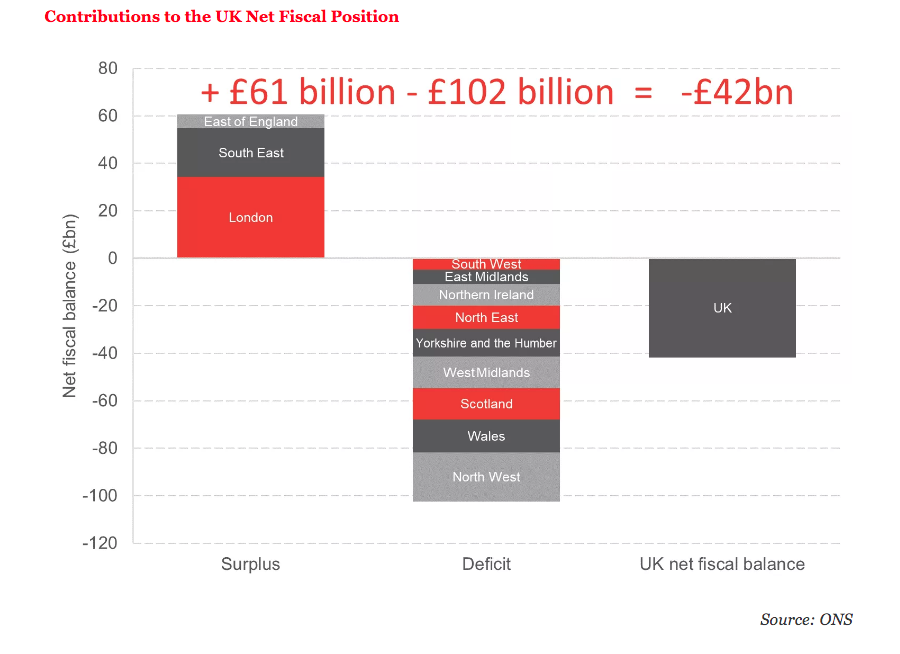
Comparing the £bn figure for Scotland to the equivalent UK figure is simply not a valid comparison. Statements such as “the GERS figures imply that Scotland is responsible for 60% of the UK’s deficit” are just statistically meaningless.
For a more accurate statement about the relative importance of Scotland to the overall UK fiscal position, we could say, on the basis of this ONS 2017-18 data:
- Scotland makes up 13% of the total deficit contributed by the 9 regions of the UK who raise less in taxes than they spend on public services.
Of course, there are important questions about the balance of the UK economy – see our blog on “UK Regional Performance: An increasingly unbalanced picture”. But it’s important to base such discussions on a proper analysis of the data.
Contributions to the changes in the deficit over time
Another issue that gained traction was the time series of the ratio of the Scottish deficit compared to the UK over time, and in particular since 2011. There were even claims that this was somehow linked to the constitutional debate.
This is not the cause of changes in Scotland’s relative fiscal position.
Rather, after 2011 there was a sharp fall in oil revenues – while the oil price itself peaked in 2014, tax revenue was lower in the sector e.g. undertaking investment which incurs tax relief, meant that tax receipts were lower after 2011.
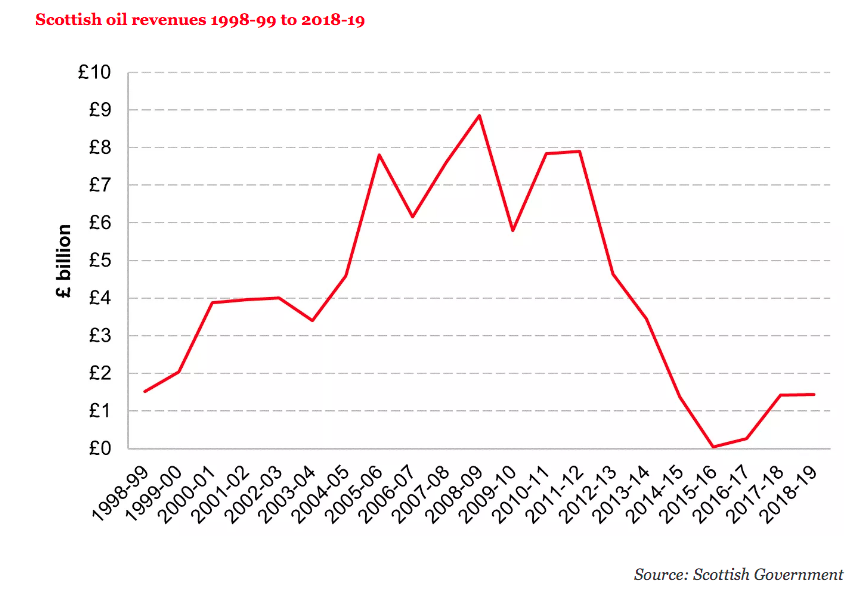
Given that oil revenues are now much lower than in earlier years, there is a fairly sustained gap in percentage point terms between the UK and Scottish deficit over time, which is mostly due to higher levels of spending per head.
Final thoughts
As an aside, there is a serious – if albeit boring – point to be made here. Each year, the level of misinformation and bad analysis around the GERS publication is pretty shocking.
This year it was these claims about Scotland’s apparent share of the UK deficit.
The last couple of years it has been that the figures somehow can’t be trusted as they rely, in part, on estimates (although with increasing fiscal devolution substantially less so).
Before then, it was the claim that the publication is a Westminster-exercise (despite the statistics being produced by Scottish Government civil servants – who also provide technical support for Ministers in their policy agenda, including in relation to independence).
We can’t think of any other government statistical publication – and a National Statistics publication at that – that is subject to such criticism and attack.
The Code of Practice for Statistics is clear that organisations producing official statistics should be defending their integrity, actively preventing their misuse and promoting correct interpretation.
Much more could be done by government to defend these statistics and proactively clear-up misunderstandings.
Update via FAI here
Leave a Reply