
How to close the gap? It’s clear that Scots are not raising as many children as they want – or expect to. Ben Wray examines the obstacles and a way forward.
According to a Scottish Government survey, the average ideal family size of young adults in Scotland is 2.08, fractionally below replacement rate and significantly above Scotland’s current fertility rate (1.26).
The expected family size is only slightly lower, at 2.02. There is only a small difference between men and women – the ideal for men being 2.11 and 2.06 for women, the expected size for men being 2.08 and 1.98 for women. It’s clear that Scots are not raising as many children as they would desire nor expect.
Scotland’s ‘fertility gap’ – the difference between the fertility rate and the ideal family size – is 0.82, higher than the UK (0.7) and every other nation for which we have data: Germany (0.7), Denmark (0.6), Netherlands (0.6), France (0.6), Estonia (0.6), Finland (0.5) and Czech Republic (0.5). Scotland’s fertility gap should be a cause for concern.
According to a recent UN study, the best approach to fertility issues is to give people maximum choice: free from financial constraints and social or government pressures, “to decide freely and responsibly on the number, spacing and timing of their children.” In an ideal scenario of genuine free choice, it’s likely that fertility rates would eventually closely track ideal family sizes. And the demographic crunch described in Part 1 would ease significantly over the long-term.
Bear in mind, ‘natural’ population size (excluding migration) would not start to grow even with a fertility rate which went above replacement levels, because the effects of natural population decline mean there are fewer women of re-productive age. It takes at least a generation – with girls becoming women of re-productive age – to change the momentum of population decline. See here for more
No Silver Bullet
International evidence suggests that downward trends in fertility are difficult to budge. Sweden, which has the most generous parental leave and childcare system in the world, saw its fertility rate rise in the first decade of this century, but since 2010 it has steadily fallen and is now at 1.4 – above Scotland’s but well below replacement rate. There is no silver bullet to falling fertility rates.
For solutions, we need to look at three main areas of concern: financial constraints, career constraints and alientation.
Financial constraints – what would help?
Affordability is not a panacea, but it is a major factor in putting many young adults off having children. A Scottish Government survey on family formation in 2026 found that for 34% of 30-39 year old’s, financial constraints was the main reason to limit family size. And, those who reported having financial difficulties were three times as likely to say that was the main reason to limit family size than those who reported ‘doing alright’ financially.
In-depth Scottish Government interviews and focus groups on family formation reveal that: “Across participants the main barriers to having children in order of influence were: lack of financial resources; inadequate maternity and paternity entitlement; lack of right housing; need to establish a career; and childcare costs.”
What would help most? Interviewees listed the following: “financial support; more government-funded childcare; greater access to social benefits; more support for parents in the workplace; improvements in maternity and paternity entitlements; equality of treatment to women who return to work; and support in housing.”
Childcare is just one of many areas in which costs play on the mind of aspiring parents. A Child Poverty Action Group (CPAG) 2023 study found that it costs £150,900 for a couple to bring up a child to an acceptable standard of living in Scotland, and £205,037 for a lone parent. The report found that reducing housing costs was key to further easing the financial burden of raising children.
Housing is a particularly important issue because access to affordable housing affects young adults, the demographic cohort of childbearing age.
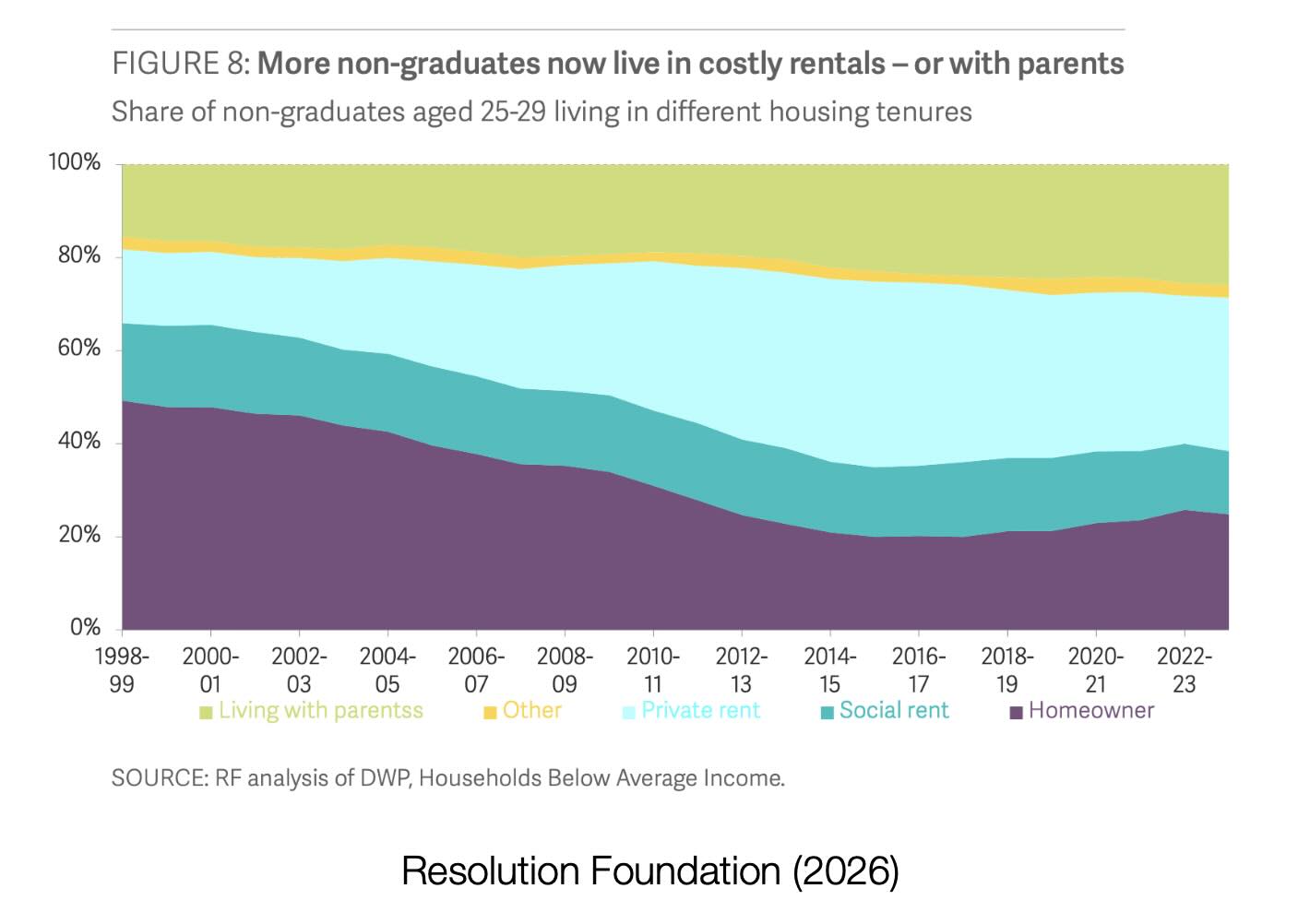
Tackling the housing crisis by reducing the cost of housing and creating housing security is indispensable for any strategy to close the fertility gap.
As the Resolution Foundation graph above shows, there has been a transformation in the tenure of housing for people in their late 20s over the past 25 years, especially those who are non-graduates, the age group which has seen the sharpest decline in fertility rates in recent years. The number of non-graduate 25-29 year olds who are homeowners (including those with a mortgage) has dropped by about half since 1998-199, while the number of private renters has more than doubled. Moreover, the number of non-graduate 25-29 year olds living with their parents has increased significantly.
These housing dynamics significantly affect the likelihood of a person to have children. Unsurprisingly, people living with their parents are least likely to have children, while homeowners are most likely. Neither does the highly insecure and expensive private rental sector offer great conditions for raising a family.
An analysis by FT data journalist John Burn-Murdoch has found that half of the fall in fertility rates in the UK since the 1990s “can be explained by falling home ownership and a rise in young adults who live with their parents”. Tackling the housing crisis by reducing the cost of housing and creating housing security is indispensable for any strategy to close the fertility gap.
Today, most people delay having children until they are in their 30s, at which point some achieve some semblance of financial security. However, by the time financial security is achieved in your late 30s and early 40s, the reproductive capacity of women begins to decline quickly. This paradox is why it’s important to consider improving support for egg/embryo freezing, IVF treatment and donor insemination to make it easier for women near the end of their reproductive years to have children.
This could be done by providing greater support through the NHS in Scotland which currently funds up to three cycles of IVF treatment when there is a reasonable expectation of a birth. This is more generous than the current system in England. However, NHS-funded IVF cycles have been falling across all parts of the UK, including Scotland, while private-funded IVF is rising. But access to IVF is significantly affected by income and wealth inequalities – one cycle of IVF treatment costs around £5,000, and for many women in their late 30s or above several cycles are required and even then there is no guarantee of success.
The Scottish Government should explore how the cost of fertility treatments and egg/embryo freezing could be further reduced, as well as improving education for young adults about the options they have available to them.
Career constraints – on women not men
A major issue for women is career pressure. The Scottish Government’s in-depth interviews and focus groups also found “a strong opinion amongst a few women that they were faced with a choice of having a career or children, which was not the case for men.” These views are reinforced by employer research showing that 20% of bosses still expect their workers to return to work before the end of their parental leave, while one-third of UK managers admit to being reluctant to hire women in case they get pregnant.
What is required is to empower workers through unions and other forms of workplace democracy so they do not fear bad bosses and feel like they can take time out of work without losing out in their career. Strengthening trade union power in Scotland would help to improve wages and conditions, reducing financial constraints on childbearing.
Alienation – more and more people are living on their own.
It’s clear: many people are not having children because they haven’t found a partner. Single people who responded to the Scottish Government survey had by far the highest fertility gap – single parents having 0.42 children on average but wanting 1.52 children. Twelve per cent of respondents said their family size was limited because they “do not have a partner to have (more) children with.”
The Scottish Census in 2022 found that there are 930,000 single person households in Scotland, 37.1% of all households. Single person households have grown 13% since 2011, up by 106,700. For the first time, the single person household is the most common form of household in Scotland. More and more people are living on their own.
The rise of single-person households, the difficulty people have in finding a partner; these are deep-seated changes in the structure of Scottish society, changes which have had many positive effects but have also undoubtedly increased alienation between Scots.
When Scotland was a religious society and an industrial economy, a large portion of people lived in social housing and communities were structured around strong social institutions: churches, workplaces, unions and housing estates. Meeting a partner and getting married in your twenties was the norm within that social environment.
Today, the church and unions have massively reduced importance as social institutions. Work does not provide the social structure that it once did. Very few people expect that they will be in a job for life. Careers tend to be built horizontally, by working at lots of different places for a short period of time, rather than vertically through progressing up one company. As social housing has declined and the private-rented sector has grown, people in their 20s and 30s move house regularly; fewer communities are formed around where you live.
There is also the influence of the digital vector in mediating our social lives, increasing the quantity but reducing the quality of our social relationships. Researchers have found that in areas where smart phones are rolled out, the decline in birth rates accelerates.
Rediscovering real life relationships
The algorithms of dating apps are designed to incentivise a large number of superficial sexual relationships – finding a long-term partner on ‘Tinder’ undermines the business model. When these sweeping changes in the social circumstances of young people are considered, it is easy to understand how the 21st century has produced a more individualist society, one that is much more difficult to find a long-term partner to make a family with.
There are no straightforward policy solutions to a fragmented social structure. In Japan, government dating apps impose onerous conditions. Users must sign a statement that they will not use the app for casual dating and are looking for a partner to marry. This somewhat desperate, regressive techno-solution to matchmaking is unlikely to be successful because it doesn’t address any of the underlying causes. Neither does nostalgia for the Scotland of the 1960s, nor should we desire such a regression. We need a multi-faceted project to tackle alienation by building social structures adapted to modern realities.
At the core of that agenda, we must disconnect our social lives from the marketplace. Precariousness in your work or your home does not build community. Instead, we need to provide spaces where people can meet and build relationships in a modern context: Make leisure centres, gyms and other sporting facilities accessible to all; stop town centres from becoming hollowed out; stimulate active cultural life with live music and local cinemas; encourage people to participate in real life rather than spend weekends at home behind their TV, laptop or smartphone.
Thriving local democracy can provide spaces for active engagement and participation. The fewer barriers there are to social connections between people, the less individualist society will be and the more chances of people finding the partner they’re looking for.
Finally, by promoting the values of equality and solidarity, it’s possible to generate an attitude shift in society, away from the ‘neoliberal self’ – where one spends all hours of the day developing capacities in competition against other workers in the labour market – and towards a more socially-driven outlook, where collective goals are valued as highly as individual ones. Such a society is likely to have less career pressure and put more value on family formation as part of what makes up a socially fulfilling life.
Conclusion – towards a fairer Scotland
Scotland’s demographic crunch is already here and will become an even bigger issue facing the country in years to come. This series seeks to highlight its contours, explain its consequences and point to what changes would help reduce its most damaging effects. Urgently needed changes could bring positive results.
Many, if not all, of the measures needed to manage the impact of an ageing and declining population and to close the fertility gap are also measures which will create a more socially equal and just Scotland.
Raising the wages of care workers, reducing the cost of housing, creating full employment, improving social participation – these are all things that would be good for Scotland even if we didn’t have a demographic crunch. It just so happens that the demographic challenges that the country faces make these measures even more urgent.
Ultimately, the fertility gap is caused by the difficulties young people have in forging the life they want under conditions of advanced capitalism. The modern world is expensive, cut-throat and alienating. Many countries have tried and failed to turn around collapsing fertility rates exactly because they have not understood how deeply rooted the problem is, erroneously believing that a subsidy here or a tax cut there will do the trick.
What is required is a coherent project to make life easier, replacing precarity with security, vulnerability with affordability, and alienation with community. If we want Scotland to have a good life long into the future, we must make it easier to live.
Feature image: Mother and child, photo Fay Young
This is the final part of the three part series.
Part 1 Scotland’s demographic crunch
Part 2 Scotland’s ageing population
Leave a Reply