
There is a real risk that Scotland’s social care system eventually breaks down altogether Ben Wray looks at the fiscal cost and labour force challenges of caring for the elderly.
Alongside a falling population over the next 25 years, NRS also projects that Scotland’s old-age dependency ratio is set to rise – from 3.3 people of working age for every person of pensionable age today (3.3:1), to just 2.85:1 in 2049.
What does a tightening old-age dependency ratio mean for the economy and public services? There are five key dynamics at work:
First, pensioners are a major source of consumer spending as they have more savings than any other age group, but they do not produce. The macroeconomic effect of more elderly people relative to the size of the workforce is therefore to structurally increase pressure towards higher inflation.
Second, significantly more is spent by the government on pensioners than they pay in taxes. As the graph below shows, this is an even greater net fiscal cost than exists for children. The fiscal impact of an ageing population is a tendency towards increased deficit spending.
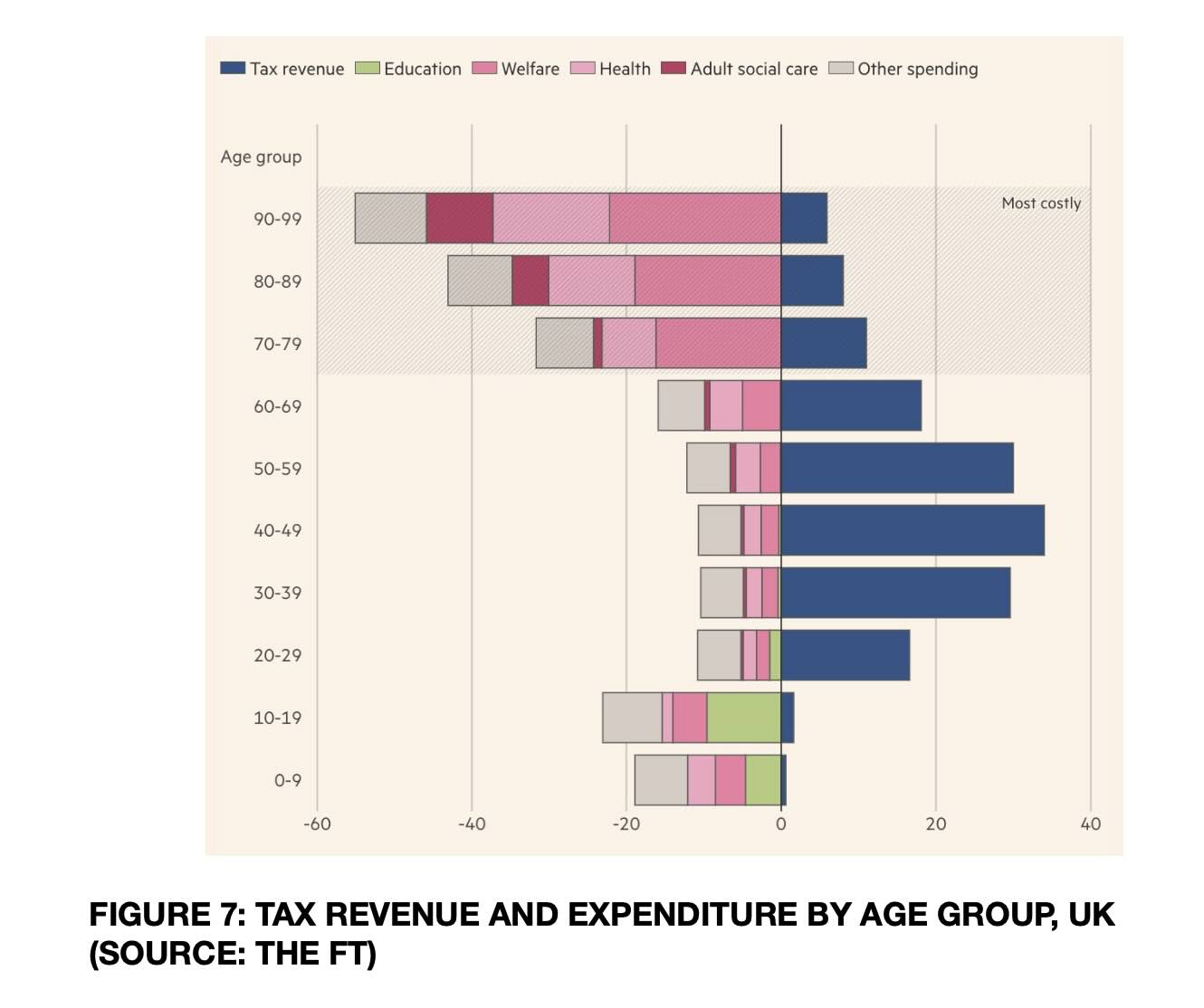
Third, the type of public spending is affected by the needs of a larger elderly population. Public spending on pensioners is focused on welfare and service delivery like pensions, social care and healthcare, whereas public spending aimed at workers, is more focused on investment to improve infrastructure and skills, which raise productivity. We can therefore expect that an ageing population has a structural tendency away from productivity-enhancing public spending.
Fourth, this public spending preference is accentuated by the growing political power of the elderly as the population ages, what has been dubbed ‘grey power’. Political scientists have found that the elderly tend to vote in a way which they believe is in their material interests, prioritising spending on pensions over education, for example.
Fifth, as the population ages a greater share of the workforce is drawn into care work to meet the needs of the elderly. Social care and healthcare are labour-intensive industries. The more workers who are dedicated to meeting the care needs of the elderly, whether that be in paid work or as unpaid carers for their parents, the fewer workers there are available for other economic priorities.
Major staffing issues in elderly social care
Elderly care workforce pressure has significantly increased since the UK Government scrapped the care visa in May 2025.
To give one example of how these dynamics might play out more concretely, let’s look at the case of elderly social care. There are already major staffing issues in elderly care. The latest data shows 69% of elderly care homes and 70% of home care services have staff vacancies, more than two in three.
These statistics are from mid-2024, but we know that elderly care workforce pressure has significantly increased since the UK Government scrapped the care visa in May 2025. The Scottish Government reports that a quarter of care workers are immigrants, “with many sector leaders citing concerns with workforce shortages and recruitment”.
Now consider that, according to NRS, the number of people of pensionable age is set to grow from just over one million today to almost 1.25 million by 2049. In that context, the difficulty in meeting the workforce requirements for elderly care today are only set to intensify in years to come.
These risks are intensified by the structure of the social care system in Scotland, which has become highly privatised over the lifespan of the Scottish Parliament. Private equity firms dominate the private care sector and extract large profits, paying lower wages than in the non-profit and publicly-run social care sector. Scottish Government funding is subsidising the profits of private equity giants.
There is a real risk that the social care system eventually breaks down all together due to the fiscal cost and labour force challenges which Scotland faces. In that context, it will be those who have the money to buy-in elderly care who will be able to cope, while families which are not wealthy will be forced to fend for themselves. This could pressure working-age women in particular back into the home as (unpaid) carers for their mum and dad. It could also lead to many elderly people going uncared for all together, putting the right to a dignified third age in jeopardy.
Transform pay and conditions
One-quarter of the working-age population is not currently working.
What is required to address this challenge is a transformation in the pay and conditions of social care work to retain the workers who are already in the sector and to recruit more. Research commissioned by the Scottish Government found that for every 1% increase in pay in social care, there would be a 1.75 to 1.8% improvement in employment in the sector. Ending the privatisation of social care would help facilitate such a transformation.
Beyond the specific issues faced in social care, a rising old-age dependency ratio should place greater emphasis on making sure that all those Scots who are of working-age are able to access socially useful jobs. Currently, Scotland’s unemployment rate is 3.7%, while the economic inactivity rate (i.e. unemployed but not registered for unemployment benefit) is 22.3%. One-quarter of the working-age population is therefore not currently working.
With the labour supply likely to tighten over the long-run due to demographic pressures, maximising the available workforce should be a major priority for the Scottish Government. The most efficient way to do this would be to establish a job guarantee scheme so that everyone who wants a job can be provided a socially useful one.
Not only would this help plug labour shortages, it would ‘tighten’ the labour market as workers would always have the job guarantee scheme to fall back on for work, improving the bargaining power of workers vis-a-vis their bosses and therefore raising wages.
Part 3 looks at the fertility gap, examining key constraints to Scots being able to achieve their ideal family size and what policies may help overcome those constraints.
Part 1 Scotland’s demography today and where it is going: an analysis of current data and projections on fertility, net migration and mortality.
Feature image: Grandmother and grandson. By Catherine Scott – Matti, CC BY-SA 2.0, Wikimedia commons
Further reading – Promoting Healthy Ageing in Scotland Scottish Parliament Information Centre: SPICe briefing.
Based on current trends, health and social care spending is projected to rise from around 40 per cent of Scottish devolved public spending in 2029-30 to almost 55 per cent in 2074-75. The Scottish Fiscal Commission has suggested that improvements to population health could ease fiscal pressures
SPICe is the Parliament’s internal research centre, providing impartial, factual, accurate and timely information and analysis for Members of the Scottish Parliament.
Leave a Reply