
“There are plenty of legitimate concerns in Scottish and British public life. The success of the radical right has been to create the impression that almost all our collective ills are the sole result of mass immigration” Charlie Ellis analyses local online responses to the Edinburgh incident that made national news – and what they reveal.
A serious incident in the national news makes a different emotional impact when it happens close to home.
The incident on Friday night on Leith Walk occurred on a street I walk, or take the bus or tram down, every single week. Seeing such hatred and rage in such a familiar place is unsettling.
The attacks began near Broomhouse Mosque, where two men were injured. Footage posted on social media shows a man bare-chested, carrying a large weapon vandalising a petrol station and then battering the door of Origano, an Italian restaurant on Leith Walk, before being held on the ground by police. As he lay there, he called out: “I’m protecting the country from these fucking Muslim bastards raping our young daughters, raping our kids. Enough is enough. I have had enough.”
But Scotland is a welcoming place
Local politicians were quick to emphasise that such behaviour and attitudes are at odds with the pluralistic values of Edinburgh and Leith. The SNP MSP Ben Macpherson and Labour’s Scott Arthur both articulated a view common in Scottish public life: Scotland is, in the UK context, exceptional in welcoming those who come from other parts of the world: our nationalism is civic rather than ethnic; the attacker’s anti-Muslim grievances were deeply anti-Scottish.
How true is this?
Reform UK’s fairly strong performance in the recent Scottish election suggests that such attitudes are not marginal and cannot be ignored. In my own research, I have found that the tropes and narratives of the radical right appear regularly in mainstream online spaces. The comments I discuss below come not from the deep recesses of explicitly political forums, but from Facebook posts under stories by the Scotsman, Edinburgh Live, and the MP Scott Arthur. We should be wary of treating online political discourse as a direct reflection of wider public opinion. If it were, Rupert Lowe’s ‘Restore Britain’ would be heading for a landslide. But we should be equally wary of underestimating its significance.
A now predictable online response
Any news story about Scottish cities now seems to prompt the same responses. In part they are driven by bad-faith actors (often based abroad, and by bots) but many are by genuine citizens. Such views have always existed in our society; the ease with which people can go online has simply brought them clearly into view. What seems to be happening now is that people who spend a great deal of time on these platforms are being actively radicalised.
Radical-right politicians and opinion-formers have been effective in shaping public discourse because they offer ready-made narratives, stereotypes that compensate for their lack of accuracy and nuance with concise clarity: qualities that suit online exchanges well.
Given that the man being held for the attacks was expressing clear anti-Muslim sentiments, I wondered whether online commentary might take a different shape. Perhaps those who share such views might consider it wise to stay out of the debate – the perpetrator was “one of their own” rather than a radical Islamist or progressive activist.
Nothing of the sort happened.
From the radical-right playbook
Responses I have seen suggest that the volume of media attention fits the “progressive” establishment narrative: ethnic minorities are the ones primarily under threat. This sits in direct opposition to the radical-right position: “indigenous” white Scottish and British people are the ones at risk, whether from physical violence, sexual abuse, or, more existentially, being “replaced” in their own country. Accordingly, many respondents accused the media of hypocrisy, arguing that coverage failed to provide “proper context” – the belief that attacks on Muslims represent only a fraction of violence committed in the other direction.
A closer look at some of these comments reveals how thoroughly the radical-right playbook influences mainstream online discourse.
“Two-tier policing” and media bias are persistent themes. Identification of the attacker as “a white Scottish man” is seen as evident bias, not routine reporting
“I find it interesting that when it’s a white person, the MSM have no problem saying so but, when it’s an immigrant they like to try to keep that under wraps,” writes one. Another: “Had he been a different colour it would have been ‘we have arrested an individual.’ Talk about two-tier policing.”
White attackers are reframed as victims of a biased system, deflecting scrutiny from the act of violence.
The question of terrorism
This logic is sometimes extended to the question of terrorism. “Amazing how when it’s someone white it’s a terror attack, yet when it’s a Muslim, they’re described as ‘Asian’ or better still ‘British citizen’, definitely not terror related,” writes one. A graphic circulating across multiple threads distils this neatly: “Two men went on violent knife rampages in Edinburgh this year, injuring multiple people. One is branded a terrorist and dominated headlines. The other was deemed mentally ill and quietly buried. Can you guess which is which?” The implication is that the terrorism label is a political tool used against white men while Muslim attackers are quietly excused.
But, the terrorism label was also raised by commenters with no apparent radical-right sympathies, one asking with evident sincerity why the word terrorism was absent when “a crazed man going after a specific religious group with a political aim surely ticks every single box.” Their point was the opposite of the radical right’s: reserving such labels for certain groups creates “subconscious and racial bias which further aggravates stuff like this.” The same grievance, expressed from different political positions shows how muddled public responses to these events have become.
Mental health framing as sarcasm is another distinctive feature. Several commenters deploy phrases like “mental health issues,” “ceremonial machete,” and “nothing to see here” as cutting irony, mimicking what they claim would be said if the perpetrator had been Muslim.
Don’t speculate about his motive too early. It was probably an isolated issue from someone with mental health issues. Don’t use this tragic incident to whip up division and hatred. Don’t look back in anger. Unfortunately knife attacks are part and parcel of living in a big city. Diversity is our strength and this is part of having a diverse population.
The text above appears word for word across multiple threads suggesting coordinated amplification rather than independent opinion. One commenter puts the implication plainly: “It’s okay guys stop panicking, he’s white. It’s allowed.”
There is a twist in the narrative, however. One commenter worried that the mental health framing would not be applied this time, so that the courts could “fling the book at him.” Same rhetoric, deployed to opposite ends, illustrates how mental health framing has been politicised online.
Justified and celebrated
Perhaps the most alarming cluster of comments display outright justification or celebration. One commenter calls the attacker “a GodDamn hero.” Another writes “Free free Scottish man.” One even hails the attacker as “a great William Wallace risen in this man” casting anti-Muslim violence as an act of national liberation. The scale of the attack is regretted by one commenter not because anyone was hurt, but because there were too few perpetrators: “Shame there wasn’t more with him for a sweeter job.” Another adds, “Doing the lords work,”
Starker still, some comments are addressed to the victims rather than about them; deliberate endorsements of targeted violence against a religious minority. One reads simply: “Shame he only got 5 of you savages.”
One particularly extensive comment, addressed directly to Muslims, frames the attack as the understandable expression of accumulated grievance and reads as a veiled threat: “What is happening is part of a gradual process where British people feel like they have been asking politely for you to leave and have been ignored. To the British mind the tolerance is reaching breaking point… You are all here on borrowed time as far as people are concerned.” The author claims not to endorse violence but cannot resist characterising it as both inevitable and rational. This is a recurring radical-right rhetorical pattern: disavowing violence in form while endorsing it in substance. In effect these comments normalise anti-Muslim violence and predict more of it without apparent concern.
One excuses the perpetrator by attributing his actions to suffering caused by demographic change: “Bet they don’t play the mental health card now, even though his thoughts of our country tortured him to do this.” Anti-Muslim sentiment is here repositioned as a form of suffering inflicted on white Scots, and the attacker recast as a victim of the people he attacked.
The echo chamber of grievance
Given my previous analysis of online discourse, I was only mildly surprised by this reaction. People were doubling down, and in many cases seeking to justify the attacker’s actions. He had been pushed too far; his violent reaction would soon be replicated as “patriots” fought back to reclaim their country. The clearest evidence yet of active online radicalisation.
It is not just that such views are held, but they appear so widely shared. Those who actively comment on news stories are a self-selecting group; people with strong views and fierce political affiliations. Facebook users tend to be older than average, not necessarily representative of society more broadly. But the sheer volume and consistency of what is being said matters.
This worldview has been injected into the mainstream by Nigel Farage, Douglas Murray, Matthew Goodwin, Tommy Robinson, and Rupert Lowe – figures who have positioned themselves as defenders of the nation against the activities of “elites” and “invaders” from the Global South and the Middle East. “I am glad you refer to far right politicians such as Farage. It is important to state the confidence his rhetoric gives people like this attacker.” said one commenter, meant as criticism. Others were making the same point as praise.
Several comments draw explicitly on the Great Replacement framework – the far-right idea that Western populations are being deliberately supplanted by non-white immigrants. “Streets haven’t been safe since we let in half of the third world.” said one. Others share images of mass deportations, or graphics comparing the wartime treatment of Nazi Germany with how immigrants are treated today. The volume, consistency, and coordinated nature of the material suggest some degree of organised activity.
Worth noting, because it stands almost alone in these threads, is one comment that attempts to shift the frame from culture and religion toward economics: “Class is what divides us… the working class” are the ones used as “cannon fodder.” Nothing radical-right about this analysis. It attracted almost no engagement. The cultural grievance frame has so thoroughly colonised these spaces that structural or economic explanations barely register.
Competitive victimhood and whataboutery
Several insist that Muslim victims of the Edinburgh attack deserve less sympathy because of violence perpetrated by Muslims elsewhere – the Edinburgh incident is minor by comparison with 7/7, Rochdale, and the Manchester Arena attack. “Chickens coming home to roost?”
The underlying logic is consistent: violence against Muslims is not really terrorism because Muslims commit worse violence; the media covers Muslim victimhood but ignores white British victimhood; politicians who respond to this attack are hypocrites for not responding equally to attacks by Muslims. Says one, “Stammer straight out with a comment, no waiting around this time. It’s this kind of thing that enrages people. All people no matter colour or ethnicity should be named and shamed in these sort of attacks. Fairness and equality is all everyone wants.”
The rhetoric of fairness and equality here is doing a particular kind of work: it frames anti-Muslim bigotry as a principled demand for consistency rather than what it is.
Shifting the blame
Why have these narratives taken such hold? There are plenty of legitimate concerns in Scottish and British public life. The success of the radical right has been to create the impression that almost all our collective ills are the sole result of mass immigration to “flood the zone” with this narrative until very little room remains for alternative explanations, whether about the ongoing effects of the financial crisis or of Brexit.
For Chantal Mouffe and others on the radical left, the rise of populism is overwhelmingly a product of that financial crisis – a “populist moment” beginning around 2015, born of “a crisis of the neoliberal model” that had, after thirty years, lost its hegemony. The radical right, however, has proved far more effective at offering a critique that connects emotionally with large numbers of people. It has adopted the language of the left including the word “globalism,” vague enough to mean different things to different audiences, and one that doubles as an antisemitic dog-whistle when figures like George Soros are invoked. The term “neoliberal” has similarly been recruited but reframed as a form of ultra-liberalism that strips countries of their distinctiveness.
Those deeper currents go beyond the scope of this piece. What the comments surrounding the Edinburgh attack reveal is how deeply radical-right narratives have become embedded in mainstream online discourse. The attack is rarely condemned on its own terms. Instead, it is absorbed into pre-existing frameworks: media bias, two-tier policing, demographic threat, accumulated national grievance that allow commenters to avoid engaging with the reality of people being targeted at a mosque.
There are dissenting voices. One warns against online speculation. Another asks what has happened to basic human decency. A third states simply: “The right-wing propaganda machine is rife.” But dissenters attracted little engagement compared to those celebrating the attacker or predicting more violence.
This rhetoric has consequences. Convincing people that those who have come to Scotland from other countries are not the source of our societal ills is going to be no easy task.
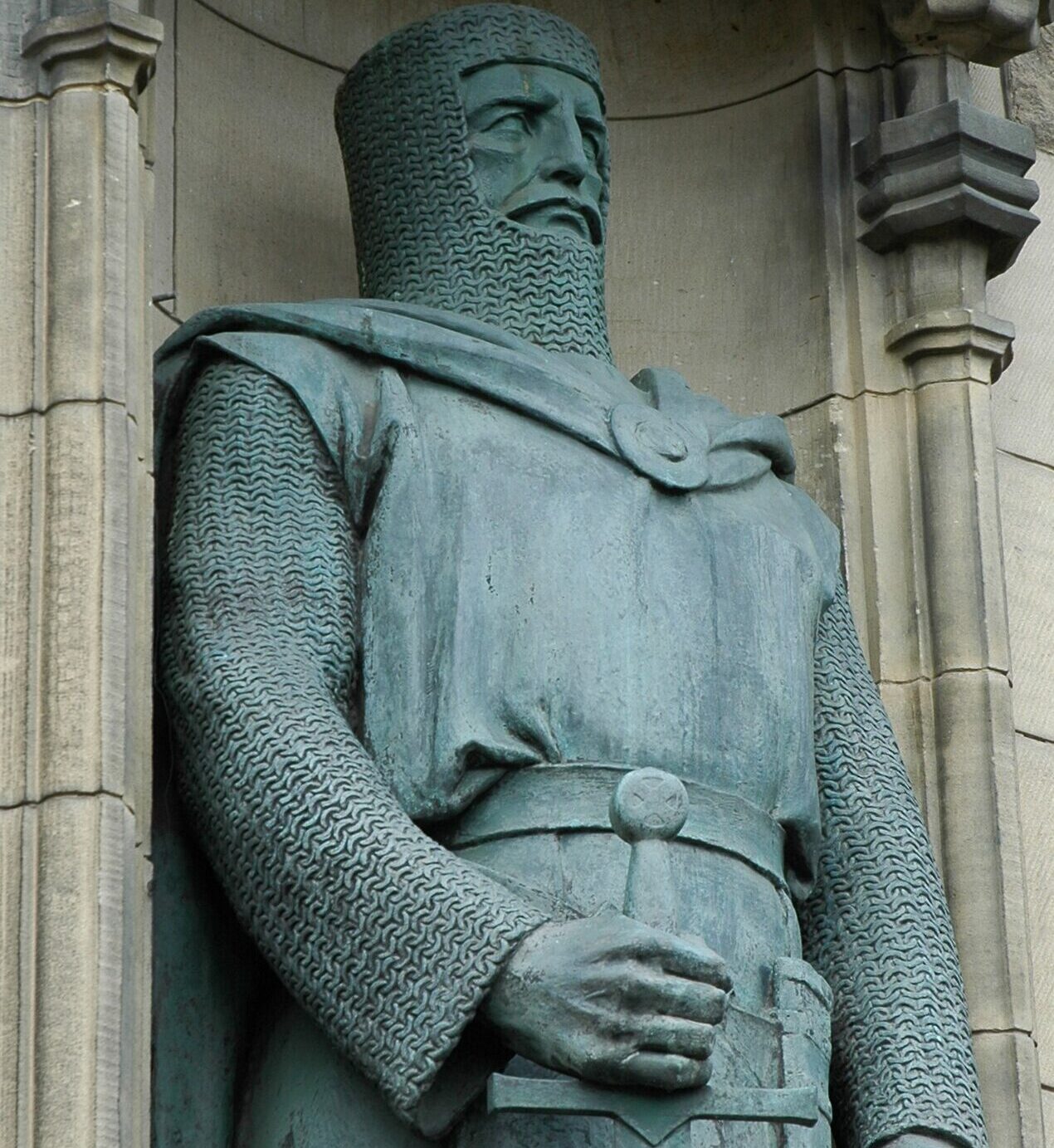
Feature image: William Wallace statue Edinburgh Castle. Photo Kjetil Bjørnsrud – Own work

Leave a Reply