
Real change takes a long hard haul. How will the new PM address the UK’s gross economic imbalances? James Mitchell addresses key questions highly relevant to Scotland. What does Andy really stand for?
Steve Reed, Keir Starmer loyalist, had a point when he warned that people were sick and tired of the psychodrama of politics. If we view Andy Burnham’s return to the Commons in terms of personalities alone – while accepting that personalities are important – then we are in for a blockbuster psychodrama.
But there is potentially – and much weight must attach to that potentially – significant policy dimensions to the recent by-elections and resignation of the Prime Minister. Makerfield has already proved to be a very important by-election. We shall see…. a change in the occupant of No.10 alone need not mean a change in policies.
The reason that there is a real prospect of change arises from what Andy Burnham has learned since he left the Commons almost a decade ago. He has enjoyed being ‘King of the North’. Whether he had the assistance of professional ‘image brokers’ or not, Burnham understands the importance of political image in a way that Keir Starmer did not. But effective image creation should not blind us to policy needs.
Burnham will come to office with a strong regional base – unusual in Prime Ministers. Most Prime Ministers are careful to avoid too close an association with their geographical base. Burnham has turned this on its head.
Team work is key
Leadership in government requires a range of skills. Just as athletes who focus almost exclusively on one muscle group or aerobic conditioning can end up with unhealthy, under-trained muscle groups compromising their health, so too can politicians who develop one narrow set of skills, especially if imagery, and will ultimately prove dismal failures.
Burnham has shown wider skills. He has been effective in using the mayoralty as a bully pulpit, to borrow Teddy Roosevelt’s phrase. He used the platform to make the case for change and bring stakeholders together. Team work is key.
The contrast with recent Scottish First Ministers, with vastly more policy tools at their disposal, is instructive. Burnham was Starmer’s rival, rather than enemy, limiting his ability to play blame games that have become the hallmark of Scottish Government relations with London. But that is only part of the explanation. Knowing how to make maximum use of limited powers is a measure of governing competence. As he is about to exerience, though must already know, Prime Ministerial powers are limited.

Political leadership is lonely but can be offset with the appointment of a team to correct imbalances in the leader’s skillset. The danger comes when the leader adds to the imbalances by appointing more with the same skills as the leader, allied with a refusal to listen to alternative, more expert opinion. In public policy, knowing what you don’t know rather than trespassing into areas beyond your expertise without adequate guidance is like wandering into the desert without a map, except others will suffer from the leader’s inadequacies.
Real reform means making difficult decisions
Burnham has surrounded himself with some impressive people. We await to see who joins his Cabinet and special advisers. He will, of course, have a media team but the lesson from Scotland is to avoid allowing spin doctors to be dominant. His policy agenda is what will count in the long term.
‘Manchesterism’, it was claimed by Will Hutton in the Observer, could revive Britain. A lot rests on that ‘could’. What seems most likely is that there will be greater attention to the UK’s gross economic imbalances. But raising an issue onto the government’s agenda is not the same as providing adequate responses. What is needed is a programme of challenging reforms and that will involve making difficult decisions.
As ever, we can expect lots of attention to his ‘first 100 days’ but he should recall words from Jack Kennedy’s inaugural address, ‘All this will not be finished in the first hundred days. Nor will it be finished in the first thousand days, nor in the life of this Administration, nor even perhaps in our lifetime on this planet. But let us begin.’ The temptation to rely heavily on soundbites, selfies and campaigning will be great, even unavoidable, but he must not lose sight of long-term goals.
A key question, highly relevant in Scotland, is the extent and manner in which Burnham addresses the UK’s gross economic imbalances while all the time addressing immediate problems and challenges. The Prime Minister will need to cut out time and avoid getting lost in responding to immediate demands. Delegation is important but even that has its limits – the buck ultimately stops with No.10. Having a clear long-term strategy, with some degree of flexibility built in, will be needed.
A welcome starting point
Too often stimulating thinking is dismissed because of its source in politics.
Important thinking has been done. The report of the Commission on the UK’s Future, produced under Gordon Brown in 2022, set out a bold programme of reform. This had been preceded by a report produced during Jeremy Corby’s leadership that is also worth consideration. Remaking the British State: For the Many, Not the Few is a provocative – in the very best sense – read and while there are differences with Brown’s A New Britain: Renewing our Democracy and Rebuilding our Economy, Burnham would be wise not to see these through the lens of intra-party battles. Too often stimulating thinking is dismissed because of its source in politics. Each report takes the UK’s imbalances seriously which is a welcome starting point and while there are significant prescriptive differences there is enough in each to stimulate serious policy discussions.
Most commentary focused on the idea of a Senate of Nations and Regions, which both proposed in different ways, but missed the essential political economy critique that informed the range of proposals. The lengthy first section of Gordon Brown’s report drew heavily on the work of regional economists. This work demands greater attention.
Rachel Reeves has been criticised for focusing on driving growth in London and the south-east of England with the Heathrow expansion and improving links between Oxford and Cambridge. Burnham has been critical of this geographically narrow approach. He will not find that expanding the geographic focus of growth is easy and will be up against powerful vested interests. There are reasons why successive governments have fallen back on growth models focused on the prosperous parts of the UK. It is far easier, more likely to get quick wins. This cannot be lightly dismissed. Politics is, after all, the art of the possible.
There is an obvious Scottish dimension. Burnham had been snubbed as Mayor by the Scottish Government. Rejection of his advances on grounds that he was merely a regional, rather than a national leader made no sense. As Prime Minister it would be more than senseless to refuse to engage fully in any efforts to rebalance the UK economy. It is in Scotland’s interests that Burnham is supported in these endeavours. Constitutional change cannot in itself rebalance the UK economy and an independent Scotland would still have to operate within the UK economy.
Prime Minister Burnham will inherit major problems and challenges including the neglected matter of economic imbalances. He has an ambitious agenda and vastly more tools of government but he will need support from across the UK if the UK is to rebalance its economy so that it works for all of its parts more effectively. And we don’t need more Edinburgh/London psychodramas.
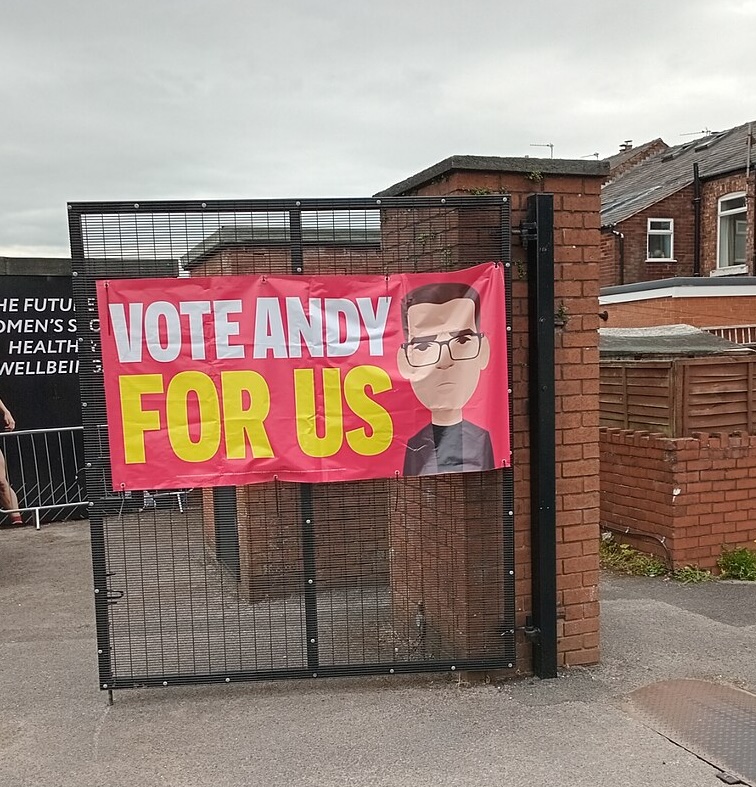
Feature image: Andy Burnham poster at campaign headquarters Makerfield 2026. Creative Commons CC0 1.0
Leave a Reply