

Ageing, decline and the fertility gap
In the first of a three-part series Ben Wray argues any plan to improve Scotland’s economy and public services is not credible if it doesn’t include hard-headed thinking about the nation’s demography.
The National Records of Scotland (NRS) projects that Scotland’s population will begin to decline by 2034. If it were not for immigration, the population would have been in decline since 2015.
At the same time, Scotland is getting a lot older: there will soon be less than three workers for every pensioner, whereas just a decade and a half ago there were four workers for every elderly person. This combination of population ageing and decline is a demographic crunch, one that has significant implications for Scotland’s economy and public services.
Scotland’s changing demography is part of a global shift. Within the next three or four decades, the global population will begin to decline. Populations are already declining in 63 countries representing 28 percent of the world population, according to the UN.
Moreover, 55 percent of countries now have birth rates lower than 2.1, meaning they are beneath the “replacement rate”: the number required to sustain the national population over the long term without immigration.
Looked at historically, these are positive developments. The fact that the vast majority of women now have control over their reproductive capacity is one of the great social achievements up there with universal literacy and running water. That life expectancy is significantly higher for someone born today than for their grandparents is a good news story, and it’s a bad news story that life expectancy in Scotland has stagnated in recent years. But while demographic changes have led to social advances, we need to recognise and grapple with the major challenges that come with this new demographic era.
The capacity of Scotland’s economy is ultimately limited by the real resources it has available to it. People are the most important of those real resources. A shrinking population reduces Scotland’s economic capacity. No government can produce workers out of thin air, neither can it make elderly people any younger. The decisions which politicians in Edinburgh and London can make are constrained by the country’s demography
This report makes three contentions.
First: Scotland’s demography should be an important subject of political debate. It cannot be right that population figures and projections are currently given significantly less attention in the public debate than fiscal projections for a nation that does not even have control over the major elements which make up fiscal policy. Any plan to improve Scotland’s economy and public services is not credible if it doesn’t include hard-headed thinking about the nation’s demography.
Second: it is time for the Scottish Government to develop an explicit demographics strategy. It is obvious that decisions which politicians make – such as public spending priorities – have an influence on demographic outcomes (on people’s health, prospects, longevity), but rarely, if ever, are the two things – public spending programmes and demographics – thought about together. Whether Scotland’s fertility rate rises or falls is as much of a political issue as whether the mortality rate, or the immigration rate, rises or falls: these are all matters of demography, and should be thought about politically and as a coherent whole.
Third: the Scottish Government should set closing the ‘fertility gap’ – the difference between how many children that women of reproductive age have and how many they want to have – as a key objective for the next parliamentary term. This is different from a pro-natalist agenda per se, which is specifically in favour of boosting the birth rate, regardless of what young adults actually want. The point here is that people should have genuine freedom of choice about whether to have children, free from financial or any other constraints. The large fertility gap in Scotland implies that many young adults do not currently feel that they can have as many children as they would like.
Part 1 looks at current data and projections on fertility, net migration and mortality to develop an analysis of Scotland’s demography and where it is going.
Scotland’s demography: The current picture
There are three key components to understanding a nation’s demography: fertility rates, mortality rates, and net migration rates.
Fertility rate – in constant decline
The Total Fertility Rate (TFR) is the total number of children women have on average at the end of their childbearing years.
As the graph of Scotland’s historic TFR shows below, TFR was 2.53 in 1971. It had already fallen below replacement rate by 1974 (1.97). From there it gradually declined over the course of a few decades to 1.47 in 2022, at which point TFR underwent a brief recovery in the context of a booming Scottish economy, rising to 1.76 in 2008, the year of the global financial crisis.
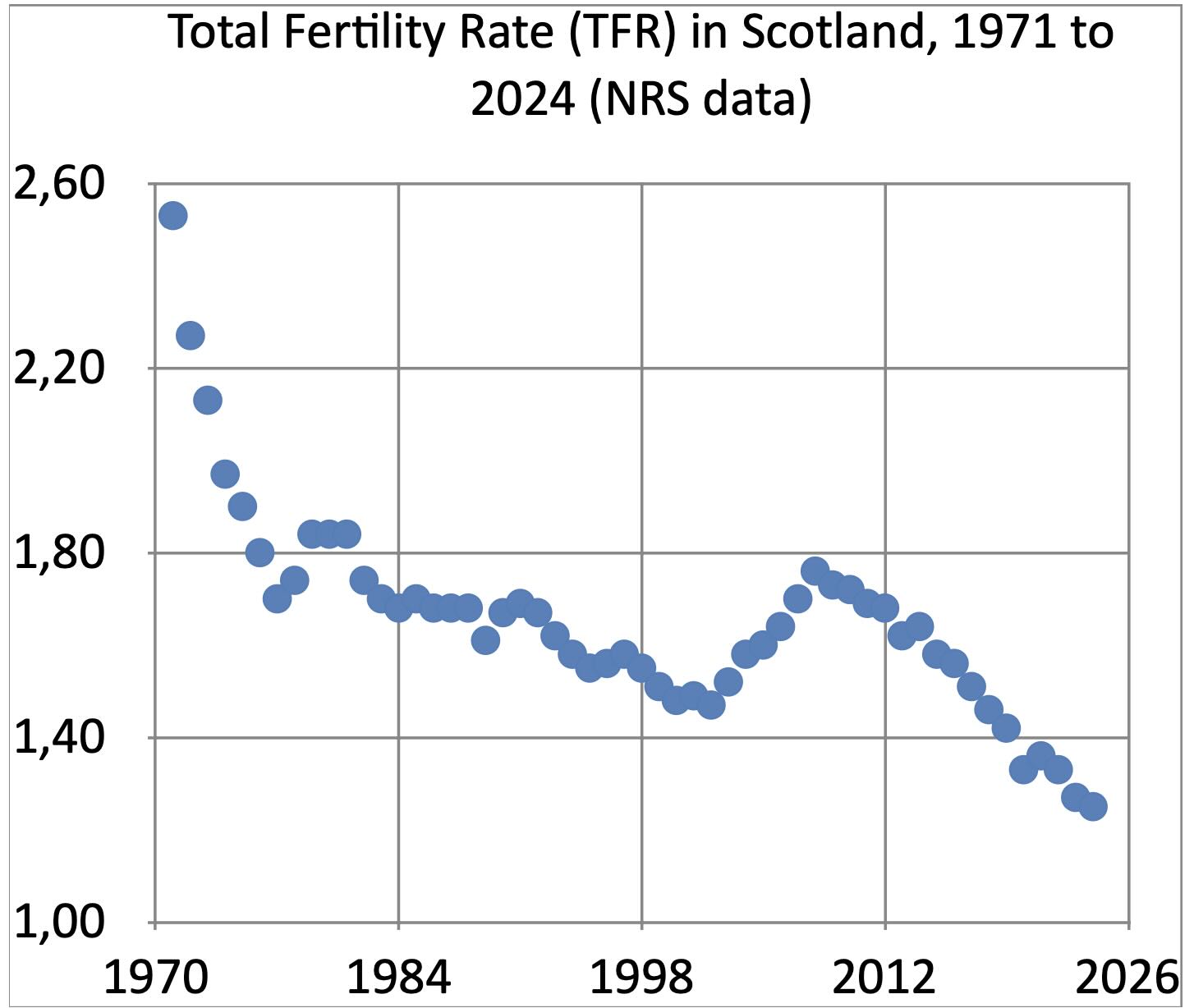
Since then, the fertility rate has been in almost constant decline, except for a brief and limited pandemic-induced boost in 2021. The latest year of the data, 2024, is the lowest TFR which the National Records of Scotland (NRS) has on record, at 1.25, significantly lower than the UK average (1.40) and below any other nation in the UK.
NRS projects that TFR will fall slightly over the next decade, and then increase slightly up to the mid-century. This projection is based on an Office for National Statistics (ONS) methodology, which has consistently underestimated the persistence of declining fertility rates over the past decade, as the ONS graph below shows.
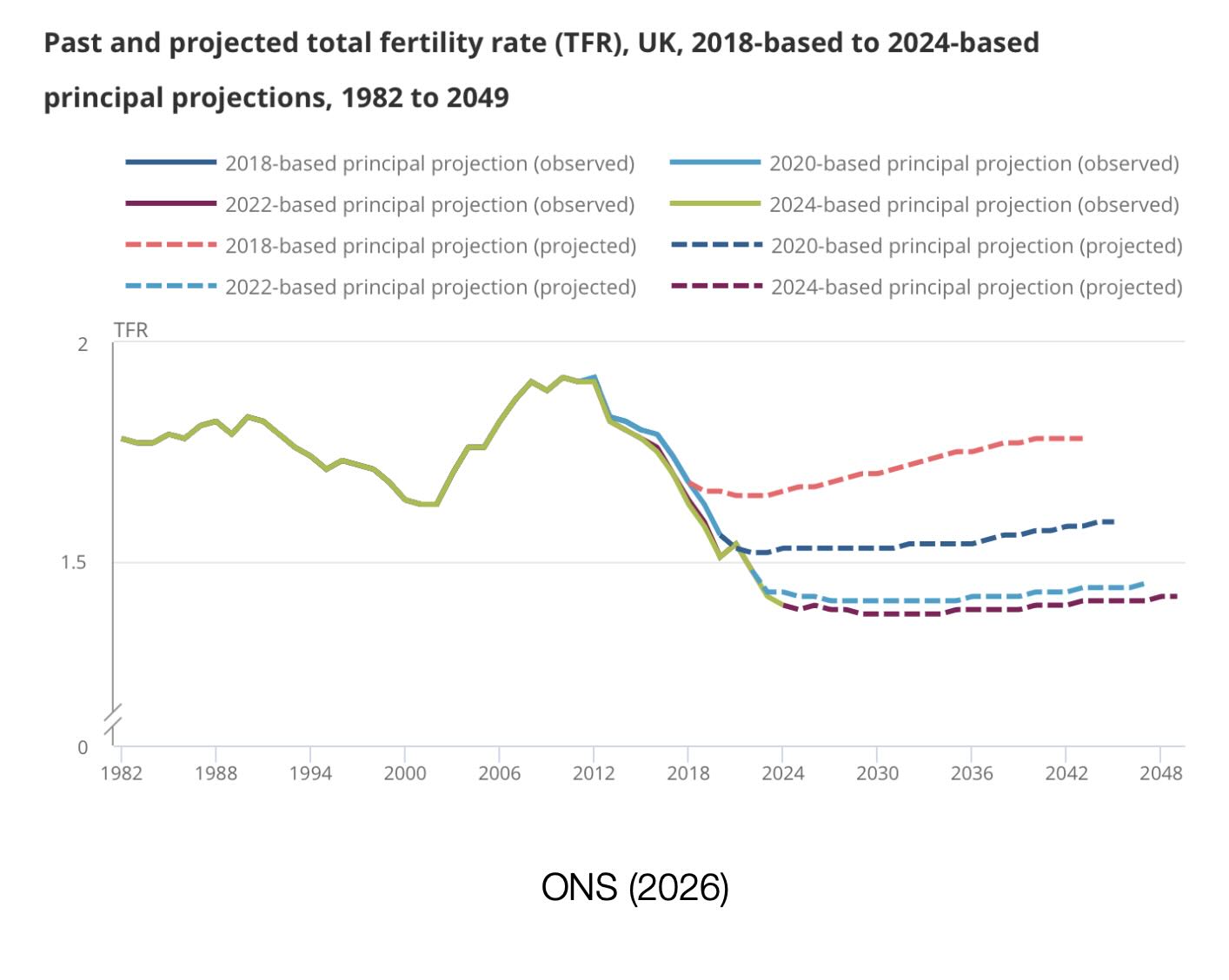
There is little reason to believe that the most recent projection (2024), based on a methodology that is essentially unchanged from the 2022 edition, will not also be mistaken.
If we look at the international picture, there is reason to believe that the UK and Scotland’s TFR rates could still have further to fall. World Bank data on TFR rates worldwide show that 16 countries around the world have a TFR of 1.2 or below, including Italy, Poland and Spain, with South Korea having the lowest TFR at 0.7. The City of Edinburgh council region already has a TFR below one.
Net migration – doing a lot of heavy lifting
Net migration is the number of immigrants arriving in Scotland minus the number of emigrants leaving Scotland. This includes people who have moved from the rest of the UK to Scotland, and visa-versa.
Net migration is doing a lot of heavy-lifting when it comes to sustaining Scotland’s population. Since 2015, there have been more deaths than births in Scotland – the ‘natural’ population rate has been in decline for a decade: the population only being sustained due to net migration.
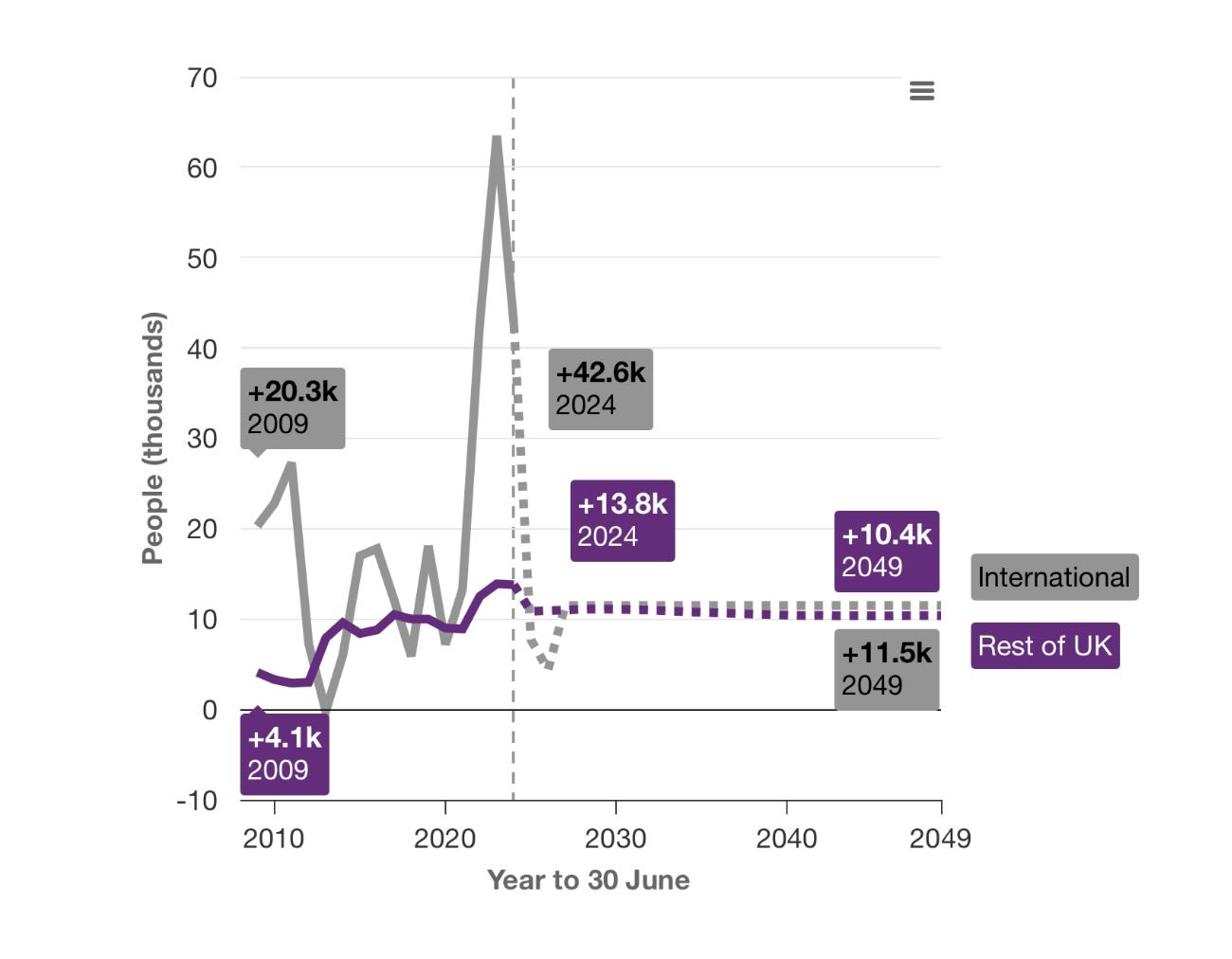
The latest NRS data (2024) shows there were 13,600 more deaths than births in Scotland, but the population continued to grow because net immigration was 56,400. This consists of 13,800 from the rest of UK and 42,600 from other countries.
As the NRS graph below shows[5], the last two years have seen the highest net immigration on record. But for the past 20 years, net migration figures have been highly volatile, especially from international migration, with one year (2012) even recording a small net emigration.
Volatility in the figures is the norm for migration patterns. As the UN points out its most recent global demographic projections, “international migration is the component of population change that is the most difficult to project.” This is because the movement of people across international borders – often a response to rapidly changing economic, political and environmental factors – is by its nature erratic. We should treat long-term projections for net migration with considerable caution.
As the graph above also shows, the NRS’ projection is that net immigration will stabilise at around 20,000 for the next 25 years; about half from the rest of UK and half from internationally. This projection has changed significantly since the last one two years ago, which estimated that net immigration would be around 30,000 per year for the next 25 years, one-third more than the current projection.
Take with a large pinch of salt
It is this change in the projection for net immigration which is the main reason why NRS’ overall demographic projection has changed so much in the last two years. In 2024, NRS projected that there would be just under 5.8 million people by 2049, over 200,000 more than the current population. In 2026, NRS has estimated that there will be less than 5.5 million people by 2049, about 50,000 less than currently. A quarter of a million swing in the projection for a country with just over 5.5 million people is not an insignificant change.
The specific cause of this shift is the fall in international net migration to Scotland over the past year, from 63,500 in 2023 to 42,600 in 2024. This fall has a major impact on the ONS methodology for projecting net migration, which is based on a 10-year rolling average of net migration, having previously used a 25-year rolling average from 2014 to 2021. Using a 10-year rolling average makes the model much more sensitive to sharp changes in the data from year-to-year – another reason why we should take these projections with a large pinch of salt.
Trying to project net migration into the future is fraught with difficulties due to the large number of moving parts involved. It is not just that it is difficult to project the number of refugees and migrants there will be, but also that is difficult to project where they will go in a world in which population decline will soon be a global phenomenon.
We know Scotland already depends on immigration to sustain its population. This dependency is only set to increase due to Scotland’s persistently low and falling fertility rate.
The graph below shows NRS’ projection for birth and death rates in Scotland up to 2049. While there are currently 13,600 more deaths than births each year, that gap is projected to increase to 31,600 by 2049. Whereas now 14,000 immigrants are needed per year to sustain the population, in less than 25 years it may be that 32,000 per annum are required, and that’s presuming that the fertility rate stabilises as NRS projects. Furthermore, even more immigrants will be needed to sustain Scotland’s working-age population specifically, because Scotland’s population is also ageing rapidly.
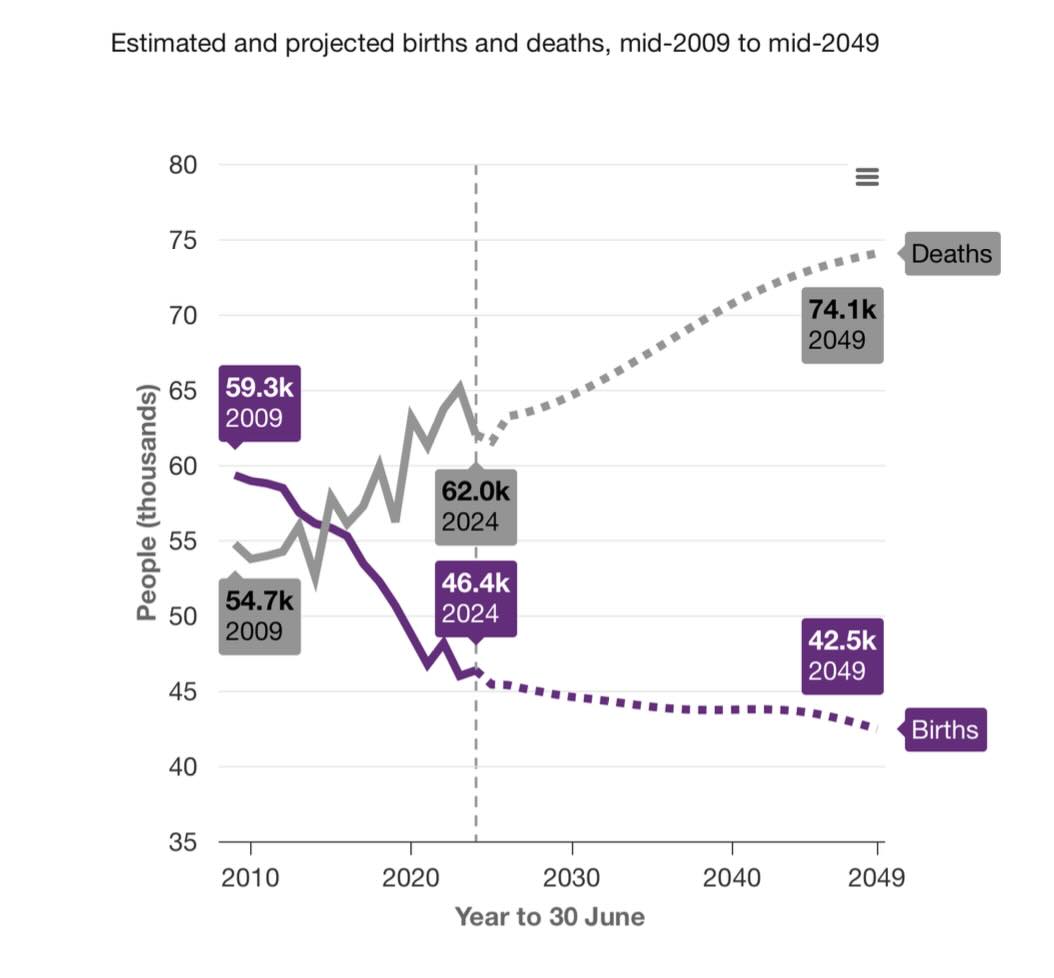
Scotland’s heavy dependency on immigration is a source of risk mainly because of the volatility of migration patterns, but also because the Scottish Parliament has no control over immigration and asylum policy. Scotland is at the mercy of UK political decision-making on migration, which can significantly affect migration trends.
Mortality – good news and bad
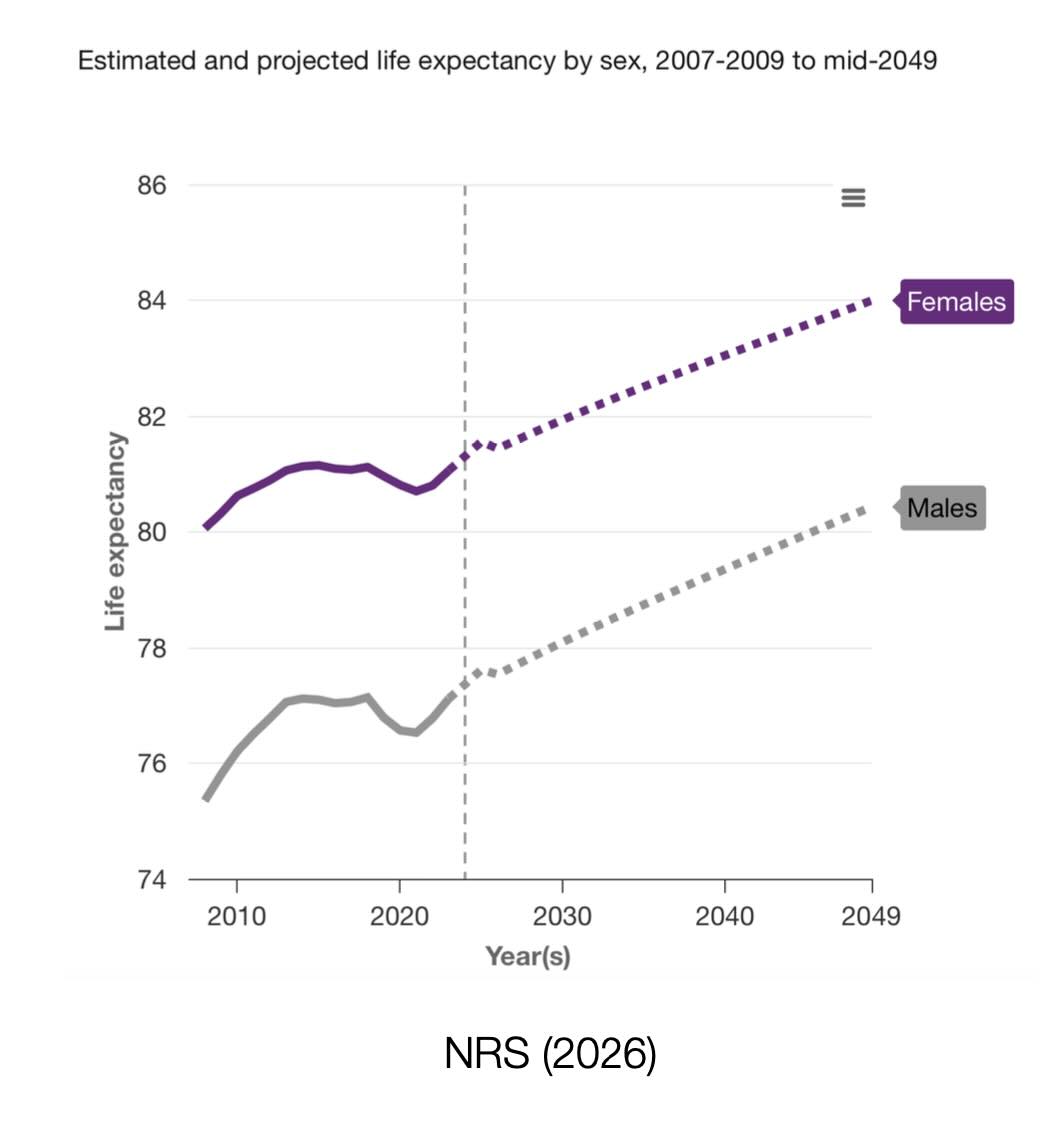
The NRS projection presumes that life expectancy will increase significantly from current levels, (see graph below).
Given recent history, this is an optimistic assumption. Female life expectancy, at 81.06, is below its 2014-2016 peak of 81.15, while male life expectancy, at 77.12, is below its 2017-2019 peak of 77.14. The good news is that in the last four years life expectancy has begun to improve again, but that is after a dip which had brought it down to levels not seen since the start of the 2010s
The NRS data is based on an ONS methodology which, as the graph shows, has consistently over-shot projections for life expectancy for more than a decade.
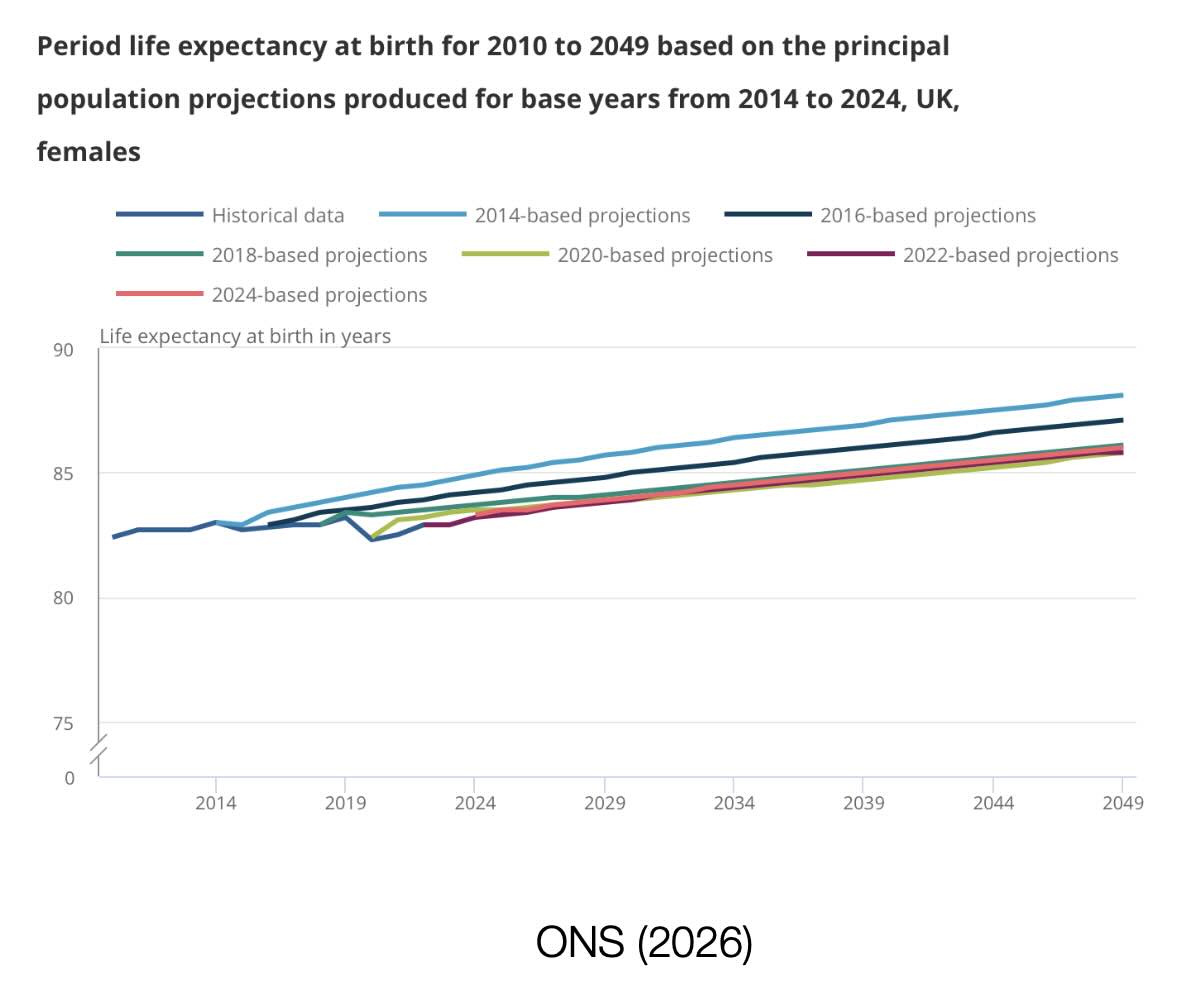
It is of course difficult to project life expectancy 25 years into the future because many things can change – economy, politics, technology – which can all have a major impact on life expectancy. No one projecting Scotland’s life expectancy in 2000 could have foreseen the 2008 financial crisis and subsequent ‘austerity’ policies from the UK Government, which academic research has found was a key factor in the stagnation of life expectancy since then.
As the ONS graph above shows, successive ONS projections have become more cautious. Even more caution may be required.
Confront challenges head-on
NRS projects that Scotland’s population will decline by 1.3% by 2049. My view is that the decline could end up being much more severe than this if fertility rates continue on their current trajectory and if net migration to Scotland returns to more modest levels seen a decade ago, rather than those of recent years.
Even if we accept NRS’ assumptions, the decline in the population that it projects raises serious challenges for Scotland’s economy and public services. challenges that have to be understood and confronted head-on
Part 2 explores the potential consequences of an ageing population for Scotland’s economy and public services, focusing in particular on labour force challenges in the social care sector.
Feature image: Lines in the sand on a Hebridean beach, photo Fay Young
Leave a Reply