
In a world where economic orthodoxies are being challenged like never before, Scotland has the opportunity to design a system that will be agile enough to deal with the new normal.
In my last two articles, I have questioned orthodox economic thinking by examining why QE did not create inflation and what’s the point of measuring bond default risk using the debt to GDP ratio in our brave MMT world.
(The following extract comes from the minutes of a meeting that took place back in 2012 but I share these same concerns, word for word.).
“I have concerns about more purchases. As others have pointed out, the dealer community is now assuming close to a $4 trillion balance sheet and purchases through the first quarter of 2014. I admit that is a much stronger reaction than I anticipated, and I am uncomfortable with it for a couple of reasons.
First, the question, why stop at $4 trillion?
The market in most cases will cheer us for doing more. It will never be enough for the market. Our models will always tell us that we are helping the economy, and I will probably always feel that those benefits are overestimated. And we will be able to tell ourselves that market function is not impaired and that inflation expectations are under control. What is to stop us, other than much faster economic growth, which it is probably not in our power to produce?
Second, I think we are actually at a point of encouraging risk-taking, and that should give us pause.
Investors really do understand now that we will be there to prevent serious losses. It is not that it is easy for them to make money but that they have every incentive to take more risk, and they are doing so. Meanwhile, we look like we are blowing a fixed-income duration bubble right across the credit spectrum that will result in big losses when rates come up down the road. You can almost say that that is our strategy.
My third concern, and others have touched on it as well, is the problems of exiting from a near $4 trillion balance sheet.
We’ve got a set of principles from June 2011 and have done some work since then, but it just seems to me that we seem to be way too confident that exit can be managed smoothly. Markets can be much more dynamic than we appear to think.
Take selling, we are talking about selling all of these mortgage-backed securities. Right now, we are buying the market, effectively, and private capital will begin to leave that activity and find something else to do. So when it is time for us to sell, or even to stop buying, the response could be quite strong; there is every reason to expect a strong response. So there are a couple of ways to look at it.
It is about $1.2 trillion in sales; you take 60 months, you get about $20 billion a month. That is a very doable thing, it sounds like, in a market where the norm by the middle of next year is $80 billion a month.
Another way to look at it, though, is that it’s not so much the sale, the duration; it’s also unloading our short volatility position. When you turn and say to the market, “I’ve got $1.2 trillion of these things,” it’s not just $20 billion a month— it’s the sight of the whole thing coming. And I think there is a pretty good chance that you could have quite a dynamic response in the market.
And I would just say I want to understand that a lot better in the intermeeting period and leave it at that.”
Plus ça change
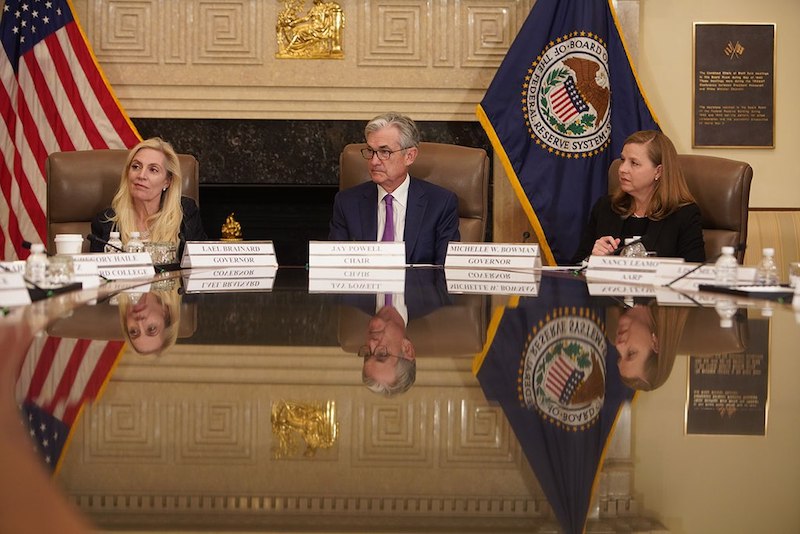
That speaker was Jerome Powell, the current Chairman of the Federal Reserve.
His concerns must be greater than they were back then because all of his predictions have come true:
- QE is now expected to be nearer $10trn, give or take a couple of trillion (!).
- Share prices have been near historic highs with an economic backdrop as negative as ever experienced during this post war period and certainly since the Great Depression of 1929-33. (UK GDP down 20.4% Q2 2020).
- Trying to reduce the size of central bank balance sheets has proven near-impossible to do without frightening the market.
Yet Powell clearly does not make these policy interventions lightly and we should not pretend they are just off-the-cuff.
The Fed has gone from overseeing the market to being the market. That has huge implications for all of us because if the world loses the biggest financial safe haven, there will be disruption beyond what happens in the markets.
The Fed oversees the health of the world’s biggest reserve currency and what happens to the US dollar matters to everybody. If an independent Scotland is to get the best possible start, it has to be designed to be part of the world that it finds itself in.
Quo vadis Scotia?
Does Scotland make the decision that excessive printing of money leads to a devaluation, let alone debasement of the currency, that does not serve the poorest in society?
Would embracing the new central bank norms mean that Scotland should invest in a brave new Green economy financed in a MMT world?
Could Scotland create a super low tax economy in a world where government spending is dependent on central bank interventions and where inflation is curbed not by interest rates but by raising progressive taxes?
Has Universal Basic Income’s time come?
I am inviting the Sceptical Scot community to help develop an understanding of how Scotland could deal with these core questions – and any other fall-out from these historic times.
Fung’s previous two articles: Central banks stumble into MMT; Where has all the COVID-19 money gone?
Further reading:
The Scottish labour market today, Fraser of Allander Institute, August 11
Advisory Group on Economic Recovery report, June 22
Scottish Government seeks validation…, Craig Dalzell, Source, August 6
Image via Wikimedia Commons/Federal Reserve in public domain
.jpg)
Extract taken from Page 192 of httpss://www.federalreserve.gov/monetarypolicy/files/FOMC20121024meeting.pdf
Leave a Reply