

Scotland’s economy was once held in great respect around the world for its innovation.
As a nation, we led the way with ground-breaking discoveries, including penicillin, and Enlightenment thinkers such as Adam Smith helped shaped modern economics. Our education system was also heralded as a success and something for us to be proud of.
But times have changed – our economy lags behind many comparable nations and our young people are facing tough circumstances, exacerbated by the impact of Covid-19 on their education, career opportunities and their health and wellbeing. We owe it to our young people to create a strong economy for them to inherit. But we are nowhere near to fulfilling our duties to create a better world for future generations.
We commissioned the ‘Raising Scotland’s Economic Growth Rate’ report from Oxford Economics to help inform our own strategy at The Hunter Foundation, and also to provide solid and up-to-date statistics to help shape policy for creating transformational growth. For things to radically change for the better, everyone, from governments to entrepreneurs, must work in collaboration.
Firstly, we must take stock of what the report uncovered. Some of the findings are bleak, but we need to take action to tackle the underlying issues rather than just wait and hope things will improve.
Lagging behind
Scotland continues to suffer from low productivity, poor business birth rate and lack of success with scale-ups. Such problems help explain why Scotland’s GDP per head is a mere 44% of Singapore’s level, 48% of Ireland’s, 68% of Norway’s and 75% of Denmark’s. Our GDP per head has been about 8% lower than that of the wider UK for many years, largely because of poorer productivity. Scotland’s business birth rate came ninth out of 12 UK nations and regions in 2019. And our report forecasts that, between 2020 and 2035, Scottish real GDP growth will average just 1.3%.
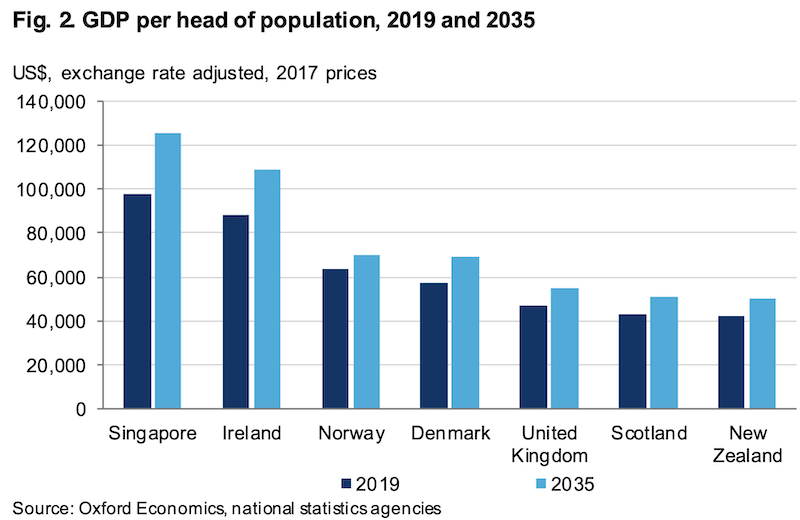
Scotland is so far behind some countries that it would need a business comparable in size with Google’s total global output to bring its GDP per head of population up the level of Norway’s. Alternatively, it would take 20 large scale businesses to make up a Google, and that is not unfeasible over a ten to 15 year period if we have the ambition. One of our own investments – in the Hut Group – shows that is indeed possible.
On the back of its findings, the report calls for a mixture of increases in government borrowing to stimulate stronger growth in demand and output;significant tax cuts to improve competition and large increases in government support for businesses, both directly and through increased spending on infrastructure, education and skills, innovation and the green economy. Our productivity rates hold the key to prosperity – we need to unlock their growth.
As the report states: “Both the UK and Scottish governments could usefully focus more clearly and identify a smaller number of priorities, target resources where they would be most effective, monitor their effectiveness, and adapt the implementation of policies, accordingly.”
Change must come
While change will take time, it’s important to aim high and think big.
For me, investing in education and skills should be at the top of the agenda – and this is within the grasp of the Scottish government as an area entirely devolved from Westminster. Some young people have had their education disrupted during the pandemic, others have lost their jobs or been furloughed, and that’s not good for anyone.
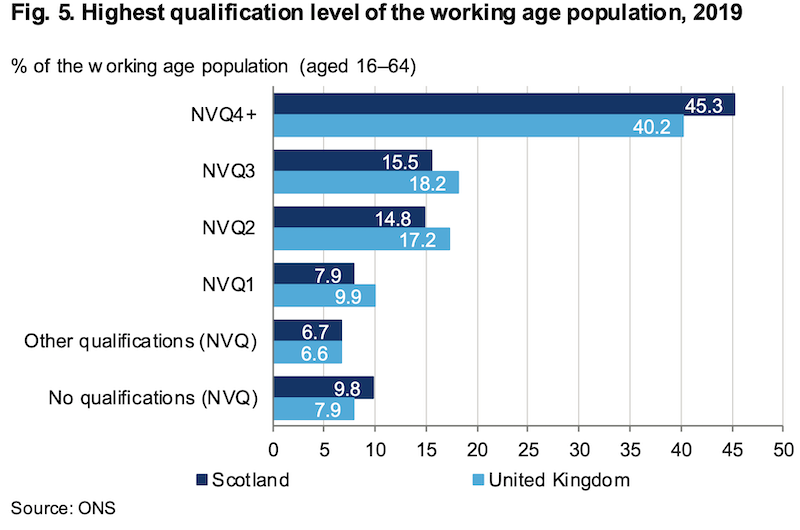
As a matter of urgency, we need to create and implement a strategy that boosts the economy, creates new jobs and improves public services to build a Scotland that provides people of ages with the opportunities to succeed.
No-one has all the answers, but if we work in collaboration, listening and hearing, we can have a shot at this.
Featured image of Sir Tom Hunter courtesy of the Hunter Foundation; Graphs/figures via Oxford Economics report
See also: John McLaren, How wealthy is Scotland?, The Scotsman
Leave a Reply