
While Andy Burnham sets out to cut the cost of living, John McLaren confronts reality: how political priorities obstruct meaningful growth. Not least in Scotland
Like many of the Prime Ministers who have preceded him, Andy Burnham is ‘laser focussed’ on making economic growth his top priority. Except of course, just like them, he isn’t. The mind may be focussed but the flesh is weak.
The economist Daniel Susskind discussed this phenomenon in a recent article in the Financial Times (FT, 04/07/26 ’Burnham must learn from Starmer’s failures on growth.) Susskind highlighted how most of the key policies of Keir Starmer were implemented despite the prevailing evidence that, in each case, they would hinder rather than help growth. Such policies included: more protection of workers through new labour rights; raising the minimum wage via increasing national insurance; introducing more ambitious net zero commitments; supporting the welfare status quo; and offering generous pay settlements for many public sector workers.
You might agree with all of these policies individually or even collectively but if growth really does come first then none of them should have been acted upon. Ultimately, the faster economic growth that Starmer and Rachel Reeves had banked on to fund public services never arrived and inevitable political difficulties ensued.
Burnhams key policies look equally unlikely to boost growth dramatically. His core economic growth policies appear to be: devolution of economic and fiscal powers; public housing expansion; re-nationalisation of core services like water and energy; all while retaining something close to the current fiscal (public finance) targets. The second and third of these ambitions will involve considerable sums of public money, which crashes into the fourth priority. They are also, as others have found, long term ambitions that are plagued with practical difficulties when trying to turn them into realities. However, it is the first ambition is the most pronounced and Burnhamite of policies and appears to be founded on the success of ‘Manchesterism’.
Upwardly mobile Manchester?
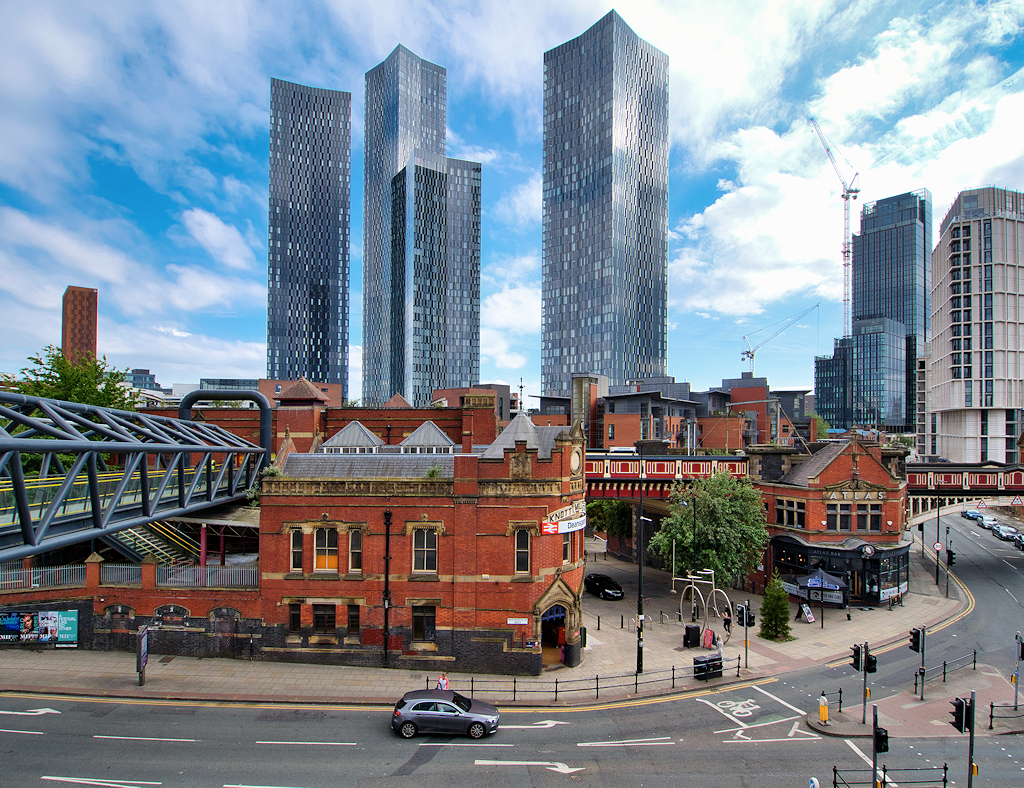
Living in Manchester, I can attest to the metamorphosis of its skyline in recent years, although the longer term regeneration goes back decades.
How truly transformative this has been is a more nuanced matter.
A recent Oxford Economics (OE) report sets out the pros and cons. While GDP growth has been well above the UK average across Greater Manchester (GM) the report also finds that:
“The most powerful criticism of Manchester’s growth is that it has failed to translate into meaningful improvements in living standards, with income growth weak and house price expansions significant. The poor income gains raise questions about the reliability of the underlying data on Manchester’s success, while declining affordability risks undermining future growth.”
OE also find that growth has been concentrated in the city centre and weaker in the outer regions, questioning whether the centre is big enough to ensure spillover effects further out, as London’s economy does in the South. This assessment feels about right and it is reinforced by the fact that the latest ONS data shows GM unemployment above, and average earnings below, the UK average.
Furthermore, GM has the distinct, and not easily replicable, advantages of: a major international airport; a cluster of high end universities; a major media presence; a fast (2 hours) and regular (3 times an hour) train service to the economic hotspot of London. So, hard enough to replicate in Hull and Leicester, never mind Hartlepool and ‘every postcode in the UK’. Manchesterism then may be a laudable approach but probably not a maximising one, especially if some of the agglomeration effects around the South East are lost.
Warm words, cold feet in Scotland
Growth promises have been regular and strident, but, on reading the small print, always conditional on a meeting a long list of provisos.
Recent evidence also suggests that devolving economic and taxation powers alone is unlikely to raise the growth rate. The devolved Scottish government is a classic example, in terms of warm words but cold feet, when it comes to prioritising growth. Such promises have been regular and strident, but, on reading the small print, always conditional on a meeting a long list of provisos. Growth is good but only on condition that it doesn’t negatively impact on various forms of equality, environmental targets, etc etc. Effectively it is saying that THESE are the real targets and stronger growth is a welcome by-product should it come about.
All well and good perhaps if this had resulted in an improvement in core Scottish public services but the reverse has happened. School education standards have dropped and the NHS is not delivering even to its pre COVID level.
Thus, while devolution has succeeded in terms of embedding itself in Scottish society it has failed in terms of delivering better outcomes through governance closer to home. The story is a similar one for Wales.
Of course things could be different in England as there will not be regional Parliaments or MP’s but the evidence is far from strong that success will be seen across the board, quickly, or even at all.
The key to growth
The key to improving economic growth in an enduring fashion is to raise growth of ’total factor productivity’ (TFP). Essentially this means introducing successive waves of applied innovation, allowing for more output from the same number of inputs. When things are going well TFP contributes 1-2% of economic growth per annum.
Following up on Susskind’s article, Martin Wolf of the FT described how UK TFP has averaged minus 0.5% a year in the past decade. And just in case you thought this was an isolated issue, the same, negative, annual TFP growth over the past decade has been experienced in Germany, Canada, Italy and France, amongst the G7 nations alone.
It’s not clear why this dramatic and politically unsettling turnaround has happened but amongst contributing factors will be: a decline in globalisation (think Brexit, Trump and war); a reversal in the unsustainable growth of the Financial sector; COVID; and worsening demographics. However, even these effects don’t fully explain the decline and fall of TFP. Hence, we are still fumbling around in the economic gloom trying to find a way through.
All of this means that it currently takes an enormous effort to get real terms growth of any size, never mind returning to 2% a year, but if you are going to caveat it with a plethora of terms and conditions then don’t expect much at all.
This is the modern political conundrum – achieving economic growth whilst already being in hock to the tune of 100% of GDP.
So you need high taxes to even begin bringing this crippling debt down, but then you don’t have spare cash to improve creaking public services and at a time when the economy is not naturally exuberant.
Result, misery.
What to do? Good question
Thus far the typical political response has been to pretend that under your administration things would be different and your policies would restore economic growth. An approach which has failed for multiple UK governments.
Nevertheless, any political alternative is a tough sell. ‘I can’t promise faster growth so I’m going to try and improve public services within the constraints that currently exist’. Hmmm.
Maybe that’s all governments should be focussing on right now. Taking a hands off approach to the economy and letting the private sector lead whilst bolstering it with long term, supportive, infrastructure projects. However, without much in the way of explanation for the static, to falling, living standards then the electorate may still feel short changed.
If so, then, for the foreseeable future, expect the political revolving door to continue birling. Except in Scotland, where it remains closed, awaiting repairs.
Feature image: Photo by David Dixon The four new tower blocks built around Deansgate Square dominate the skyline. Their 21st century design contrasting with the nineteenth century architecture of the Knott Mill (now Deansgate) Station (a Grade II listed building). CC by-SA 2.0
Leave a Reply