Political parties with commanding parliamentary majorities are often tempted by the promise of assertive leadership and decisive action. Yet, as the events of the last few weeks reveal, a large majority is no substitute for the subtler arts of political management, party cohesion and narrative discipline.
Missteps like suspending four MPs and sacking three trade envoys are not isolated misjudgements but symptomatic of deeper issues within Labour’s approach to internal governance. These are issues that need to be addressed if this government is to make the difference needed.
At the centre of the week’s controversies sits the leader’s decision to discipline members of his own parliamentary party. On the surface, such acts might be interpreted as “factional authoritarianism” – a heavy-handed display to quell rebellion. But it is more probably rooted in clumsy party management and weakness.
This is especially true given Labour’s comfortable majority, which is currently around 160. It is reasonable to expect a majority party to exude a certain confidence and to practise tolerance for internal debate. It knows, after all, that a handful of dissenters pose no existential threat to the government’s legislative agenda. Instead, the government appears brittle, hyper-sensitive to criticism, and more interested in enforcing unity than fostering meaningful dialogue.
The consequences are not trivial. Rather than projecting an image of strength and competence, the government gives the impression of insecurity and control for its own sake. The sacking of trade envoys – posts which previously were barely known or understood by the public – appears to many as petty and vindictive. The broader public takeaway is not about Labour’s policy on trade or any other issue, but about its willingness to punish internal dissent.
Lost narrative and missed opportunities
A parallel failure lies in the government’s continuing inability to control or shape the public narrative. Just days before the prime minister decided to suspend his rebels, the government announced £500m for a “better futures fund” to support vulnerable children and families. This could have been a bold declaration of intent for the new government. It could have been a huge win. Yet, it was disconnected from any overarching narrative and proved yet another missed opportunity to champion a new direction for the party and the country.
Instead, media and public attention shifted immediately to the suspensions and sackings, drowning out any potential positive coverage of the government’s messaging. The chancellor’s Mansion House speech – an annual opportunity to set the agenda – fell similarly flat. Rachel Reeves received only insipid headlines before being entirely overshadowed.
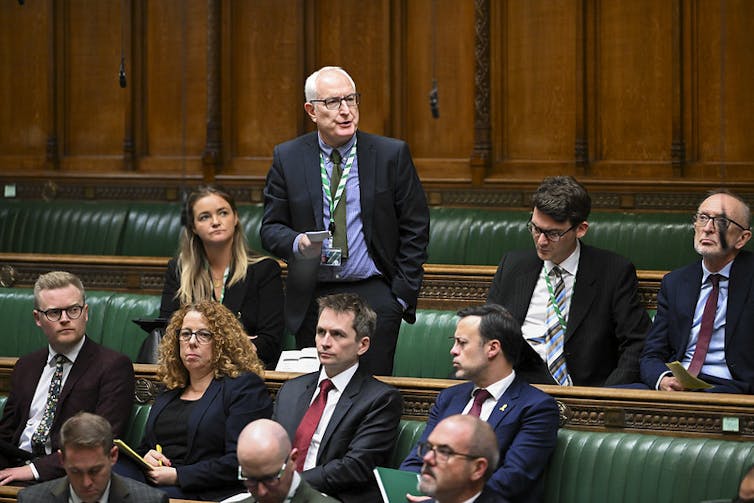
Neil Duncan-Jordan, one of the suspended MPs. Flickr/UK Parliament, CC BY-NC-ND
The government’s inability to sequence and frame its positive announcements, and to anticipate how punitive actions would dominate the news cycle, requires urgent attention. It is not enough to make policy announcements; there must be a coherent story that MPs and the public alike can follow.
Rebellion, dissent and party discipline
The rebellion that sparked this drama was not led by perennial troublemakers, but a group of select committee chairs who are experienced, respected parliamentarians and not easily dismissed as the “usual subjects.” When the government gutted its own benefits bill to quell the backlash, a majority of rebels indeed relented. Only Rachel Maskell (one of the four MPs now suspended) and 46 others persisted in voting against the bill at third reading.
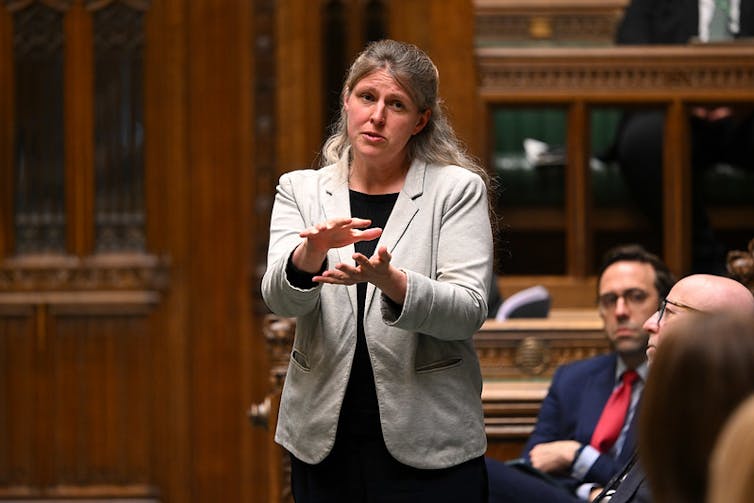
Was this really worthy of suspension, especially so early in a new parliamentary session? The government’s justification rests on the need for discipline – that rebels should “play ball” after exacting concessions. But this only works when both government and rebels understand and respect the same rules.
The claim is that the four rebels and three MPs who lost envoy status are persistent rebels, but this is an overreaction. In either case, it is clear the backbenchers felt ignored and undervalued, and that the government failed to take their concerns seriously in the first place.
There is a sense that Labour’s leadership is more interested in enforcing conformity than in building consensus. A true show of strength would be to sit down and discuss with colleagues how differing views can be accommodated, and to have some confidence in your argument and build a narrative around it.
Several warnings about internal unrest were ignored. The Whips Office flagged issues around poverty, pensions, and benefit reform, but these concerns were sidelined by Number 10. Ministers called for a broader anti-poverty strategy but again found themselves ignored. Select committee chairs, who tried for months to initiate constructive dialogue, were only heard in the final days before the bill’s debate.
External threats
Labour’s majority, while impressive, is based on fragile foundations. It won with only a 34% share of the vote. Many of the newly elected MPs are inexperienced and hold wafer thin majorities. A 5% swing against Labour would see more than 100 MPs lose their seats. External threats – an ascendant Reform UK, a possible Corbynista party, and the consolidation of the Liberal Democrats and Greens – compound the sense of fragility.
In this context, disciplining a handful of MPs as some sort of a show of strength to keep putative rebels in line, is not going to work. The government cannot afford to alienate its own MPs.
Labour’s early weeks in government provide a cautionary tale in the risks of prioritising discipline over dialogue, and of losing sight of the narrative that should bind the party and its supporters together. Most Labour MPs want the government to succeed, but early heavy-handedness breeds resentment and undermines unity just when it is most needed.
True political strength lies not in the ability to punish dissent, but in the confidence to accommodate it – building a compelling story that inspires loyalty rather than demands it.
If the government wants its MPs to sing from the same song sheet, it must first establish the melody. The significant achievements of this government – £40 billion more on public services, international trade deals, infrastructure investment, renters’ and workers’ rights, energy initiatives, advances in the living wage, and free school meals – can only resonate if they are woven into a story that MPs and the public can share.
The lesson is clear: discipline without narrative and command without consensus are recipes for internal discord and political decline.
First published by The Conversation
Featured image: Brian Leishman MP, fdlickr/UK Parliament via Wikipedia CC BY 3.0
Colin A says
Apart from the illusory Plan for Change it’s become clearer by the day that Starmer has lost the plot but worse, never really appeared to have one.
The early resolve apparent in July 2024 dissipated quickly to a series of unconnected minor triumphs but no clear vision as to what was needed to rectify 14 years’ Conservative incompetence.