
The potential to break the Scottish political deadlock grows as the prospect of a Labour Government at Westminster looms into sight.
Scottish Labour was marginalised so long as the dominant issue was a binary choice between independence and the status quo. It struggled to shift the focus away from the constitution and onto Labour’s more comfortable territory of health, welfare and social services. The party of devolution was damned by Tories as soft on nationalism and condemned as unionist by the SNP.
But the SNP-Tory political co-dependency is now under threat. Each party depends on the other to sustain its support. Each prefers the other as its main opponent. Life becomes more difficult for each with a Labour revival.
Scottish Labour’s recovery was always likely to be, to borrow a phrase, a process, not an event. The first and most challenging stage was to overtake the Tories and become not only the main challenger to the SNP but perceived as such. The SNP would far prefer the Tories as its main challenger but could be relatively relaxed so long as Labour and the Tories were fighting it out for second place. Labour is now clearly the main challenger to the SNP. The SNP had positioned itself, aided by the shift of focus with the independence referendum, as the main anti-Tory party.
Electoral plates are shifting
The problem the SNP now has is similar to that which the Tories faced responding to New Labour after 1992. The Tories could not find a clear and consistent attack line. There is one significant difference. The Tories had been holed below the water by Black Wednesday in September 1992, losing the reputation for economic competence just as it has again now. The SNP has not experienced such a catastrophe. But neither has it retained the reputation for competence that won it an overall majority in Holyrood in 2011.
Governing competence matters less so long as the constitution assumes primacy along a sharp binary divide. The SNP only needed to present politics as a choice between independence and Tory unionism. Tory poll leads across the UK were portrayed by the SNP as evidence that Labour could not ‘convince the UK electorate that Keir Starmer is the man to replace Boris Johnson’, as SNP HQ claimed. Starmer indeed did not replace Johnson but that was only because, in an act of desperation, the Tories, fearing defeat, jettisoned Johnson for someone who has proved even more electorally damaging to the Tory cause. And now Starmer not only looks more Prime Ministerial but set to replace Liz Truss (or whoever may replace her…).
Labour’s dramatic revival undermines that simple formulation. A former SNP strategist offered a rather desperate interpretation of the YouGov poll showing a 33 point Labour lead and took comfort from, or assumed limited public understanding of polls, a +1 increase in SNP support to 5% across the UK. As Labour’s lead was confirmed, SNP HQ turned from arguing that Labour could not win to past performance. Then came a tweet from SNP HQ: ‘The Tories can be removed from power temporarily, but for Scotland there is only one that will do it forever – independence’. As the SNP is avowedly democratic and there is no democratic way to remove a party ‘forever’, we can safely take this as evidence that the SNP is indeed rattled.
The problem is not just which party is in power at Westminster — the problem is Westminster, Nicola Sturgeon at SNP Conference 22 in Aberdeen
Hating the Tories
Then there was Nicola Sturgeon’s ‘I detest the Tories and everything they stand for’. The comment is typical of a strand of Scottish politics. For decades the competition between Labour and the SNP has been more about which is the more effective anti-Tory vehicle. In place of radical or progressive ideas, the competition is to see who can sound – and the emphasis is on ‘sound’ – most anti-Tory. It will not convert Tory voters – they were unlikely to be converted anyway – but might help shore up support in places where Labour is the threat. The SNP is clearly on the defensive. Nicola Sturgeon’s speech closing her Aberdeen conference was very defensive, an appeal to the faithful and the core vote.

There have always been politicians who have denounced opponents in very strong terms. Party events and conferences create an atmosphere for such behaviour. Emily Thornbury’s comment that she hated the SNP was an example though she had the good grace to apologise subsequently. Nye Bevan’s denunciation of the Tories at Labour’s 1948 conference is notorious: ‘No amount of cajolery, and no attempts at ethical or social seduction, can eradicate from my heart a deep burning hatred for the Tory Party… So far as I am concerned they are lower than vermin. They condemned millions of first-class people to semi-starvation.’ Bevan’s views were forged in childhood experiences in Tredegar where his father, a miner, died of pneumoconiosis without any compensation. Nicola Sturgeon is no Nye Bevan. Her comments were less vituperative, more controlled and far less convincing. She is far from unusual in Scottish politics in practicing the art of anti-Tory rhetoric as a substitute for progressive politics.
Defensive nationalists
What happens in the aftermath of the election will be more challenging for the SNP than its current struggle to respond to Labour’s advance. A Labour Government is a major headache for it. Convincing voters that London government is all bad will become much more difficult than at present.
The ‘same old Labour’ Party is ‘willing to chuck Scotland under Boris Johnson’s Brexit bus in order to get the keys to Downing Street’, Sturgeon in Aberdeen
The biggest challenge for the SNP will arise if Labour is returned as the largest party but without an overall majority. Over many decades now we have seen thata very high cost is paid by parties aligning with the Conservatives. The SNP suffered for many years because it was perceived to have ushered in 18 years of Tory rule after bringing down the Labour Government in 1979. In 2015, the Liberal Democrats lost 49 of their 57 seats across Britain, including 10 of their eleven seats in Scotland, after they coalesced with the Tories. And, of course, Labour lost 40 seats, clinging on to only one seat in Scotland, in 2015 after working with Tories in Better Together.
Labour’s plans to replace the Lords with a House of Nations and Regions will ensure that all parts of the UK will have an authoritative and effective voice at the centre regardless of who is in Downing Street. SNP MPs will have little choice other than to support a reform that will undermine support for independence unless it sides with the Tories to defend the archaic House of Lords.
Still, it might be argued that voters in Scotland have yet to take on board the fact that Labour now stands on average at 50% in the Britain-wide polls, says John Curtice.
The process of recovery has begun for Scottish Labour. It can now focus on winning back what Anas Sarwar describes as ‘soft SNP’ voters. This will not be plain sailing. The SNP remains a formidable campaign organisation. The SNP’s incompetence across a range of policy areas contrasts with its brilliance in campaigning. The ‘creatives’ who run the SNP communication network are in a class of their own when it comes to performative politics. But their evident discombobulation tells us that Scottish Labour is back and a real threat.
Further reading: Labour can take ten to 12 seats from SNP at next GE, Kathleen Nutt, Herald; No bombast from Sturgeon..., Severin Carrell, The Guardian; SNP conference: enormous venue with precious little substance to fill it, Tom Gordon, Herald; How much of a challenge does Labour pose to the SNP?, Prof John Curtice, What Scotland Thinks
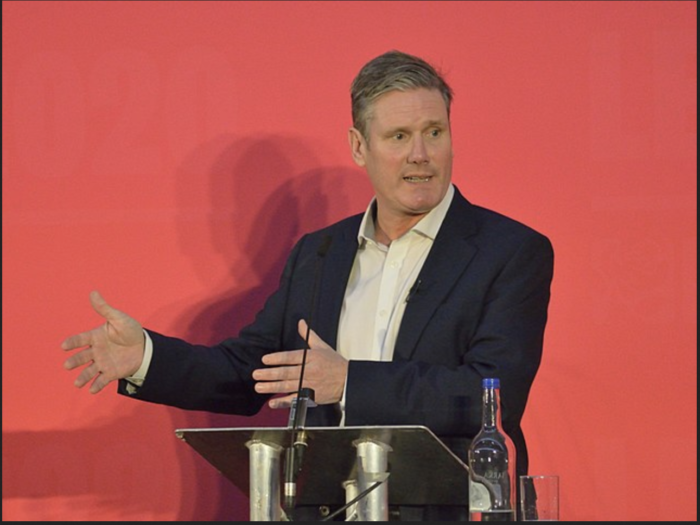
Featured image of Nicola Sturgeon at her party conference in Aberdeen via the SNP; Keir Starmer at Labour’s 2020 leadership hustings via Wikimedia Commons, CC BY-SA 4.0

Leave a Reply to Big Tam Cancel reply