
“it would probably be more efficient for the government to redirect cash directly to households rather than to cap prices and support producers.” Institute of Fiscal Studies.
Food prices have risen sharply and are set to go higher. That hits families on low incomes particularly hard. But will SNP government plans to introduce a ceiling on ‘20-50 essentials’ make family shopping in large supermarkets more affordable? Or just stuff the basket with unintended consequences?
While the argument heats up MSPs can turn to SPICe for help. Let’s hope they do. The latest briefing from the Scottish Parliament Information Centre – Food price ceilings: what does theory and evidence tell us? – is a healthy does of factual information. Free from spin.
The report, written by Heidi O’Keeffe ( a Strathclyde University Economic Futures Placement Student with SPICe) begins with a crucial point made by the Institute of Fiscal Studies head of devolved and local government finance David Phillips
The effect of a food price cap depends on why prices are high [that’s O’Keeffe’s bolding]. If MSPs click on the link they will find David Phillips does not mince words in his analysis of the SNP manifesto promise to introduce food cap to cut the cost of living.
Unless there are specific anti-competitive reasons for elevated prices, ceilings could have the unintended consequence of creating shortages of these items, by causing demand to exceed supply. Indeed, suppliers or retailers could also deliberately restrict the availability of these items in Scotland. Products could also be reformulated to reduce production costs, which could adversely affect their quality.
Higher prices often reflect spikes in the costs faced by producers, so a price ceiling may cause some of them to stop producing. The manifesto indicates that a framework to support Scottish producers would be put in place, but it is unclear what form this would take.
If it were financial support for producers when costs increased, then it would probably be more efficient for the government to redirect cash directly to households rather than to cap prices and support producers. [Sceptical Scot bolding]
So why are prices high?
The SPICe report explains: “Firms across the food supply chain have faced significant cost pressures in recent years.”
These include:
- Energy costs – increasing production and transportation costs.
- Fertiliser costs – higher because of war ( Ukraine and Middle East)
- Climate shocks – driving up price of grains, wheat, and vegetable oils.
- Labour costs – retailers paying higher National Living Wage (up by 40% since 2020)
- Brexit – more regulation has increased food prices (border controls added 6% in 2021 alone says London School of Economics)
Altogether the Competition and Markets Authority (CMA) found no evidence that lack of competition was driving price increases. Instead “firms faced continued pressure to pass on cost savings to customers.”
So the UK has created its own special price increases but inflation is worldwide. How do other countries deal with the rising price of food ?
Evidence from elsewhere is limited, says the SPICe report, because price capping is not common in European countries. But experiences of Hungary and Croatia give some indication.
When Hungary imposed mandatory price caps on 18 essential foods in 2022 it gave some help to low income families but led to shortages on items like milk (sales trippled) and had no overall effect on food price inflation. “In fact”,” says O’Keeffe, “evidence suggests that the policy had the unintended effect of driving up prices of uncapped substitute products faster than overall inflation, as retailers sought to offset their losses on staple food items.” Adding to inflation.
Likewise in Croatia where the European Commission found that food price caps only temporarily slowed inflation.
Costs or benefits?
Overall, SPICe finds more costs than benefits: temporary upsides of lower prices could be offset by potentially longer-lasting downsides to smaller traders and producers.
Are there other, maybe better, options? MSPs turning to AI for answers might find several alternatives ranging from reducing or removing VAT from staple foods to subsidies for farmers and producers. But they all cost money (deepening the fiscal black hole which Scottish Government has yet to mention).
Simplest, quickest and probably most efficient, is the David Phillips solution: give the cash direct to households.
Time will tell. The proposal is now out for consultation and Tom Arthur, Minister for Business and Fair Work, is seeking help from anyone and everyone :
“If you are involved in the food, retail or hospitality industries, work on a farm or fish in our seas, if you procure, store, transport, package, prepare or serve food, campaign to improve our food system, or are simply looking to put food on the table for you and your family, I want to receive your views and input on this important work.”
Pretty much all of us, then. Thank goodness for SPICe (see more HERE)
Consultation closes 25 November 2026.
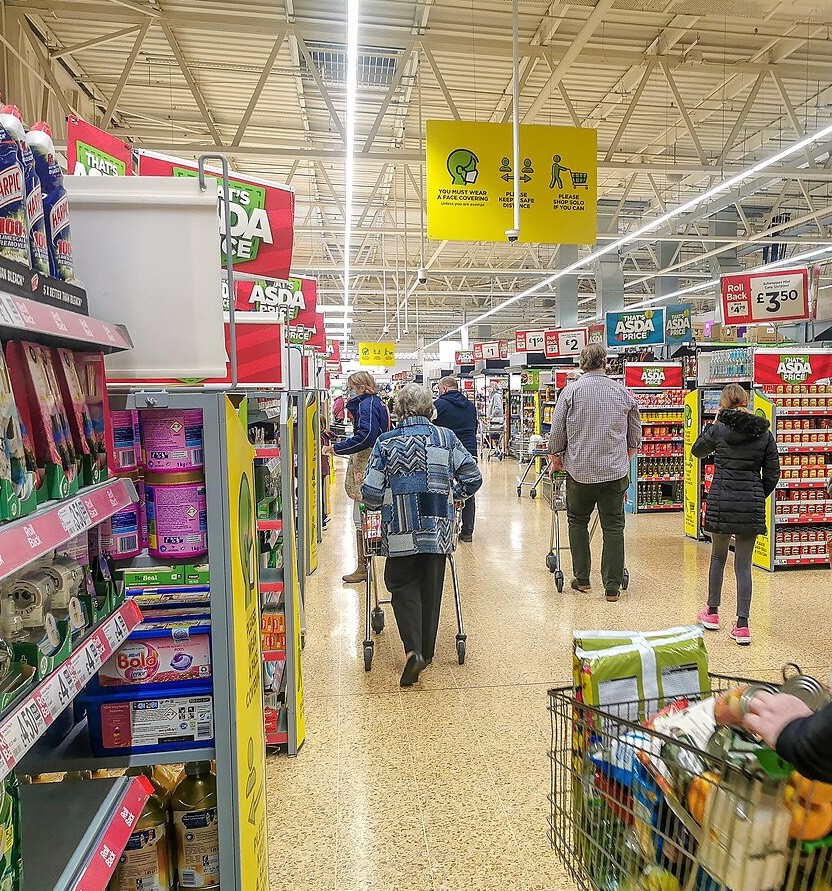
Feature image: Taunton ASDA by Lewis Clarke CC BY-SA.20
Leave a Reply