
“You do not have to become an extremist to become trapped in a silo. It is enough to spend most of your time hearing increasingly confident versions of arguments you already accept, while rarely encountering people who would question the assumptions underneath them.” Charlie Ellis takes his seat in the audience and looks around
The core theme of Jon Ronson’s The Castle is what he calls our ‘fractured, siloed society’: a world in which we spend more and more of our time consuming and discussing ideas we already agree with, and in which those ideas can become more extreme as a result.
He cites the YouTuber Andrew Gold, who has found that growing his audience means inviting increasingly extreme guests. A mild scepticism towards ‘woke’ ideas has, Ronson argues, led Gold towards an apparent embrace of hard- and far-right narratives. Gold has achieved success, but Ronson is interested in what that success has cost him.
He also discusses the comedy writer Graham Linehan, who, in Ronson’s account, became consumed by the trans debate, ‘very disinhibited’ and increasingly cut off from friends, a process that eventually contributed to the end of his marriage. Linehan’s version is different: Ronson and others abandoned him first, he argues, and that abandonment, rather than the debate itself, was what set his life on a downward course. Whatever the balance between those accounts, both point to the same mechanism. Audiences reward stronger and more provocative positions, and once those positions start attracting an audience, there is an incentive to go further.
One problem with this kind of siloing is that it is much easier to see in other people than in ourselves. The Edinburgh International Book Festival, one of the biggest parts of the city’s August events, is an interesting place to look at that problem. I attended and reviewed five events this year, all broadly political and all worth going to. In three of them, the speakers ended up illustrating, more or less unintentionally, the dynamic Ronson describes.
Reading the Room
Anthony Seldon did it most openly, and in his case deliberately. Discussing his new essay collection on Brexit, the contemporary historian repeatedly polled the audience in the Courtyard Theatre and quickly established that he was speaking to a heavily pro-EU crowd. When he asked how many wanted the UK to rejoin, close to 95 per cent of the hands went up. Seldon had a story about this. His worst experience on the speaking circuit, he said, was in Boris Johnson’s former constituency of Henley, where he failed to realise that the room was full of committed Brexiteers who had little interest in hearing a sceptical case for the EU. Since then, he has made a point of finding out who he is talking to before he starts. At the Book Festival, he returned several times to the people he believes the Leave campaign understood and Remain did not: people who felt ‘left out’ of the centres of power and influence.
He did not simply tell the audience what it wanted to hear. ‘Emotion was on both sides,’ he said, arguing that the Remain campaign had been arrogant and out of touch with the ‘deep hurt’ felt by people who believed decisions were being taken for them by distant institutions. But his own judgement on the referendum was uncompromising. He called it ‘catastrophic,’ described the lack of a threshold or any clear plan for what Brexit would mean as a ‘big error’ that worked in Leave’s favour, and said there is ‘no agreed structure’ for referendums in the British system, which he thinks remain ‘alien to our system’. Cameron, he said, ran a ‘terrible’ campaign because he was too frightened of the Conservative press to make a positive case for membership. The whole thing was ‘ill conceived’ and ‘amateurish.’ Boris Johnson came in for even harsher treatment. Seldon described him as the worst prime minister in modern history and said his handling of Brexit had ‘discredited the integrity of the office.’

There was little in this that was likely to unsettle the audience. Seldon had quickly established what most people in the room thought and then tried to push beyond it by explaining why Leave had won. The Henley story served another purpose too. In a subtle way, Seldon was suggesting that the Courtyard Theatre audience was itself in a silo, only this time an ideological one. He had learned in Henley what happens when you fail to understand the people in front of you. In Edinburgh, he knew exactly who they were.
A Pitiful Level of Debate
Philippe Sands offered a slightly different example. As a specialist in international law, discussing the argument for Britain leaving the European Court of Human Rights, a court Britain itself helped create, he called the Conservative and Reform position ‘pitiful.’ At the same time, he acknowledged it ‘resonates’ with many voters. That is an important distinction. Something can seem legally or intellectually unconvincing to an expert and still have considerable political appeal. Sands at least acknowledged that rather than pretending the problem ended with his own assessment.
Sands is a prominent international lawyer, a familiar face on the BBC, a university professor and a newspaper columnist. He is also part of the establishment that has come under increasing attack from the politicians he was discussing. He seemed conscious of that, making fun of his own north London dinner-party circuit. The audience laughed, partly at him but also with him. At one point he wondered why there were not more young people in the room. On Trump he was much less restrained, calling him ‘a monster’ and tracing his bullying back to his father rather than his political career. He praised Mark Carney for ‘not accepting bullying,’ which produced audible agreement. It was difficult to imagine many people in that audience objecting to the description.
Sands was similarly critical of politicians who, he said, ‘egg on’ people who blame immigrants for social problems, and he described parts of the country as ‘febrile and hostile.’ On Gaza, however, he was less willing to offer a straightforward answer. Asked about the legal meaning of genocide, he said the word had been ‘instrumentalized’ in political debate and described the wider argument as ‘a mess.’ That was probably the closest the discussion came to resisting the pressure of the room. He finished by saying, ‘I am an optimistic person,’ and encouraged the few younger people present not to give in to despair. It was a warm ending, but it also brought home the question he had raised earlier: why were there so few young people there in the first place?
Heterodox in Whose Terms?
Mariana Mazzucato came at the issue from another direction. The economist acknowledged that she ‘mainly works with progressive politicians’ and that there is a charge of a liberal bubble around events such as these. She nevertheless described her own political economy as ‘heterodox.’ That description makes sense in some contexts. Her ideas challenge parts of mainstream economics and the traditional view that the private sector creates wealth while the public sector mainly enables it. But it is harder to regard them as especially heterodox in a room at the Book Festival, or in much of the academic, NGO and cultural world in which the festival operates. There, criticism of neoliberalism, which Mazzucato herself called a ‘deficient theory,’ is hardly an unusual position.
She was fluent and fast, and Benny Higgins, her co-panellist, called her a ‘tour de force.’ She moved between the entrepreneurial state, the argument that private enterprise can be ‘parasitic’ on public investment, and her distinction between value creation and value extraction. ‘Progressives are bad at organising,’ she said, contrasting them with the libertarian Mont Pelerin Society, which she credited with building the intellectual infrastructure for neoliberalism over several decades. She argued that the weakness of the left had helped create space for populism on both sides of the political divide, which she dismissed as ‘crap.’ The audience laughed.
Again, there was nothing particularly surprising about the reaction. Mazzucato was speaking to people who were already familiar with much of her argument and broadly sympathetic to it. Some of her strongest points were directed at her own side. She called the 2022 mini budget ‘crazy’, argued that ‘growth is a function of investment’ rather than something politicians can simply announce, and identified poor investment, public and private, as ‘the UK’s big problem’.
For Mazzucato, the venue itself was also part of the argument. The Book Festival’s home, a reuse of the old Royal Infirmary, sits within a development now dominated by private flats and offices. She saw this as part of a wider problem: the loss of genuinely public spaces where people can meet and argue. I spend quite a bit of time at the EFI and think it is a fantastic new public space. But from the people I bump into there, and from the events I’ve attended, I’ve also had the sense that it has its own bubble. The space is open to everyone; the audience it attracts is rather less so.
When Everyone Agrees
None of this means the events were poor, or that the speakers had nothing worthwhile to say. Quite the opposite. Seldon, Sands and Mazzucato were knowledgeable, experienced speakers, and all three showed some awareness of the audiences they were addressing. The question is what happens when that awareness becomes part of a wider pattern. If political discussion mostly takes place among people who already agree, arguments become more refined without necessarily becoming more tested. The people who might challenge them simply aren’t there.
That matters because disagreement is not the same thing as ignorance. Someone who takes a different view on Brexit, the European Court of Human Rights, Gaza or the role of the state may be badly informed, but they may also start from different assumptions about what matters and what should be done. Listening mainly to people who share our assumptions makes it easy to forget that distinction.
That is the point Ronson’s examples raise. You do not have to become an extremist to become trapped in a silo. It is enough to spend most of your time hearing increasingly confident versions of arguments you already accept, while rarely encountering people who would question the assumptions underneath them.
Sceptical Scot is, at least in part, an attempt to do the opposite. That makes writing an essay about political bubbles for Sceptical Scot slightly awkward, since the people most likely to read it may already be sympathetic to the argument. There is no easy way around that. I am part of the audience I am describing.
Perhaps that is the more useful question to leave hanging. Not whether the Book Festival has a bubble, but how large it is, who gets inside it, and who never gets invited in.
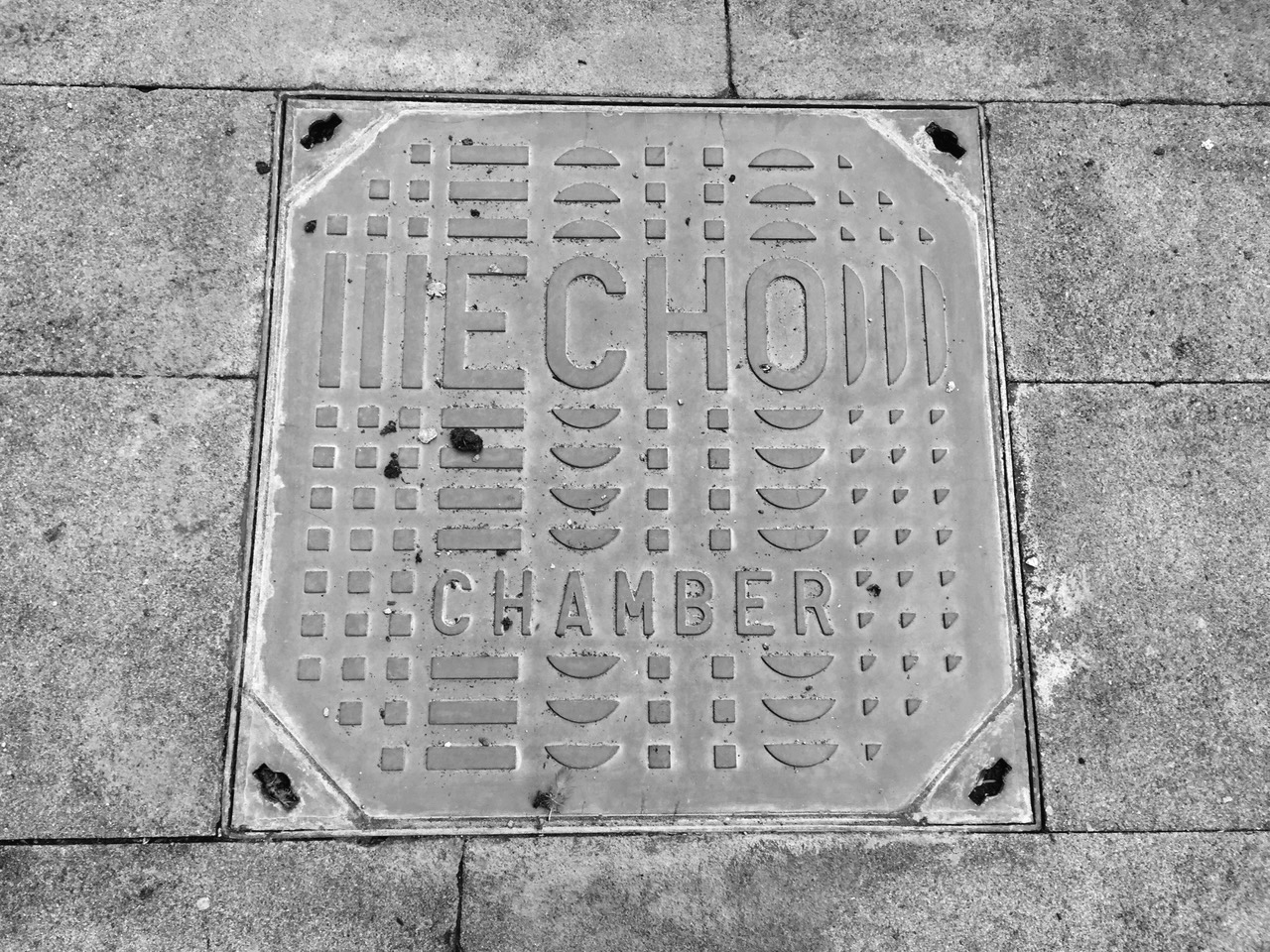
Featured image: Permanent installation in Trunks Close, Edinburgh. Part of Open Close. Concrete cast by Gray Concrete. by Tommy Perman
Leave a Reply