
John McLaren sees a brighter future for the SNP but only if it finds the courage to risk real reform.
Has a new nadir in Scottish politics been reached with the SNP’s reaction to its long-time chief executive’s embezzlement of over £400,000 in party funds?
Oh, the betrayal, the horror of realising that the person you put so much faith in has diddled you, but how could anyone have possibly known?
Sure, there was almost £700,000 raised from mid 2017, peaking in 2019, to help fund another referendum.
Sure, by mid 2021 a certain Peter Murrell had to loan the party over £100,000 to get it out of debt, but how was anyone really supposed to join the dots?
The £400,000 that was embezzled and spent, sometimes in very large chunks, on domestic and personal items for the Murrell-Sturgeon household? Well all that was cunningly disguised, which was why no-one had a clue why the SNP went from record breaking fundraising to not having a pot to piss in within two short years.
Yes, that’s the party line and any queries should be met with, as any decent, well paid, lawyer will tell you, a firm “No comment”.
Members need to know the truth
All of which is a shame because it would have been nice to know, via a court case or some form of enquiry, how such a shambles actually manifested itself.
A public enquiry may not be necessary, as no public money was embezzled, but SNP members deserve to know the truth. An open and transparent internal enquiry might also do the SNP a favour in terms of convincing people that things really have moved on.
And it should not be forgotten that most of the original enquiries of deceit and financialn mismanagement came about through internal SNP expressions of dissatisfaction. They were not ‘got at’ by other political parties, the media or through Parliamentary scrutiny. Hey, if it hadn’t been for those pesky malcontents, they would’ve gotten away with it…
So, only a few weeks after imperiously storming to another Scottish election victory the SNP is reminded of another one of its past failings. Absent internal matters, how should it react?
Time to take stock
First let’s look at where we currently sit.
• Most public services are, to put it kindly, far from being dynamic.
• The Parliament itself is moribund, but allegedly about to revived by the newly elected Presiding Officer who, in over a decade and a half of SNP rule, has never been vouchsafed a Ministerial position – which may, or may not, be a good thing.
• The SNP has lost its only high-profile economics leaning minister, Kate Forbes.
• There is a £5 billion gap looming between spending and funding plans.
• The SNP manifesto was a hollow vessel, in terms of ideas for either improving services or closing the funding gap.
Did I miss something?
So the answer to the ‘how should it react’ question is – not with what’s in the Manifesto.
To boldly go
The better reaction, even more so on the back of the Murrell debacle, is to admit to endemic past failures and to be bold in terms of policy making.
The political risks to such a strategy seem slight, given that they just won handsomely again after presiding over such a guddle.
Boldness would mean leading the argument and not backing off from self interest groups when it comes to reform.
There are plenty of examples from across ‘admired’ small, independent, countries in Scandinavia, and the ‘Arc of Prosperity’. But that requires crucial changes to policies on tax, education, health and governance.
Tax reform
Income based taxes can be reformed and raised, but based on close to average earners paying thetop rate, as happens in Scandinavia, not on ‘bleeding the rich’.
Council tax – please god – can finally be addressed and brought into the 21st century.
Education
The school curriculum can be revisited and the current failures excised.
Higher and further education can be put on a firmer financial footing, either by more government funding or by some use of fees.
A plan for health
The future of the NHS can be made more certain by having a 10 year plan and an associated long term workforce plan.
Effective governance
The government can establish a properly staffed Treasury department to better ensure cost effectiveness.
Civil service staff can start to return to their places of work, or, if working from home can be proved to be more efficient, then reshape the government’s estate and sell off prime sites.
Local Government can be given full authority to act in those areas which are within its agreed remit.
The Parliament can be reformed in terms of its accountability, either through the new presiding officer, committees, a second chamber, or all three.
There are many, many, more areas ripe for reform but let’s start with the biggies.
Wanted: a serious economic thinker
Are the current crop of SNP MSPs up to the task? I have no idea, but even if they aren’t now, repeated trying should reap rewards eventually.
One area that needs to be addressed immediately is the lack of economic focus within the party.
Post Alex Salmond, and after Andrew Wilson’s contrived ejection, the SNP has lacked a serious economic thinker. Worse, the leadership has shied away from making any attempt to get to grips with its importance in decision making. A replacement, suitably elevated in the ministerial hierarchy and with the FM’s ear, needs to be found or brought in.
What might be the upsides of such a bold but risk laden strategy? If it works, there is a greater chance of the SNP being seen as ready to run an independent Scotland.
If doesn’t work, then, given the last election results, there seems little risk of actually losing support.
If it is really unpopular, then a term out of office may well improve the party – a chance to refresh –and strengthen the belief in going it alone if the replacement government disappoints.
Will it happen? Well, sometimes it’s nice just to dream…
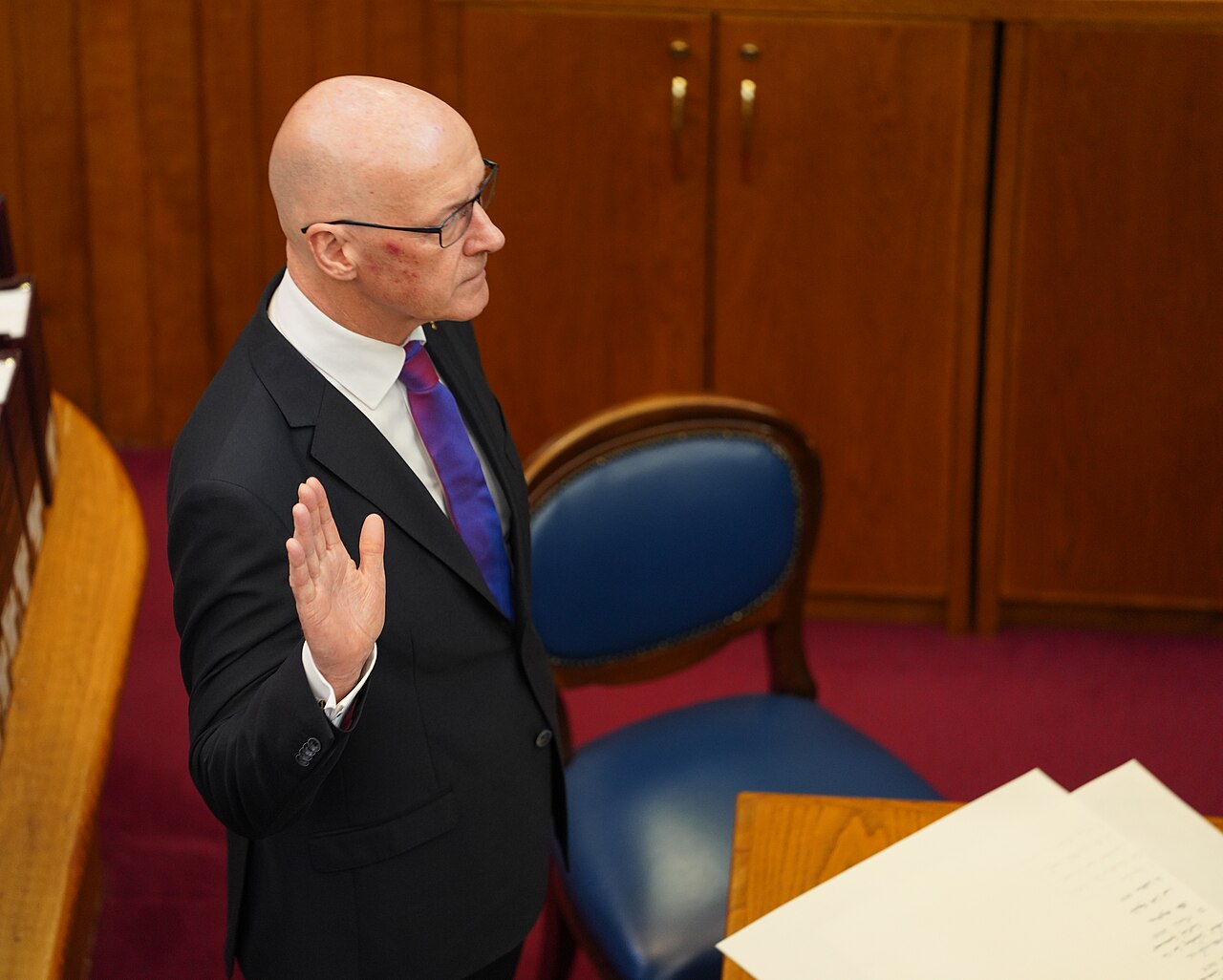
Feature image: John Swinney sworn in as seventh First Minister in 2024. Photo Scottish Government, CC BY 2.0
Leave a Reply