

Then I’ll do the lights, fill the lamp with oil,
Lynette Roberts
Get coal from the shed, water from the well;
Pluck and draw pigeon, with crop of green foil
This your good supper from the lime-tree fell.
Poetry has played an important role in the history of Wales.
From the medieval courts, to the ongoing National Eisteddfod (the largest music and poetry festival in Europe), writers have used verse to document the land’s culture. But while male writers, such as the 12th century poets of the princes and more recently Dylan Thomas, have presented one perspective of Welsh history and culture, female poets have documented a very different take on Wales through the centuries. Here are four who bring a different perspective.
1. Gwerful Mechain (est.1462-1500)
Gwerful Mechain is one of the few Welsh medieval poets from whom a substantial body of work has survived to this day. One of the loudest voices speaking up for women of the time, Mechain was also one of the first poets in Wales to write about domestic abuse. To Her Husband for Beating Her is a poignant and powerful poem full of enraged language and energetic imagery.
Born into a noble family, Mechain was free to explore her own poetic interests without the pressure of securing patronage, unlike many of her male contemporaries. She became a prolific writer who was not restricted to one style. Her work includes religious, humorous and socially conscious poetry. One of her most well-known works, To the Vagina, chastises her male counterparts for praising a woman’s body from her hair to her feet but ignoring one hidden feature. She was bold and did not shy away from what some may consider crude imagery, as in her poem, To the Maid as she Shits.
This extract, in Welsh then English, is from Cywydd y cedor (The Female Genitals):
Pob rhyw brydydd, dydd dioed,
Mul frwysg, wladiadd rwysg erioed,
Noethi moliant, nis gwarantwyf,
Anfeidrol reiol, yr wyf
Every poet, drunken fool,
Thinks he is just the king of cool,
(Everyone is such a boor,
He makes me so sick, I’m so demure)
2. Katherine Philips (c.1632 – c.1664)
Born in London, Katherine Philips – who later wrote under the moniker “The Matchless Orinda” – moved to Wales when she was around 15 years old. From her home in Cardigan she became a significant female British poet, as well as the first woman to have a commercial play staged, Pompey.
Despite the stigma against women publishing their work, Philips succeeded by circulating handwritten letters and volumes, as her male contemporaries did, while upholding supposedly feminine virtues such as humility and chastity in her works.
Though she was married with two sons, much discussion around Philips’ poetry and life concentrates on whether she was or was not a lesbian. The emotional focus of her poetry was often on women and the passionate relationships she had with them. Regardless of Philips’ own sexual orientation, her work was the first British poetry to express same-sex love between women.
3. Sarah Jane Rees (“Cranogwen”) (1839–1916)
Sarah Jane Rees (also known by the bardic name Cranogwen) is perhaps one of the most pioneering poets in this list. Born in Llangrannog, west Wales, she spurned all attempts to enforce gender stereotypes – her family wanted her to work as a dressmaker – and instead joined her father on board his ship for two years after leaving school. She continued her education, eventually gaining her master mariner certificate. Returning home by the age of 21, Cranogwen fought against opposition to run her old school, and taught children as well as providing navigation and seamanship education to young men.
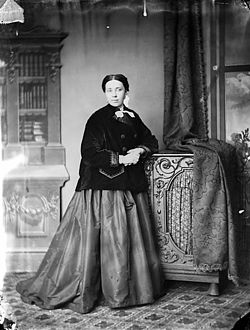
In 1865 she entered the Eisteddfod festival as Cranogwen with Y Fodrwy Briodasal (The Wedding Ring), a satirical poem about a married woman’s destiny. When she was announced as the first woman to win the prize, there was disgust from the established and renowned male writers who had been competing. Cranogwen became famous overnight and a collection of her poems was released in 1870.
The following lines are taken from My Friend:
Ah! Annwyl chwaer, ‘r wyt ti i mi,
Fel lloer I’r lli, yn gyson;
Dy ddilyn heb orphwyso wna
Serchiadau pura’m calon
Oh! My dear sister, you to me
As the moon to the sea, constantly,
Following you restlessly are
My heart’s pure affections
4. Lynette Roberts (1909-1995)
Lynette Roberts was born in Buenos Aires, Argentina to parents of Welsh origin. A friend of Dylan Thomas, during World War II Roberts moved to Carmarthenshire with her then husband, journalist and poet Keidrych Rhys, and stayed in Wales for the rest of her life.
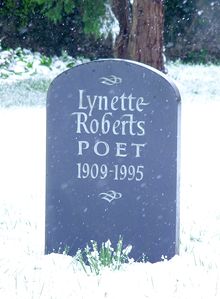
Although now her work is seeing a resurgence, for a long time Roberts has been overlooked. She was a poet ahead of her time and her use of language is refreshing. Roberts was influenced by the rich colours and landscape of her childhood, which she entwined with the rural landscape and culture of Wales during a time of upheaval – World War II.
Roberts’s poem Swansea Raid is perhaps one of her most powerful and insightful works. It depicts a snapshot of a relationship between herself and fellow villager Rosie and the tension between war and home. The changing technological world of war brought out warm, colourful language in her work, setting the colloquialisms of quiet, rural Wales against the starkness of bombing and constant threat of loss. Her most influential work has to be the heroic poem Gods with Stainless Ears, on the war’s disruption of domestic life.
This verse is from Roberts’ 1944 Poem from Llanybri:
Then I’ll do the lights, fill the lamp with oil,
Get coal from the shed, water from the well;
Pluck and draw pigeon, with crop of green foil
This your good supper from the lime-tree fell.
First published by The Conversation
Secondary images via Wikipedia
Leave a Reply