

To a hardened EU-apologist, the spectacle of British pro-Europeans marching in ersatz blue and yellow uniforms is heartening. It is also puzzling.
Where, I wish to scream politely, was your passionate militancy while much of the British media and political classes trashed the European Union for four decades?
Confronted with the genial blue and yellow hordes I also find myself turning perversely Eurosceptic. Fine, OK, d’accord, I want to shout, Brexit is a self-harming nonsense. Europe needs the EU; Britain needs the EU; this is the only European Union that we have.
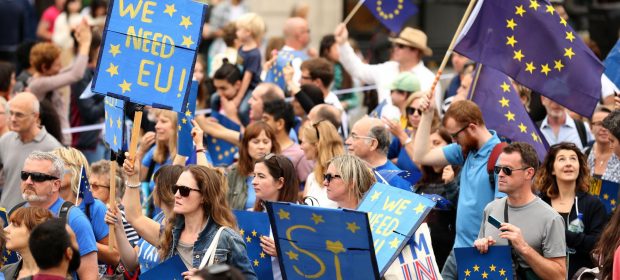
But the EU is also a deeply flawed institution with its own capacity for self-harm and a timid, confused approach to self-healing. Brexit should be an opportunity for the “other 27” to rethink and renew the EU for the 21st century. It should be the occasion to ponder why anti-European feeling has become so widespread, not just in Britain, but in parts of eastern Europe, Italy and even Germany.
Despite much talk, especially in Paris, the signs are that this opportunity will be missed or muffed in the coming years.
Dangers ahead
The European Union is entering a labyrinth of internal and external dangers, of which Brexit may be the least threatening (except to Britain).
There is a lurch towards Putinesque, anti-democratic authoritarianism in Hungary and Poland; there is the muddled, populist anti-Europeanism of the two shapeless parties which “won” the Italian elections; there is the prospect of a trade war with the United States; there is the unresolved middle-eastern and African migrant crisis; there is a persistent threat from radical Islam; there is a slow-down in the Eurozone recovery, which may or may not prove to be just a blip.
The threat posed by Hungary and Poland is potentially more poisonous than Brexit. Britain finds that it cannot leave the EU while keeping the economic benefits. Warsaw and Budapest believe that they can remain in the EU while abandoning the union’s core values of pluralist democracy, tolerance, press and judicial freedom. They wish to be left alone to pursue their experiments in “mini-me” Putinism while benefiting from EU cash and freedom of movement and trade (and refusing all migrants).
The other 27 states could not ignore Brexit. They have, so far, proved admirably united in their response to London. Brussels could, in theory, continue to function while ignoring Warsaw and Budapest. This is the danger. The EU might abandon or cheapen its principles of liberal democracy for the sake of a quiet life.
So far, the signs are mixed. Poland was confronted on state-capture of the judiciary and backed down. The new seven year EU budget under discussion would tie Brussels funding to respect for democratic principles and the rule of law. On the other hand, the Commission president Jean-Claude Juncker crassly congratulated Viktor Urban on his manifestly undemocratic re-election last month.
Italian reefs…
The Italian political crisis is intriguing and, potentially, even more destructive. For 60 years, Italy has been taken for granted – by itself and by its partners – as an inactive, feckless but finally committed “core European”. Italy never offered much in the way of ideas; Italy systematically broke the rules; Italy rarely opposed anything for long.
The Eurosceptic movements which triumphed in the March elections, the League and the Five Star movement, have few clear ideas but will feel duty bound to block and oppose. A government led by either could wreck France’s plans for stronger institutions for the Eurozone, even though Italy might be one of the main beneficiaries. A prolonged Italian political and economic muddle might tip the Italian banking system, and the whole of the Eurozone, into another debt crisis.
And yet and yet….I fear that the greatest of all threats to the unity and constructive reform of the EU in the next five years may come from an even more unlikely source – Germany. Several senior Brussels voices – including Juncker and Guy Verhofstadt, the former Belgian prime minister – have spoken recently of the “danger” of the EU being dominated, post-Brexit, by a Franco-German “axis”.
Hardly. The greater danger is a mismatch between the boyish activism of the French president, Emmanuel Macron, and the stubborn minimalism of Berlin.
…and German myopia
At this time of multiple crises, the EU needs the full, creative engagement of its most powerful member state. As Chancellor Angela Merkel limps through her final years in power, the EU faces the prospect of a kind of internal isolationism in Germany – a self-harming selfishness.
The young French leader has put forward an ambitious programme for reforming the EU and, especially, for strengthening the Euro to prevent a return of the near-calamitous debt crisis of 2010-11. Not all of his ideas – a European finance minister; yet another European assembly to set joint Eurozone economic policy; a substantial eurozone budget or intervention fund; a two-tier EU – will fly. All the same, Macron is right. Some form of reconstruction of the ramshackle Eurozone rules and institutions is essential.
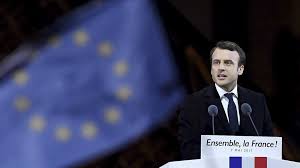
A joint Franco-German paper is expected in June. As things stand, the German right-left coalition government which laboriously emerged in March after September’s election appears unwilling to deliver more than token change. At most, the uneasy new grand coalition in Berlin is talking about a tidying up of the ad hoc, inter-governmental systems for management of the Euro invented at the height of the debt panic, rather than allowing the fully-fledged, new Brussels-based policies and institutions envisaged by Macron. Such tinkering could leave the Euro, and the EU, open to another existential crisis.
This is not an argument which is easily made in Germany – especially with the rise of the far-right Eurosceptic party the AFD and the slow rout of the Europhile Social Democrats. Selfish, the Germans ask? How can you call us selfish?
Who pays the greatest net share of the EU budget and has done so for 60 years? Who will pay the biggest chunk of the EU contributions once made by Britain? Who absorbed almost a million Middle East migrants when others refused or got away with as little as they could?
Fair enough. Selfish is perhaps not the right word. Short-sighted would be better. Germany’s economic success is rooted in German virtues but also depends on the favourable exchange rate created by the Euro, which boosts German exports to the EU and to the rest of the world.
Refusing to do more to bolster the Euro against the next crisis is not just against the interests of struggling countries like Greece or Italy. It is also against Germany’s interests.
Self-harming surpluses
So is Germany’s miserly policy of hording twin surpluses – on trade and public taxation and spending. No one suggests that the Germans should agree to sell fewer cars. Germany might, however, lift the handbrake on its own consumption and suck in more produce from other EU countries. Berlin might invest some of its six per cent budget surplus on the country’s creaking public infrastructure (which would boost the EU economy as a whole). It would also help – although not an EU issue directly – if Germany played a fuller part in its own defence by meeting Nato’s target of 2 per cent of GDP.
Germany, and Europe, desperately need a young leader to confront Berlin’s political rigidities and delusions: a German Macron. Since no such person exists, can the charming and ever-lucky French Macron persuade Chancellor Merkel and her uneasy coalition to abandon Berlin’s self-defeating minimalism?
We may not have to wait long to find out. British commentary has understandably identified the EU summit in Brussels next month (June) as a critical moment in the Brexit negotiations. Will there or will there not be a breakthough on Britain’s trade status post-2020 and the Ireland-Northern Ireland border?
In the continental pre-summit debate, Brexit hardly gets a mention. The June summit is seen as the great test of President Macron’s ability to deliver some form of credible reform plan. The precise details may be less important than a sense of a clear direction of travel – the impression that the EU is willing to look beyond its familiar muddle and fudge and take charge of its own destiny.
Main image: By Ilovetheeu CC BY-SA 4.0 (httpss://creativecommons.org/licenses/by-sa/4.0)], from Wikimedia Commons
Leave a Reply