
You gotta grow, you gotta learn by your mistakes
…And if you get it wrong you’ll get it right next time (next time)Gerry Rafferty
“Scottish government proposals would interrupt and damage the delivery of essential services, take several years to fully implement, reduce the diligence of a threatened workforce, and add unnecessary financial costs at a time when Scotland’s financial resources are severely stretched.”
We have been here before. Or some of us have. In the first of two articles on Scottish Government’s plans to reform local government, Mercat Group’s Keith Yates (former CEO of Stirling Council) applies his personal experience of the 1975 and 1996 reorganisations. With knowledge of the strengths and weaknesses of both, he says the 2026 proposals will not work. He urges the Scottish Government to channel their inner Gerry Rafferty and get it right next time.
In Part 2 he presents an alternative
The Scottish Government intends to reshape the 32 Scottish Councils into what John Swinney has described as a ‘smaller’ number of local democratic councils. The case for the reform of local governance is undeniable. It is an opportunity to devolve power from the highly centralised nation that Scotland has become. Equally important is devolving many public services that have been hoarded by the Scottish Government since its inception.
Preserving the existing local governance architecture is not seen as an option; Holyrood seems blind to the problems of delivering local services in the complex landscape of public services that it has created in its lust for centralising power at Holyrood.
The Scottish Government asserts that Scotland is “fortunate because of its size that some functions are best delivered at national level, others regionally, and some closer to communities.” It also believes some authorities are “too big to be local, and too small to be strategic.”
It now proposes:
- To replace 32 councils with 6 to 10 regional authorities focussing on strategic decision making
- Regional authorities to take over delivery of many core services currently provided by local authorities
- Perhaps 120 to 160 community authorities to focus on local decision-making
- Councillors, elected at current ward level, to sit on both community and regional authorities
- This general model to sit alongside bespoke solutions for island communities.
Artificial intelligence might be stretched to devise a new architecture from these random propositions. However, the Scottish Government is keen to hear other views of where the best balance of powers and functions lies. The Mercat Group has had direct involvement and management of the 1975 and 1996 reorganisations. We have experienced the strengths and weaknesses of both, and like the Accounts Commission, believe that the Scottish Government’s propositions contradict the principles required for successful change. They would interrupt and damage the delivery of essential services, take several years to fully implement, reduce the diligence of a threatened workforce, and add unnecessary financial costs at a time when Scotland’s financial resources are severely stretched.
The Scottish Government proposes to augment the complexity of governance by adding another layer of local democracy: regional authorities (6-10) and community authorities (120-160). In addition, some of the 135 non-democratic bodies are to be merged at the Scottish level. Why not devolve some of these? Any examination of the current delivery of public services would suggest that it is the conflict between the priorities of the 32 unitary councils and non-democratic government bodies that has hindered progress, prevented growth, and slowed the pace of progress. The potential advantage of moving to unitary councils in 1996 has never been fully realised because the Parliament has accumulated so many public services.
Whatever happened to Devolution?
It was not meant to be like this. Devolution was to be extended to the most appropriate democratic level. Not just to councils (locally accountable, with knowledge and experience of responding to diverse needs of Scotland’s communities). But also to the communities that bring energy, pragmatism and ideas to improve services and design projects.
Local Government has been stripped of many public services since the 1990s, including careers, colleges, water and sewerage, police, fire, assessors, trunk roads, and many smaller services. Budgets have been frozen, with many non-statutory services like libraries, leisure and sport, and cultural facilities closed.
Other services like roads, parks, economic development, planning, transport, building control, environmental health, and residential care have suffered a massive loss of capacity. Knowledgeable staff have taken voluntary redundancy and have not been replaced; the parity of esteem between the Scottish Government and Councils remains an enigmatic promise.
Our councils are in crisis, and this has kicked on to community-based organisations who have lost grants and are less able to play a key role in developing local facilities and services. Devolution has been devalued; Donald Dewar never intended this.
In 1996, the reorganisation of local government from nine regions and 53 District councils to 32 unitary councils was only part of the story. The Scottish Office decided that many of the functions previously carried out by local government were to be transferred to non-governmental bodies such as Scottish Water, Scotland’s Colleges, Children’s Hearings Scotland, and numerous Inspection Agencies were established. Other services such as transport, assessors, police and fire were transferred to joint boards, and subsequently most of these became Scottish-wide services. At the same time, the UK government reduced income tax and transferred the resulting funding gap for the new councils to find – or reduce services.
Place matters
Local government did not argue against the concept of unitary authorities; it made sense. There had been much tension between the two levels of local democratic control. What was missing was an evidence-based approach to defining the localities by examining the geographic spheres of influence across Scotland. Place matters.
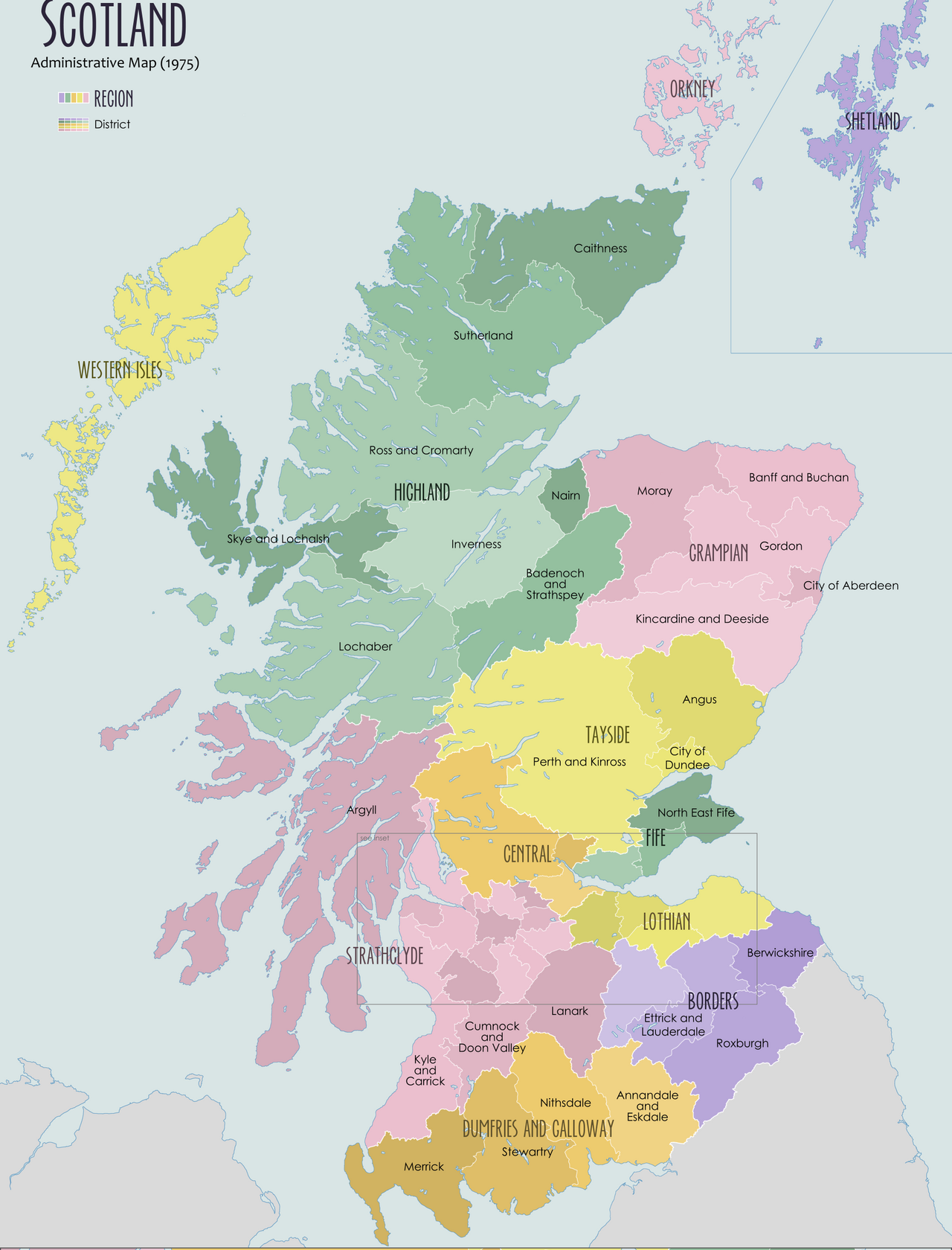
It’s where people travel to work, shop, go to events, colleges, receive healthcare, and where networks of well-established organisations for the environment, care, sport, U3A, and a host of other activities. Geographic Information Systems were available to analyse this, but they would not have provided the answers wanted by the UK Government. Hence, 32 unitary Councils were created. This compares with 65 Councils from the 1975 reorganisation: 9 regions, 52 districts and 3 island authorities. Before 1975, Scotland’s local democracy was served by 424 units of counties, cities, burghs (large and small) and landward districts.
In the consultations on the 1996 reorganisation, most of the existing regional and district councils argued that they should become the unitary authority. This diverted attention from delivering services for two years and was a largely futile exercise in self-preservation. The reorganisation was a Scottish Office political decision.
The UK government thought the large regions were too powerful; they had already dismantled the metropolitan counties in England. John Major, then prime minister, had said that Strathclyde Region was a monstrosity. The Scottish Office proposed a new structure that would eliminate five large regions and the smaller districts in the rural regions. Instead of creating new unitary councils based on evidence-based geographic spheres of influence, they spatchcocked the new unitary councils and created five or six unitary councils that, on past voting records, would result in councils of the same persuasion as the UK government.
In the 1995 elections, it didn’t work out; the government party won none of the 32 councils.
Transforming Councils for the Future
The most cost-effective, high-performing councils are not the largest but the ones that streamlined structures and took a fresh look at moribund practices.
Reshaping councils costs time and money and, if imposed, is vociferously opposed by the existing councils. Conversely, disruption can enable the sort of radical change that is resisted by existing organisations. As Machiavelli observed, “The innovator makes enemies of all those who prospered under the old order.” In 1996, some of the new councils delayered the management structures, created service portfolios that made the silos of professionals more collaborative, and streamlined moribund governance structures. These changes would have been unlikely to gain support from the old order, but over time they have been adopted and have transformed most authorities.
The real problem is that councils have been emasculated by austerity, freezing council tax, ring-fencing budgets, and creating a Rubik’s Cube of public services through the multiplication of non-democratic government bodies. It has scattered accountability and constrained ability to generate growth through delays in decision-making fostered by too many players with conflicting priorities.
The Scottish Government appears to believe that strategic means big, hence six to ten unspecified regions. Experience tells us that there is a dichotomy in this thinking. Yes, if there is a clear sphere of influence in a large city or rural region, but no, in smaller (second-tier) city regions, islands, or counties. In either case it is the authorities better aligned with their sphere of influence that are most likely to be in tune with their communities and businesses. The most cost-effective, high-performing councils are not the largest but the ones that streamlined structures and took a fresh look at moribund practices. They are no longer prisoners of the silos; they have focused on customer needs and collaboration between services. ‘Big is better’ like ‘small is beautiful’ are mere mantras.
There is no imperative for the comprehensive reshaping of existing unitary authorities, although there is scope for mergers in four or five areas. Councils should be encouraged to merge voluntarily if the geography and economies justify this. The Scottish Government should incentivise this by ceding power and finance in the way that Westminster has done in the English city regions and local government reforms.
The majority of the 32 unitary councils could continue in their present format in a local governance model that would operate within strengthened City Growth Deal mechanisms in the largest city regions of Glasgow and Edinburgh. The voluntary coordination of some services, like transport and some aspects of economic development, is already widely accepted. This model has been well developed in some of the English City Regions and echoes what the Scottish Regional Councils were responsible for before they were abolished.
‘Get it Right Next Time’ was Gerry Rafferty’s song about what to do if you screw up. To be fair to the Scottish Government they have asked for dialogue in their proposals for reform.
“You need direction, yeah you need a name
When you’re standing in the crossroads every highway looks the same
After awhile you get to recognize the signs
So if you get it wrong you’ll get it right next time (next time)
Tomorrow: Part 2 presents an alternative – realistic reform.
Featured image: Administrative map of Scotland in 1975 showing the reforms of the Local Government Act (Scotland) 1973: XrysD CC BY-SA 3.0
Leave a Reply