
Policy was subservient to campaigning. Swinney’s admonition, two decades before, that the SNP needed to make the transition from being a ‘party of protest to being a party of government’ was largely ignored.
After almost two decades in power the SNP has still to complete the ‘painful transition’ from party of protest to a professional party of government, says James Mitchell (about to submit manuscript for a commissioned book on ‘Scottish Nationalism’ to publisher).
After losing eight seats in the 2003 Holyrood elections, John Swinney told his party that it needed to make the ‘painful transition’ from being a ‘party of protest to a party of government’. He sought to stabilise the party’s finances, make it fit for government and concentrate power in the hands of the leader. This was his only notable achievement in his first term as leader. Swinney stood down after another set of poor results in the European elections the following year.
Members had poured into the party after Winnie Ewing’s 1967 Hamilton breakthrough. In 1969, the SNP claimed 120,000 members but members poured out after the euphoria died down. This pattern would be repeated as the promised land disappeared from view.
Throughout the 1970s, SNP Headquarters made membership claims that were little more than exaggerated guesswork. But the fluctuations were real, even if the numbers were not. In 1975, the introduction of ‘Short Money’, state funding of opposition parties represented in the Commons, helped the party as it had won eleven seats with 30% of the vote at the previous election. But the loss of members and then nine seats in 1979 left the party in a precarious financial state. SNP staff were made redundant. The party received occasional bequests but nothing compared with trade union and business contributions received by Labour and the Conservatives. The advent of the Scottish Parliament helped given its equivalent of Short Money. But the SNP still relied heavily on its members for financial support. The decentralised nature of the party meant that it was left to local branches to pursue renewal of membership from individuals annually.
Centralising Swinney takes control
Swinney also proposed a change to the party’s stated objective as a sop to critics.
Swinney linked stabilising the party’s finances with empowering the leadership in his reforms. Under the old system, it was easy for a single discontented branch to challenge the National Convenor, as Swinney experienced when a relative unknown challenged him in 2003. The prospect of an SNP First Minister being challenged by a few malcontents could not be discounted. There was also concern that delegates to SNP annual conferences were not representative of the wider membership. These activist footsoldiers were assumed to be true believers, more hardline and less inclined to accept the compromises thought necessary to win elections and govern. Swinney shifted power from annual conference delegates, who elected senior party officers including the party National Convenor, to the wider membership.
This culminated in proposals to introduce a centralised membership list combined with introducing One-Member-One-Vote in leadership contests and in candidate selections. The office of ‘National Convenor’ was changed to ‘Leader’. The SNP had traditionally rejected the idea of having a leader and saw leadership as shared amongst a number of key figures. This had been necessitated by the lack of full-time politicians with leadership shared amongst people unable to devote themselves full time to politics. Devolution provided the SNP with a larger body of full-time politicians.
The central membership list disposed of the need for local membership secretaries chasing up dues each year and provided more stability in membership and therefore income. The widening franchise for leadership positions combined with more stringent nomination rules was assumed to work to the advantage of incumbents and assist more moderate candidates.
Swinney also proposed a change to the party’s stated objective as a sop to critics. Since its establishment, the SNP had straddled internal tensions with its ultimate objective defined as ‘self-government’. Many leading figures back then rejected ‘separatism’ and explicitly favoured what amounted to devolution though few inside or outside the SNP interpreted ‘self-government’ as anything other than independence long before Swinney had become leader. The change was a symbolic gesture designed for internal purposes.
Enter the ‘dream team’
The SNP appeared professionalised, looked and sounded like a party of government. Except…
Swinney saw the changes as important in transforming the SNP into a party of government. But he would not be central to this process. His successor would be elected under the new constitutions. Having ruled himself out of the contest in favour of Nicola Sturgeon, Alex Salmond changed his mind when it looked likely that Roseanna Cunningham would win. A deal was done and Sturgeon stood aside and instead contested the Depute position with Salmond’s support. This ‘dream team’ emerged victorious.
It is difficult to determine the extent to which the Swinney reforms proved important in the concentration of power in the leader. It is more likely that the sense of optimism generated by Salmond’s return and, even more important, electoral success under his leadership gave him increased authority. Salmond never saw himself as a Convenor of his party even during his first period as leader. Had he chosen to remain leader after the 2014 referendum then few in the SNP would have objected. Indeed, many including very senior figures in the party, despaired at the prospect of the party’s most successful leader deciding to stand down. Once more, Salmond’s preferred candidate was Sturgeon. He had long prepared the succession.
Sturgeon inherited an SNP in excellent health. Support for independence had long bounced around 30% until the independence referendum. Membership had soared – once more achieving levels claimed back in 1969 – with a potentially massively enhanced activist base and income from membership. The mood was optimistic and the party was united. The SNP appeared professionalised, looked and sounded like a party of government. Except impressions were deceptive as has become increasingly clear.
Doing what SNP members like best
The SNP lost the referendum but arguably won the campaign.
The referendum campaign had seen the SNP doing what its members liked best. It had long been an impressive campaign vehicle, often innovative, imaginative and energetic. This was evident during the referendum. The SNP and Yes presented themselves as positive but the public saw through this. It may have offered a hopeful message but more than a little tinged with protest and negativity. As the definitive study of the referendum noted, ‘Yes supporters were voting against the Union as least as for independence’.[1]
The SNP lost the referendum but arguably won the campaign. As much as anything, new members wanted the rallies and festival-style campaigning to continue. Nicola Sturgeon did not disappoint. Sturgeon was a formidable campaigner and skilful debater. She commanded the Holyrood chamber as First Minister as she had when she was leading the opposition in Holyrood.
Policy was subservient to campaigning. Swinney’s admonition, two decades before, that the SNP needed to make the transition from being a ‘party of protest to being a party of government’ was largely ignored. Blame games are almost inevitable in modern politics but attempts to blame Scotland’s ills on Westminster have grown tiresome, unconvincing and in some cases offensive. All governing parties indulge in populism to some degree but the SNP under Sturgeon turned it into an art form.
The SNP has been stuck in campaign mode since. It may be that Sturgeon really believed that another referendum was imminent and focused her energies on treating campaigning as an adjunct to governing. But if so, she showed little appetite preparing for a referendum unless she intended to somehow circumvent weaknesses exposed in the prospectus on offer in 2014. At one point it looked as if she might be moving the debate on with the establishment of the Growth Commission under Andrew Wilson. Wilson’s report attempted to address weaknesses but provoked a backlash inside the SNP and wider nationalist movement. Publication of Wilson’s report was delayed then finally buried.
Hard and painful choices evaded
the few who raised legitimate questions, performing their duties responsibly, were not only ignored but traduced and bullied.
Reactions to Wilson’s report highlighted deep divisions on key issues that would have to be addressed if not in a referendum then certainly if Scotland became independent. Sturgeon had never looked comfortable when questioned on the economy and public finances. Hard and painful choices would be needed but were evaded.
The Brexit referendum not only gave the SNP ammunition to claim Scotland was different given the 62% of Scottish voters who supported Remain. It offered a model on how to win a referendum without a coherent and honest prospectus. Had Sturgeon’s bluff been called – though that was never likely – then we could have expected the campaign for independence to have taken a leaf out of the Leave playbook. Leave won in 2016 by making what might generously be described as outlandish claims and failing to address challenging questions on transitional arrangements and the costs of Brexit. The SNP has failed to address exposed weaknesses in its 2014 prospectus and leaves as much to chance as back then and fails to take account of the more challenging circumstances Scotland now find itself in.
But the SNP’s other weakness is that it has failed to fully professionalise organisationally. It may have become more adept as a campaign organisation but it remained an amateurish organisation lacking the checks and balances, proper accountability mechanisms and transparencies a truly professional body would have.
These problems must have been obvious to any insider yet the few who raised legitimate questions, performing their duties responsibly, were not only ignored but traduced and bullied. As with its failure to reflect on weaknesses in its independence prospectus, the SNP has stuck its head in the sand over its internal failures. The SNP still has to complete the ‘painful transition’ to become a party of government and a professional organisation. That does not look likely any time in the foreseeable future.
[1] A. Henderson, R. Johns, J. Larner, J. and C. Carman, (2022), The Referendum That Changed a Nation, Basingstoke, Palgrave Macmillan, p.81.
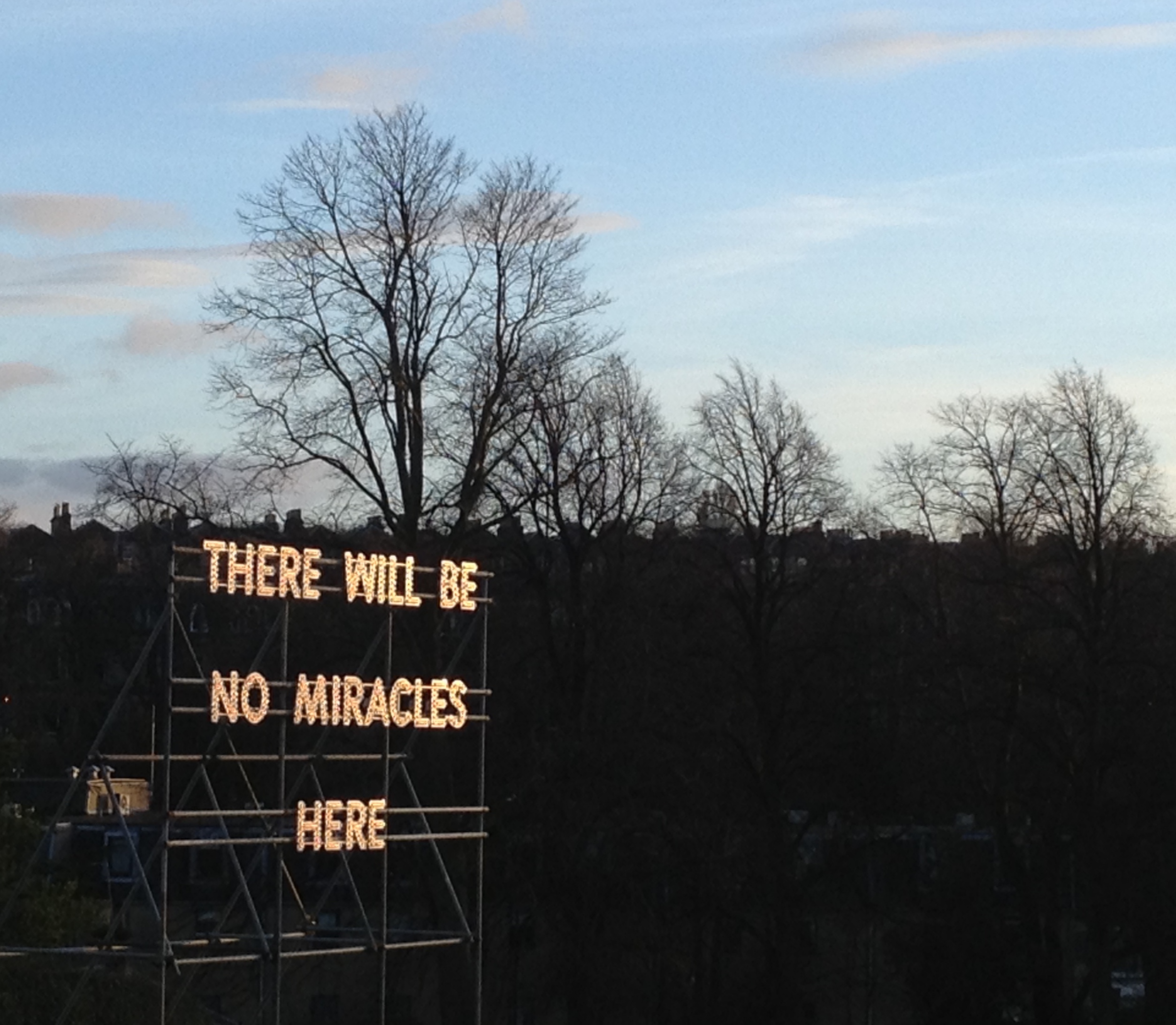
Feature image: Nathan Coley’s installation, There Will be No Miracles Here, at Scottish Gallery of Modern Art (Modern Two), photo Fay Young.
Leave a Reply