
Scotland’s First MinisterJohn Swinney pledges a referendum by 2031, piling the pressure on the new UK Prime Minister. But has Andy Burnham already made a concession which speeds the process? In this repost from Scotland Explained, David McWilliam untangles the complexities exposed when Chris Law asked why Northern Ireland has a statutory route to a constitutional vote while Scotland does not.
At Prime Minister’s Questions, Chris Law asked a question that carried its own headline.
The SNP MP for Dundee Central reminded Andy Burnham of his promise to uphold every word of the Good Friday Agreement. He then pointed to a basic constitutional difference within the United Kingdom: Northern Ireland has a legal mechanism through which its people may decide whether to leave the UK, while Scotland does not. The official exchange is recorded in Hansard.
Did Burnham accept that the people of Scotland have an equal right to choose their future? And should the conditions for another independence referendum be set out in law?
Burnham did not answer the second question. But in trying to answer the first, he said something more consequential than he may have intended.
He described Scotland as being in ‘exactly the same situation’ as Northern Ireland. He then said there would not be another Scottish referendum until majority public support had emerged.
That is not a legal commitment. It is not permission for a referendum, and Downing Street was quick to insist that government policy had not changed. But it replaces the language of an unconditional veto with the language of a condition.
And once a condition has been named, it can be examined.
The situations are not the same
The legal position in Northern Ireland is unusually clear.
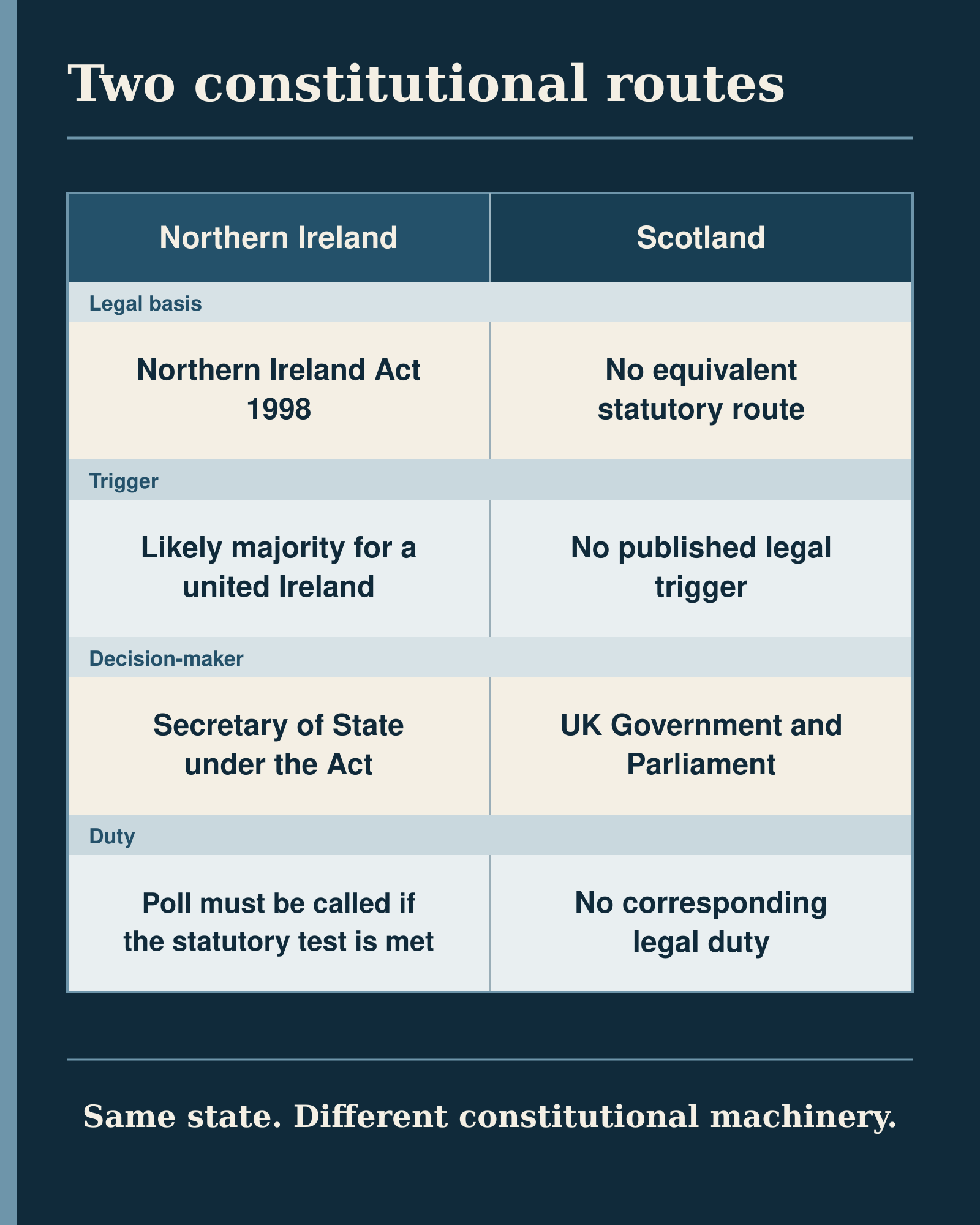
Schedule 1 of the Northern Ireland Act 1998 gives the Secretary of State the power to call a border poll. More importantly, it requires the Secretary of State to do so if it appears likely that a majority voting would choose to leave the United Kingdom and join a united Ireland.
Burnham described the point as one of ‘clear consensus’. That is not the statutory wording. The legal test concerns whether a majority outcome appears likely. It does not require an undefined wider consensus before the question can be considered.
There remains considerable discretion in deciding when the threshold has been reached. The Act does not provide a polling formula or a mechanical trigger. But the duty exists in law. The decision is not presented as an unrestricted political gift from the government of the day.
Scotland has no equivalent provision.
The Scotland Act 1998 places provisions outside Holyrood’s competence when they relate to reserved matters, while Schedule 5 reserves the Union and the UK Parliament to Westminster. In 2022, the UK Supreme Court unanimously concluded that the Scottish Parliament could not legislate unilaterally for an independence referendum, even one described as advisory, because such a Bill would relate to reserved matters.
A lawful referendum therefore requires the cooperation of the UK state, through a temporary transfer of power under a section 30 order or through legislation passed at Westminster.
Northern Ireland possesses a statutory route, however politically contested its activation might be. Scotland possesses only a route dependent upon political consent from the government whose authority would be challenged by the vote.
Those are not exactly the same constitutional situations. That difference was the point of Law’s question.
This is the distinction explored in Managed Region, Comfort Zone: Scotland can administer substantial responsibilities, but the constitutional boundaries within which it operates remain controlled elsewhere.
What Burnham changed
Before this exchange, the government’s position was that another referendum was simply off limits. That is the language of prohibition: no test, no threshold and no route through which democratic support might alter the answer.
Burnham’s formulation was different. He said that he was not aware of majority public support for another referendum and that, until this changed, one would not take place.
The word until matters. It makes the present refusal contingent rather than permanent. If the absence of majority support is the reason for refusing a referendum, the emergence of majority support must at least require the decision to be reconsidered.
That does not mean Burnham promised to approve one. His answer created no legal duty, and Downing Street subsequently reasserted the government’s opposition. But the retreat does not erase what was said in Parliament. It instead reveals the tension between two positions:
• Scotland has an equal right to democratic choice, which suggests that sufficient public support must ultimately be capable of producing a vote.
• A referendum remains wholly at Westminster’s discretion, which allows that choice to be refused regardless of the level of support in Scotland.
Both positions cannot remain indefinitely credible at the same time.
A threshold without a rule
Burnham also left every important practical question unanswered.
What constitutes majority public support: support for independence, or support for holding a referendum? They are not the same proposition.
How should that support be demonstrated: through opinion polling, a Scottish Parliament election, repeated electoral mandates, a parliamentary vote or some combination of these?
How large and how sustained must the majority be? Who decides when the evidence is sufficient? And what obligation would then fall upon the UK Government?
Northern Ireland’s legislation does not eliminate all such uncertainty. Nor should Scotland and Northern Ireland be treated as historically interchangeable. The Northern Irish provisions arise from a particular peace settlement, endorsed through referendums north and south of the border.
But that does not weaken Law’s central point. It strengthens it. Within the same state, one nation has a recognised legal path through which constitutional consent may be tested. Another must ask the Prime Minister of the day for permission without any published criteria governing the answer.
The issue is not whether Scotland should mechanically copy the Northern Ireland Act. It is whether a multinational democracy can continue to leave one of its most fundamental constitutional questions to undefined ministerial discretion.
The Democratic Power Test
The immediate political argument will focus on whether Burnham made a concession and whether Downing Street successfully withdrew it. The more important institutional question is where the power actually lies.
To treat this only as an SNP-Labour skirmish would be to fall into Scotland’s Parochial Trap: reducing a structural question about democratic power to personalities, parties and parliamentary point-scoring.
If sovereignty rests with the people of Scotland, there must be some lawful and intelligible means through which a sustained democratic choice can be expressed.
If there is no threshold that Scotland can meet, no evidence that Westminster is obliged to recognise and no process it is required to follow, then the claim that Scotland is a voluntary and equal partner is difficult to reconcile with the constitutional machinery.
That is the Democratic Power Test: not whether politicians say that people have the right to choose, but whether the institutions provide a route through which that choice can have effect.
On that test, Scotland’s present settlement fails.
A constitutional right that depends upon the changing language of individual prime ministers is not a dependable constitutional right.
The question Burnham now has to answer
Chris Law did not ask the Prime Minister to endorse independence. He asked for equal democratic standing and for the conditions governing a future referendum to be placed in law.
Burnham’s answer inadvertently demonstrated why that request matters. A constitutional right that depends upon the changing language of individual prime ministers is not a dependable constitutional right.
If public support is now relevant, the government should say how it will be measured. If majority support would cause the refusal to change, the government should explain what process follows. If Scotland is genuinely in the same position as Northern Ireland, it should identify the law that makes it so, or acknowledge that no such law exists.
Downing Street can insist that policy has not changed. It cannot make the contradiction disappear.
This was not simply another exchange about whether Scotland should become independent. It was a more fundamental question about how a state based upon consent recognises when that consent should be tested, and who has the power to decide.
A question of democracy, certainly.
But first, as Chris Law understood, a question of law.
A question for readers
If majority public support is the condition for reconsidering a referendum, how should that support be demonstrated, and who should decide when the condition has been met?
First published on David McWilliam’s Substack, Scotland Explained: A Question of Law
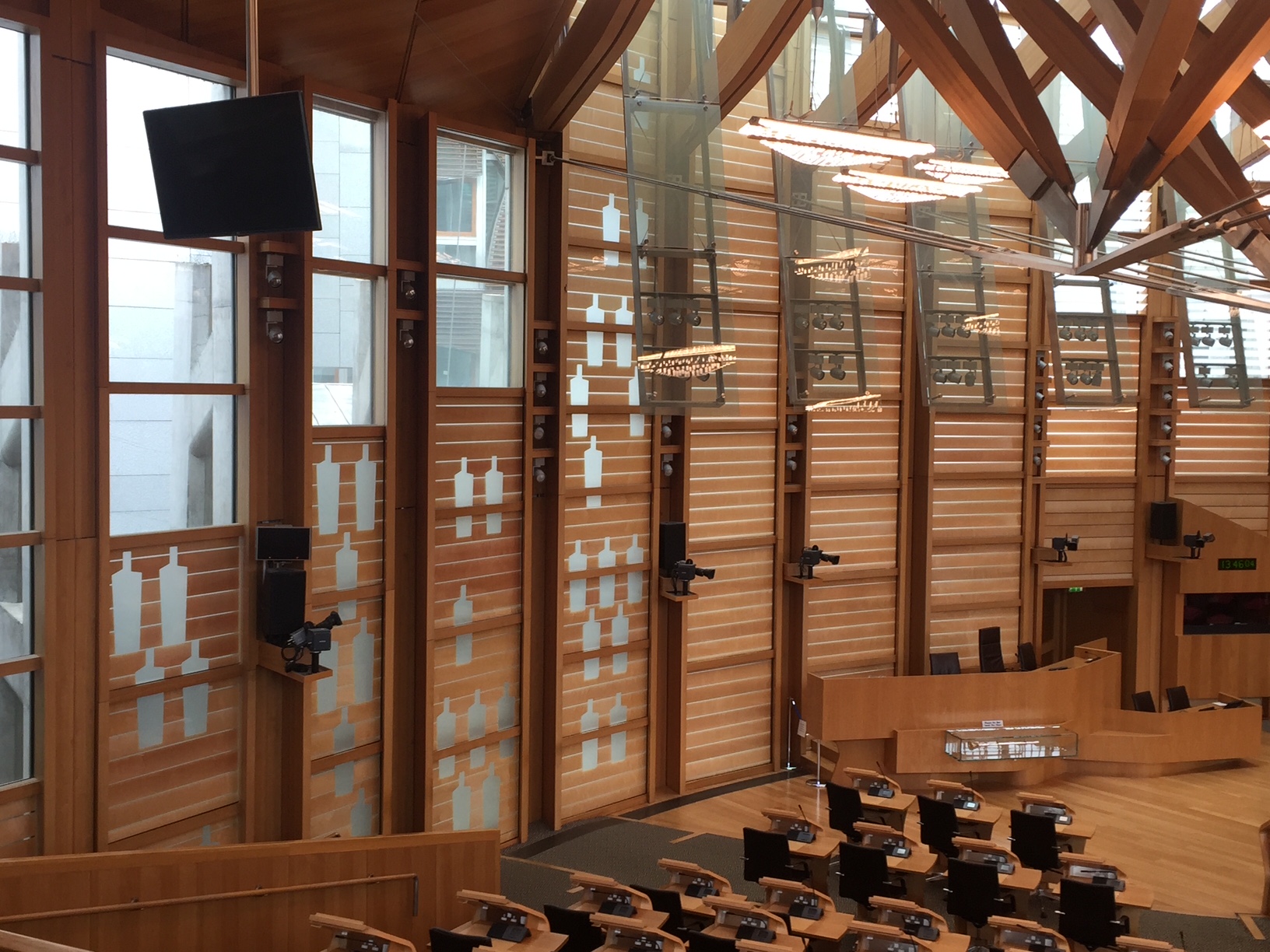
Feature image: inside Scottish Parliament icons on the wall symbolise Scottish voters. Photo Fay Young
Leave a Reply