
Who really won the 2026 Scottish election?
Almost half of Scottish voters took no part in shaping the new Scottish parliament now facing formidable challenges in the economy, living standards and environment. To say nothing of the constitution.
Results show that 2.35 million chose not to vote (1.9 million registered voters and 450,000 non registered) a total that vastly outnumbers the 877,000 who voted for the SNP, the largest party in the first past the post ballot.
The numbers should be startling but this level of apathy is not new. Devolution was expected to increase democratic engagement but since the eagerly anticipated first Scottish Parliamentary election in 1999 turnout has averaged 54.9%. Only the 2021 election stands out when 63% voted (this, the Covid election involved a considerable increase in voters registering for postal votes).
The 2026 10% drop in turnout is simply a return to the apathetic norm.

Is apathy the right word?
There are many reasons why people do not vote but surely this scale of disengagement raises legitimate questions over the health of our democracy in Scotland.
Do we just shrug our collective shoulders? Or do we now face the need for radical change?
The Mercat Group of former Council CEOs and Parliamentary Returning Officers, argues that we not only can but should all face up to the challenges of current disillusion with democracy. A look around the world shows that Scotland could do better and we propose four early initiatives that the Scottish Parliament could take:
- compulsory voter registration
- easier and more informed postal voting
- individual on-line voting
- compulsory voting where each member of the electorate is obliged to vote in each election and face a sanction for not doing so.
There are pros and cons in each proposal and opposition can be anticipated from libertarians and others. However, our society is built on foundations that require all of its citizens to behave in certain ways under some form of compulsion. Think of the civic requirement to register births, deaths and marriages, to undertake jury duty; compulsory education for all under 16 years, taxation and a whole host of laws we are all required to comply with.
We live in a society governed by laws, often generated by public reaction to some event or issue with the familiar cry, “Why doesn’t the Government do something about it?”
Acceptable change
In Scotland think of new laws proscribing smoking tobacco products in public places and licensed premises; tough alcohol drink driving laws and making it illegal to smack children. All these changes faced considerable opposition as did earlier UK legislation making it compulsory to wear seat belts in vehicles and further back, compulsory crash helmet wearing for motor cyclists. Most today would agree that all these legislative changes limiting our individual behaviour are acceptable.
The major exception to that trend was the almost universal public opposition to Margaret Thatcher’s Conservative Government’s Community Charge (Poll Tax). Judged to be both unjust and unfair it was the subject of mass opposition across the whole of the UK and was quickly abolished following Margaret Thatcher’s consequential resignation as Prime Minister.
Compulsory Voter Registration
Although a record number of people registered to vote in 2026 we know that the Electoral Register (the voters roll) is roughly 450,000 short of where it should be, a deficit generated by those who refuse to register their names and addresses and those moving home and have not quite got round to re-registering. Somewhat surprisingly there is no legal obligation on individual members of the public to register to vote, only a requirement to respond truthfully to communications from the Electoral Registration Officer (ERO). That situation could be easily remedied with an appropriate amendment to current legislation requiring all members of the public over the age of 16 to register their details with the ERO timeously.
Compulsory Voting – a civic duty
This would require a registered voter to vote in person at a polling place or vote by post or by giving another registered voter their proxy vote. Failure to undertake any of these would lead to some form of penalty – possibly a monetary fine.
As to the extent to which this change in the law could lead to greater turnout, the experience of 21 democracies where voting is mandatory may provide some possible answers with Australia’s experience over 100 years a useful place to start.
Australia – a seismic impact
In 1924 a Private Members Bill introduced compulsory voting in Australia’s federal elections. The impact was seismic with the turnout increasing from 60% in the 1922 election to 91% in 1925. Turnout since then has stayed at that lofty level. A fine of A$20 is levied for not voting.
With such consistently high levels of turnout, it’s fair to assume that it is not the fear of the £11 fine that is driving these 90%+ rates but the general public’s acceptance that voting is part of your civic duty.

The Other 20
Elsewhere there’s a cluster of democracies in South America including Brazil, Argentina, Chile, Bolivia, Peru, Paraguay Uruguay and Ecuador all of whom require their citizens to vote. The consequential turnout rates are in the range of 65% for Paraguay to 92% in Chile. The sanctions applied varies in these South American democracies ranging from fines to suspension of certain rights. Possibly the strictest sanction is applied by Uruguay where an individual can lose access to range of public services for repeated non-voting.
Beyond South America, compulsory voting is the norm in Belgium, Singapore, Switzerland, Greece, Turkey, Egypt, Thailand and a number of other smaller nations.
Flip Flopping
Currently sixteen countries including Italy, Austria, Netherlands, Philippines, Spain and Venezuela have had compulsory voting but have reversed that policy to one involving voluntary voting. In Venezuela where turnout had been at 90% between 1970 and 1993 when voting was compulsory now averages a turnout rate of around 60%.
A 2006 report by the Australian Electoral Commission noted that at that time thirty-two countries had compulsory voting.
None of the Candidates are Acceptable
In the literature challenging compulsory voting, a common objection relates to the absence of an option to accommodate a voter’s view that there is no acceptable candidate. The only option to a voter in our current electoral system who thinks this, is for the voter to spoil his or her ballot paper, which is at least recorded in the results as a “void vote.”
Some have suggested that there should be a formal place on the ballot paper where voters could place their X against “None of the Candidates are Acceptable”. All such votes would be tallied and announced by the Returning Officer at the end of the count.
I am not aware of any of the countries with compulsory voting having this built into their system probably to avoid an outcome where the votes cast for “None of the Candidates are Acceptable” secures the largest vote. Technically however new legislation could brigade votes thus cast into the current system together with the other four categories of votes declared void.
The Next Steps
This short article covers only some of the issues we argue need to be addressed. We believe that the Scottish Parliament should recognise the problem of low turnout and make use of Parliament’s access to a wide spectrum of knowledge as well as its own sources of research and intelligence to examine this issue with a view to bringing forward proposals to increase election turnout.
We will be making our views known to Government Ministers and MSPs and if you believe that “Something needs to be done about it” then please contact your MSP and say so.
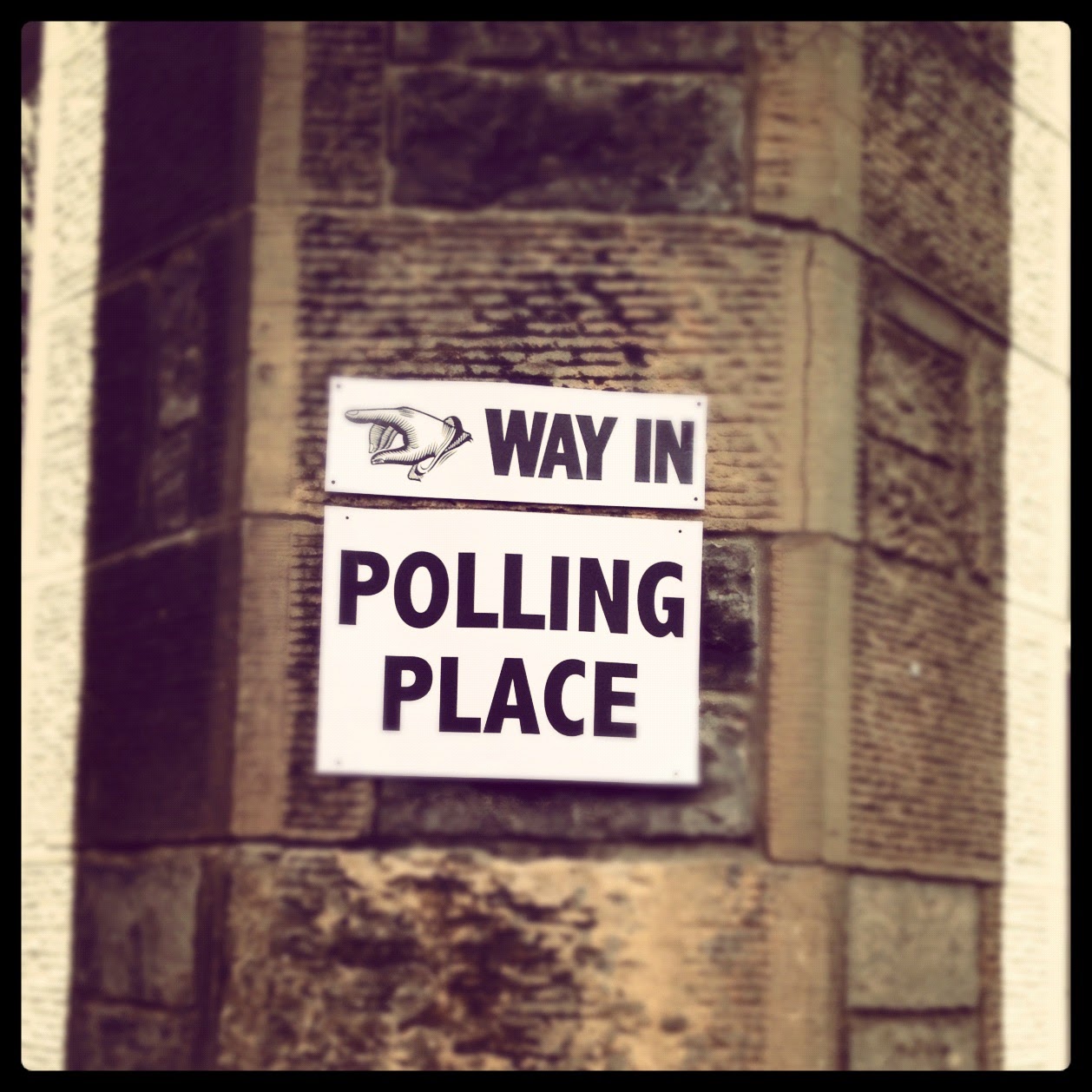
Feature image: Way In, photo Fay Young
Further reading: ‘Toothless’ compulsory voting can increase voter turnout UGA Today
“You don’t need to punish people to encourage voting,…Sometimes just making voting compulsory, even without teeth, is enough.”
Leave a Reply