
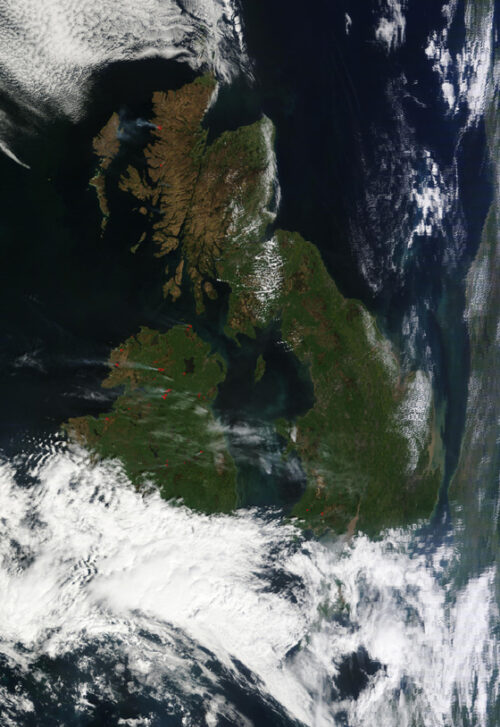
Politics happens not only between Ireland, Northern Ireland and the United Kingdom, but across them as well.
There is a British-Irish and an Irish-British politics, along with growing relationships between state and political actors in Scotland, Wales and parts of England with their counterparts in Ireland North and South. Such relations are built into the three-stranded institutions of the 1998 Good Friday Agreement which still function, however unevenly. That is because they represent the deep historical and contemporary power structures and interdependencies of the two islands.
This abiding complexity challenges conventional understandings of legal sovereignty, borders and territory. Contemporary uncertainties as to the political and constitutional futures of each polity involved requires more preparation for change, since each affects the other.
The “totality of relationships across these islands”, a phrase originating in exchanges between the two sovereign governments in 1980-1, remains a meaningful framework for analysis and political action. That should include their mutual relations with Europe and the European Union which affect the islands’ futures. Such a wider comparative perspective can only improve our understanding of the dynamics at play in British-Irish relationships.
Joined together across the Irish Sea
These are some of the main working assumptions and themes of the book I have edited with Michael Keating and Nicola McEwen, Political Change across Britain and Ireland, Identities, Institutions and Futures (Edinburgh University Press 2025). It represents a convergence of views between researchers in Ireland and Britain that the political and constitutional futures of the two islands should be analysed together rather than separately.
The book brings together 21 Irish and British academic authors in 11 jointly written chapters. They deal with contrasting and converging political cultures in Scotland, Ireland and Northern Ireland; gender politics in Northern Ireland and Scotland; UK inter-governmental relations and territorial cohesion; the roles of Sinn Fein and the Conservative Party within Irish and UK party systems; spatial framings of peripherality in Wales; the enduring relevance of the rights secured in the 1998 agreement for Ireland and the UK whether or not Irish unity happens; comparisons of Irish, Scottish and Welsh nationalist views about the UK’s future; and in conclusion a critical analysis of where the UK’s political union and diverse unionisms stand in uncertain times.
These are selected transversal takes on key issues beyond the usual sovereign territorial frameworks. They are pursued in an exploratory fashion rather than as a comprehensive analysis of territorial politics across these islands. That would be premature, since the field needs to be opened up much more and is subject to such rapid change.
We use the framework of Identities, Institutions and Futures to bring key themes together and believe they offer a way to organise future research by new generations of scholars. We intend to pursue that further through more joint research and a blog series with the Edinburgh-based Centre for Constitutional Change. Interested readers are invited to register for the book’s Belfast launch on October 1st.
Big mistake
Major contemporary forces driving political change in the UK include:
- · continuing deep regional and social inequalities;
- · Labour’s failure to deliver on its social and political reforms amidst poor economic performance and low productivity;
- · Nigel Farage Reform’s appeal to growing English dissatisfaction with its governing elites, dysfunctional structures and policies on immigration, which now see it outpolling Labour and the Conservatives by 2:1;
- · how these problems relate to the Brexit agenda notwithstanding its highly unpromising outcomes.
Underlying most of these is a deep disenchantment across the UK with its democratic credentials and constitutional settlements a generation on from devolution. Such issues have fallen down the political agenda amid a complacency about the need to address them. That is a big mistake because such unresolved questions can break fast, finding political and civic leaders quite unprepared. Support for Scottish and Welsh independence in the EU, and for referendums on Irish unity, grows in response and would accelerate under a Farage-led government.
Ireland’s political parties, governing elites and citizens North and South should factor such potential British change much more into their strategies so they can prepare responsibly for their likely consequences on that island. It is part of a wider need for more anticipatory foresight planning in Irish governance.
First published by Slugger O’Toole
See also: Michael Keating, Making sense of politics in these islands, Sceptical Scot
Leave a Reply