
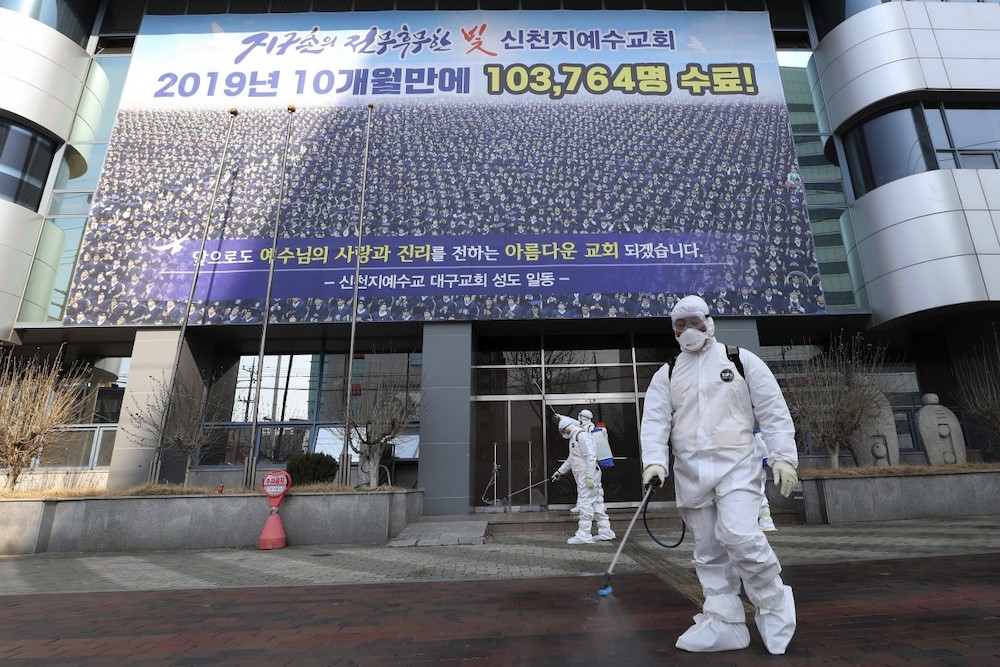
Clusters of cases of COVID -19 have been common worldwide. In several countries, big ones marked the beginning of the national epidemic.
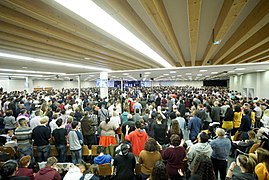
In France it was the international gathering of the Christian Open Door Church at Mulhouse from 17-24 February, with 2,500 linked cases. In South Korea it was the meeting of the Shincheonji Church in late February with 5,212 confirmed cases (amounting to almost 50% of all cases recorded in the country). In New Zealand its second biggest outbreak (96 cases – the biggest was a wedding with 98) started in March at the Marist College girls school in Auckland.
And the first outbreak we know about in Scotland (but only thanks to investigative journalists) occurred at the Nike Conference on 26-27 February when 70 international delegates met at the Hilton Carlton Hotel in Edinburgh, leading to 25 confirmed cases.
Details of this outbreak have not been officially published. In other countries they write them up and publish more rapidly. In South Korea, for example, we know from the Korean Centres for Disease Control and Prevention report that the virus was busy at a Zumba dance workshop in late February and early March, where three instructors infected 50 students between them; and the US Morbidity and Mortality Report has described in detail a choir practice on 10 March at Skagit County in Washington State which led to 33 confirmed infections among the 61 attending members.
Shout it out
A feature common to all these outbreaks was the expulsion of breath by those involved much more vigorously than in normal conversation. Evangelical religious gatherings have decibel levels many orders of magnitude greater than Quaker meetings. Zumba dancing and choir practices speak for themselves, as does the alleged Nike haka in Edinburgh and the fiafia night in mid-March at the Marist College in New Zealand, as well as a St Patrick’s Day celebration at a bar and eatery in Matamata in the same country (77 cases) when the participants were encouraged to get themselves “Shamrocked”.
Heavy breathing helps but is not necessary for virus transmission. There were 712 cases on the Diamond Princess cruise liner moored off Yokohama. And more than 40% of care homes for adults in Scotland have had two or more probable COVID 19 cases. Neither setting surprises. Before COVID -19 struck I was regularly instructed by lawyers acting on behalf of travellers who had fallen ill on holiday and sought to sue the travel organisers. I have prepared microbiological expert witness reports on infections on 21 cruise ships, 18 caused by a virus.
And a quote from a prescient paper entitled “Influenza in long-term care facilities” by authors from Nottingham University and the WHO published in 2017 (doi:10.1111/irv.12464) says it all: “Long-term care facility environments and the vulnerability of their residents provide a setting conducive to the rapid spread of influenza and other respiratory pathogens. Infections may be introduced by staff, visitors or new or transferred residents, and outbreaks of influenza in such settings can have devastating consequences for individuals, as well as placing extra strain on health services”.
COVID -19 press conferences hinge on the R0 number. But another quantity is very relevant to understanding the epidemic. It is k, the overdispersion parameter, a measure of how many cases occur in clusters. The smaller it is, the more the cases cluster; in other words, the greater the number of superspreader events in which one infected person has gone on to infect many individuals. Without doubt, k is small for COVID -19. In New Zealand, which has set the standard for openness about its epidemic’s epidemiology, 41% of its cases have occurred in 16 clusters of 13 or more cases, five of them in care homes. In Scotland more than 400 care homes have had two or more cases, and many have had big outbreaks.
Pareto – and Sturgeon’s Law
It looks as though the Pareto principle, the 80/20 rule, may be in operation, where most cases are getting their infection from a few infectious individuals. Pareto derived his 80/20 from the distribution of income in Italy at the beginning of the 20th century, when 80% of the wealth was held by 20% of the population. It has been suggested that even fewer than 20% of initial COVID -19 cases might be the crucially important initiators of big outbreaks.
It is possible that Sturgeon’s Law may be in operation. Sturgeon (Ted, the science fiction author, not Nicola) said – referring to the genre at a Science Fiction Convention in 1953 – that 90% of everything is crap, but it’s the 10% that isn’t crap that is important. The good news is that if Pareto and Sturgeon are operating, preventing superspreader events will cause R0 to tumble in a very big way. Contact tracing will test this hypothesis. The sooner we get on with it the better!
Further reading: UK suffers highest death rate, FT, May 28; South Korea reimposes restrictions, Guardian, May 28;
Featured image: Shincheonji church in Daegu via Yonhap; Christian Open Door Church via porte-ouverte.com
Leave a Reply