
John McLaren looks for clues in John Healey’s first Budget to see whether more realistic tax, spending and borrowing plans have been put in place compared with previous Chancellors and what the future holds for living standards.
The Chancellor of the Exchequer’s Autumn Budget was a modest affair, which was pretty inevitable given the self imposed manifesto and fiscal rules restrictions. As a result, the big picture on spending, tax revenues and borrowing is little changed to that outlined by Rachel Reeves back in March.
Overall, this can be viewed as another holding Budget which barely moves the dial in terms of resolving underlying economic and fiscal problems. Key tax and spend decisions will therefore have to be revisited, yet again, at next year’s Spending Review. All this at a time when events in the Middle East, Ukraine, the USA and beyond could seriously affect future prospects and necessitate a further shift in policy measures.
While the Chancellors statement is the centrepiece of any Budget, the real meat lies in the Office for Budget Responsibility’s (OBR) Economic and Fiscal Outlook (see https://assets.publishing.service.gov.uk/media/6ae1f7b839d29f3f9b9b3f36/economic-and-fiscal-outlook-october-2026-web-accessible.pdf ).
ECONOMIC OUTLOOK
The OBR’s forecast for key economic variables, up to financial year 2031-32, shows that:
- real terms (i.e. adjusted for inflation) GDP growth remains weak, not reaching 2% in any year and averaging around 1.5%;
- the forecast for inflation (CPI) has been raised significantly this year and next and is now expected to peak at 3.75% in early 2027 before falling to the 2% target rate by 2028 (note that the OBR is pretty much obliged to assume this return to target);
- living standards (real household disposable income) fell in 2025-26 and are expected to do so again in 2026-27, down to a level below (pre COVID) 2019-20;
- like inflation, interest rates are forecast to be higher, averaging 4.8% from 2027-28 onwards, around a full percentage point higher than had been forecast in March.
Overall, this is a disappointing economic outlook, with GDP growth remaining anaemic, well above target inflation persisting and interest rates needing to be further raised as a result.
FISCAL OUTLOOK
Turning to some of the key fiscal forecasts up to 2031-32:
- day-to-day spending in ‘unprotected’ Departments (i.e. outside the NHS, Defence and schools) post 2027-28 is forecast to be falling, in real terms, by over 2% a year This is a wholly unrealistic scenario and extra funding will inevitably be found. The question remains, where from?
- at the same time, National Debt as a % of GDP is higher at the end of the forecast than at present, so this cannot be the source for a fillip to Departmental spending in later years.
The OBR published an illuminating chart (Chart 3.2) showing how fiscal packages have evolved since the financial crisis. It highlights the initial fiscal tightening (austerity) period (2010-2014) followed by a fiscally neutral period (2015-2018), then the Covid related fiscal loosening (2020), followed by another neutral period (2021-2022), then more loosening (2023-24) and finally the current period of neutrality. It has been the, significantly larger, loosening periods that have led to National Debt reaching close to 100% of GDP and associated ballooning debt interest payments once near zero interest rates ended.
SCOTLAND
Spending decisions in the Budget result in a total of £600 million more in funding for the Scottish Budget between 2026-27 and 2029-30 (excluding the impact of technical adjustments related to public pension contributions), with day-to-day spending rising by almost £900 million while capital spending falls by over £300 million. The Scottish Government will also have to decide how it reacts to various decisions made by the Chancellor that apply to England only but for which Scotland receives funding consequential’s.
For the independence movement the OBR had less good news. It forecast that, even with a higher oil price, North Sea related revenues would be zero by 2031. That ship has sailed, although the wind still blows.
As uninviting as UK prospects appear, the position looks even more difficult from a Scottish perspective, as past analysis by the Scottish Fiscal Commission has highlighted. At present, the Scottish Government needs to find extra money to help fund: the University sector, in the absence of tuition fees; additional benefits payments; higher paid public service workers and more.
OVERVIEW
The Autumn Budget did not resolve the basic problems that the new Prime Minister and the Chancellor of the Exchequer face:
- slow growth;
- high debt and associated interest rate payments;
- potentially underfunded Departments, including Health, Education, Local Government, Justice, Defence and beyond;
- significant longer term funding needs related to ageing demographics and climate change;
- a historically high tax burden.
Neither did they resolve how the Defence budget increase will be achieved or benefit payments reformed, and much else besides.
The National Institute for Economic and Social Research described last years Autumn Budget thus – “Today’s Budget locks in a high-tax, high-debt steady state in a world of low productivity growth and higher interest rates. Even the historically large tax share of GDP now planned is only just enough to stabilise – not reduce – a debt ratio stuck around 100% of GDP for the foreseeable future.” Nothing has changed.
The result of all of this for individuals – stagnant living standards – is what breeds the political discontent widespread in the UK and even more acute in countries like France. Using a 10 year rolling average, the OBR illustrates (Chart 2.7) how growth in living standards have shifted since 1965-66 and in particular how they have stagnated since the financial crisis. Before the crisis they grew by a healthy 2 to 3% a year. Cumulate that over 20 years and it makes big difference. Since the crisis they fell to around 1% and looking forward they are expected to be well under 0.5% a year. The OBR states that “By 2029-30, our central forecast sees growth over the prior 10 years averaging less than 0.1% a year. As a result, 10 years on from the onset of the pandemic, RHDI per person would be just 1% higher than its pre pandemic level.” If we think things are bad now, in terms of civil discontent, they look like getting even worse.
The biggest challenge relates to boosting the economic growth rate. Without that, solving all of the other problems becomes nigh on impossible. Unfortunately, the government is no nearer understanding how to achieve this. As the OBR points out in its analysis, while the Office for National Statistics recently revised up output per hour – one measure of productivity – the measure that matters more in fiscal terms – output per worker – was unaltered, as hours worked declined. Result, continued misery.
Absent faster economic growth, the best that can be done is to make some judicious spending savings and tax rises. However, given the state of many public services, large scale spending savings seem unlikely. Which leaves tax rises. As I have written before, these need to be broad based – think ALL rates of income tax or VAT. Not an issue for most European countries but politically toxic at present in the UK.
It is important to recognise that, without higher growth, you cant solve all of these problems together. Higher taxes may improve the debt position and boost public services but they would also result in further falls in living standards. Risks abound in these tempestuous times. A serious government needs to be in power for an extended period in order to be radical and stabilise matters, but they also need to be electable in the first place.
A time for reckoning will come, we just don’t know when that time will be yet.
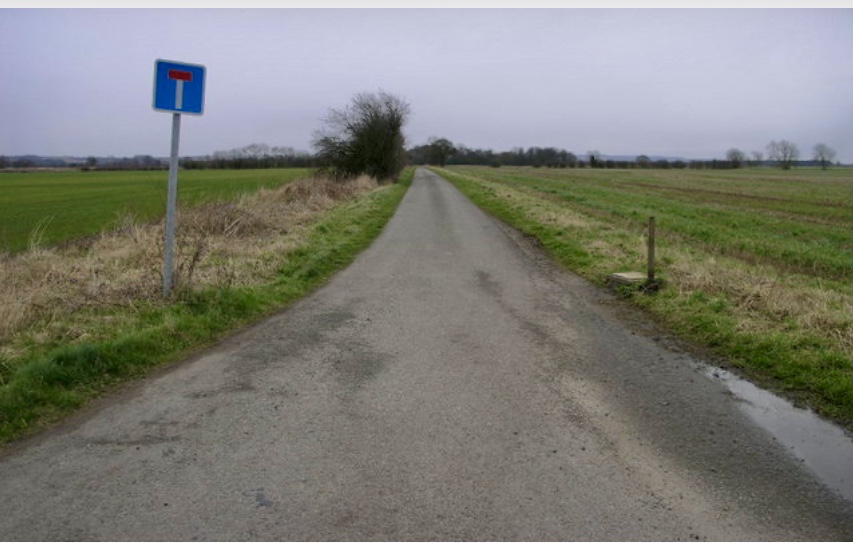
Feature image: Road going nowhere CC By-2.0
Leave a Reply