
Canada is a much easier partner for the EU than other current candidates for joining. But, Kirsty Hughes argues, the EU needs to step away from comfort zones to demonstrate a powerful, strategic European centre where the remains of the ‘west’ could regroup.
If ‘the West’ once meant the US, Europe and a few others, then that moment and that alliance is now well past as Donald Trump’s second presidency continues, still with two years to run. And if an authoritarian, far right, chaotic US presidency was the only challenge then perhaps the European Union would manage the current fractured geopolitical instability better than it currently is.
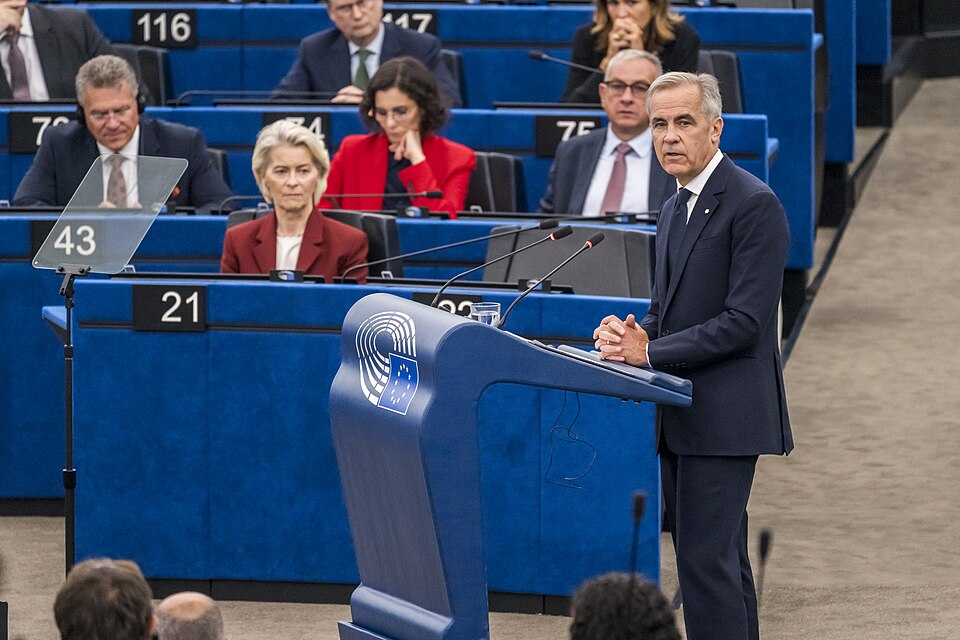
But, as the European Commission President, Ursula von der Leyen, ran through in her annual State of the Union speech, there are further, well-known challenges aplenty, including AI (whether out of control or energy guzzling data centres), China, Russia and its war against Ukraine, conflict in the Middle East and elsewhere, climate change and economic/cost-of-living challenges. Yet, what drew the most media attention was not her promise of a new EU security strategy nor the idea of a European Security Council (beloved of many think tanks) but rather her offer of associate membership of the EU to Canada, with its prime minister, Mark Carney sitting in the audience before addressing the European Parliament himself.
Mark Carney has made a name for himself this year with his talk of an alliance of middle powers. But whatever its faults, the EU – with a population of over 450 million – is not a middle power and shouldn’t behave like one. For Canada (population 41 million), pushing for new and strengthened alliances, in the face of its now dangerous and erratic neighbour, makes perfect sense.
What does it mean?
But the EU doesn’t actually have an ‘associate member’ status. And if it were to mean anything, it would essentially mean a deeper trade agreement than its current one, quite possibly including broadly-defined bits of security cooperation. Nor are EU member states likely to agree to the use of the ‘member’ word if a deeper or wider EU-Canada deal does get off the ground. The EU is also well aware, as with its deals and resets (still to come) with the UK, that it doesn’t want to set precedents that cause problems elsewhere – including to the members of the European Economic Area (EEA), to its bilateral relations with Switzerland and indeed the UK, and to its stuttering enlargement process to Ukraine, Moldova and the applicant countries in the western Balkans.
What is most telling, perhaps, about the enthusiasm with which Ursula von der Leyen made Carney an offer that she doesn’t control (the member states do) is how comfortable she clearly felt in the context of EU-Canada relations (even while ten EU member states have yet to ratify the current CETA trade deal). Canada after all is a mature democracy and market economy, a member of the G7, the G20, NATO, the OECD, the OSCE. It’s a much easier partner for the EU than pretty much all its current candidates for joining the EU.
The EU’s hopes that Iceland would vote last month to re-open membership talks (dashed by the outcome of the Icelandic referendum) were also based on a similar comfort-zone feeling – after all, an existing EEA member choosing to join the EU at this time would have underlined the EU as a zone of attraction in these troubled times – and been quick and easy unlike the other existing candidates (and there’s a positive lesson there too for a future independent Scotland).
Struggling to meet challenges
If the EU is to show it has strategic clout, that it could establish a relevant, powerful European security council, that the remains of the ‘west’ could regroup around it, then it needs to step away from these comfort zones.
Fine to strengthen ties with Canada and the UK. But if the EU cannot handle Ukraine’s accession bid – disagreeing over how fast or slow to move in bringing it towards membership, nor deal well at all with the chronically slow western Balkans accession process, then that rather suggests the EU is struggling to rise to Europe’s current challenges let alone wider global ones.
In her speech, Ursula von der Leyn underlined the importance of keeping to the EU’s climate change targets. But the European Commission President has proved a shape-shifter on climate change, her first term European Green Deal morphing into weakening of various climate initiatives (with the support of the European People’s Party and the far right in the European Parliament). The twin biodiversity crisis did not even get a mention in her speech and a push for deregulation in various areas (‘simplification’) is very much on the agenda.
This week, European Council President, António Costa, heading to the UN General Assembly, penned an op-ed in the Financial Times with the Presidents of Brazil and Tanzania – and yes PM Mark Carney. This rather curious group of four are establishing a new initiative “Partners for Multilateralism’ or P4M. It sounds well intentioned and open with the aim of reinforcing the international multilateral system and its associated values. And as the world fractures into more blocs, overlapping groupings, temporary alliances then an initiative to sustain and defend, if update too, existing international institutions, most of all the UN, is surely welcome.
Shifting alliances
In the end, the EU cannot become something it’s not. There is no single European government.
But there’s also an inescapable sense of shifting alliances and initiatives that are well-intentioned but not really adequate nor barely strategic given the range and unpredictability of global challenges and conflicts.
In today’s world, the EU still faces serious challenges in showing it has a united, strategic foreign policy in the face of different political and economic challenges. Ahead of von der Leyen’s state of the union speech, Amnesty International and Human Rights Watch called on her to ban trade with illegal Israeli settlements. But the EU member states still can’t agree on this. Efforts to speed up the Ukraine accession process have also run into member state objections. On migration, the EU continues to pursue a fortress Europe approach, ignoring its own demographic challenges.
In the end, the EU cannot become something it’s not. There is no single European government. The EU is an organisation that lives by procedures and member state interests. Efforts to be more strategic, move faster, innovate more are all needed and would be welcome. But shifting to a flexible, fast-moving or more strategic EU is always going to be clunky, rather slow and partial. That may not be enough as the EU’s own politics of its member states becomes more challenging and in a world of rapid and unstable geopolitical change. But, for now, it’s what we’ve got.
First published on Kirsty Hughes Europe and Scotland Substack
Feature image: Mark Carney speaking to the European Parliament 17 September 2026. Wikimedia Commons

Leave a Reply