
The UK Supreme Court said that their ruling on biological sex as a distinct category in equality provision should not be interpreted as a defeat for trans people. Trans people have the right to live in dignity, free from harassment and discrimination, they ruled.
Most of those who welcomed the judgement also made a point of saying that they support the rights of trans people to be themselves, to live as they wish, and to be treated well. So if the legal battle is now over, then perhaps we can take a break from the culture war too, and think about how we can build acceptance and respect.
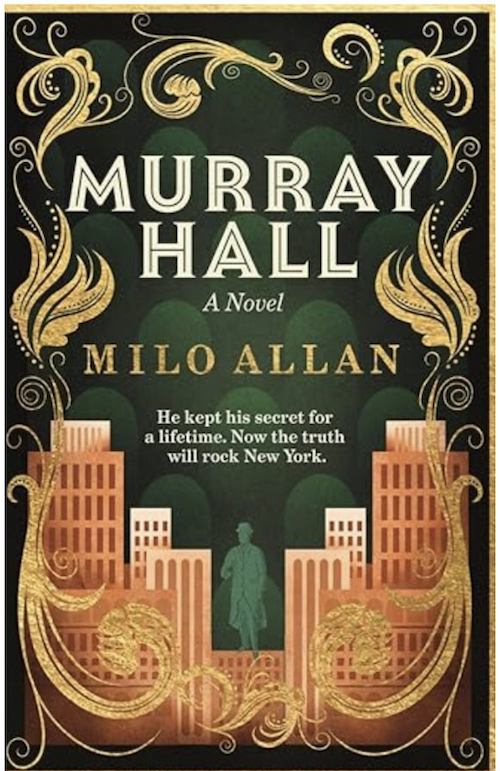
Coincidentally enough, this ruling came just the day before the launch of a novel celebrating the life of a trans man in late 19th-century New York, written by my friend and colleague Vicky Allan in collaboration with Milo Clenshaw, under the joint byline Milo Allan.
I haven’t read it yet but my copy is on pre-order and should be landing on the hall mat any day. It looks to be a dramatic tale and it reminds us that trans people have probably existed through history.
Murray’s story
Bail bondsman and Tammany Hall politician Murray Hall died in 1901 from breast cancer, which he had been hiding because he didn’t want to risk exposure. Up until then he had been a well-kent figure in the Big Apple, propping up the bar and knocking back a dram, running a commercial intelligence operation and living with his wife and adopted daughter in Greenwich Village.
The story goes that on the boat to America 25 years earlier, Murray changed his name and reinvented himself as an aristocratic and well-educated Scot, although he was actually born into a working-class family in Govan and left school at an early age.
As a teenager, Mairi Anderson swapped identities when her brother John died, perhaps at his urging. He was buried as Mairi (or Mary) and she took his clothes and identity, first as John Anderson and then as John Campbell. He married and lived as a man but was eventually unmasked as a biological woman and fled Scotland for the New World.
Edinburgh’s Medical Officer Sir Henry Littlejohn told the Evening Post after Hall’s death that he thought this was the same person: “She had strongly marked features, and this, taken along with the fact that her constitution was remarkably robust and masculine lent her aid in posing as one of the sterner sex. Johnnie Campbell as she called herself, soon found employment as a mason’s labourer at Duddingston, and later was engaged in the construction of the railway viaduct at Dalkeith. No one suspected her sex.”
“She could “carry the hod” with any of the other workers; her hands were as hard and strong as those who had been at the work all their days, and her ‘stride’ is said to have been as firm and steady as that of any of her fellow workers walking the ‘plank’.”
A Senator told the New York Times how Hall used to ‘hobnob with the big guns of the County Democracy’ and said that he ‘cut quite some figure as a politician’. He added: ‘He dressed like a man and talked like a very sensible one.’”
Another political colleague told the New York Times: ‘He’d line up to the bar and take his whisky like any veteran, and didn’t make faces over it, either. If he was a woman, he ought to have been born a man, for he lived and looked like one.’”
Some commentators of the time were outraged that Murray was able to vote – biological women didn’t get that right until 1920 in the USA. Similarly that he was able to take an active role in politics.
Milo Clemshaw, who is himself a trans man in his 20s, told the Sunday Post: “Murray Hall’s story is a reminder that trans people are everywhere. Whenever I encounter those with negative views or prejudices towards trans people, they tend to not know trans people or think that they don’t. They have stereotypes in mind when, in reality, trans people are everywhere in every profession and every walk of life but might not fit into those stereotypes and therefore go undetected.
“Murray Hall and all trans people are complex people – they are not heroes or villains, they are just human like anyone else.”
In a postscript to the novel, Milo recognises the part history plays in looking back at a life lived outside social norms: “There are many reasons why Hall might have lived as he did, the two most obvious being that he was transgender, or that he saw and understood the privileges men enjoyed and wanted to access them himself. It is possible that both were true. For myself, I do believe that he was trans, or at least genderqueer, because I can’t imagine someone committing so fully to a life that didn’t truly reflect who they were. But that’s just more conjecture – if there is an objective truth to the story of Murray Hall, we haven’t found it.”
In an article in the Herald. Vicky acknowledged the possibility that Johnnie Campbell and Murray Hall are not the same person. “Given that so many parts of the story do not quite match up, I can’t help wondering if this was a fusion of two separate lives and stories. And if it was, was this because these lives were so threatening, in their day, that they had to be melded into one? What if, rather than the life of Murray Hall being a vanishingly rare thing, it was more common than is often assumed?”
Vicky quotes Emily Skidmore author of True Sex: The Lives of Trans Men at the Turn of the Century, about dozens of newspaper reports of women living as men. In it she writes how trans men often chose “out-of-the-way places to make quite regular, maybe even ordinary, lives. They were in a word, unexceptional”. The ability to live a modestly happy life, out of the public eye, is something I imagine many trans people still aspire to. It is up to us as a society to give them that space.
First published in the author’s A Letter from Scotland Substack
Leave a Reply