
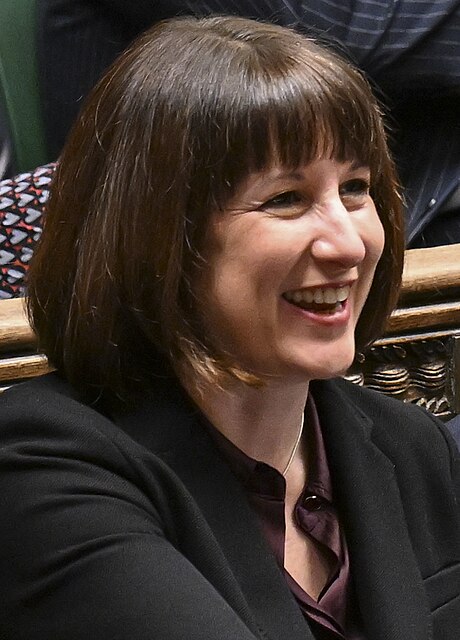
On 19 March the (then Shadow) Chancellor Rachel Reeves delivered the 36th Mais Lecture at Bayes Business School in London. This was an opportunity for Labour to set out its stall on economic policy, and Rachel Reeves used it as a chance to outline her proposed fiscal rules. In doing so, she said:
[O]ur fiscal rules differ from the government’s. Their borrowing rule, which targets the overall deficit rather than the current deficit, creates a clear incentive to cut investment that will have long-run benefits for short-term gains. I reject that approach, and that is why our borrowing rule targets day-to-day spending. We will prioritise investment within a framework that would get debt falling as a share of GDP over the medium term.
Source: Labour transcript of the Mais Lecture
The borrowing rule in place that Reeves refers to is the supplementary target, which is defined in the Charter for Budget Responsibility, and which says that public sector net borrowing (PSNB) must be below 3% of GDP in the final year of the forecast period that the OBR projects. This is five years into the future, and so the current end is 2028-29 – but whenever the next forecast is, it will roll over to 2029-30.
Labour’s proposal means that will no longer use this rule and will instead make sure that it keeps the current budget in surplus in 2029-30, while maintaining the fiscal mandate – the rule that debt should be falling as a share of GDP in the final year of the forecast. This seems like it would be a clear dividing line in terms of macroeconomic policy.
The current forecasts for net borrowing and budget
The current budget deficit is simply defined as net borrowing excluding net investment. So in a formal sense, Reeves is right – her proposed rule does not formally limit investment. Though neither does the current one: it is perfectly possible for the government to meet the 3% borrowing rule with more or less investment.
Net borrowing is forecast by the OBR to be below 3% in every year of the forecast, and falling in every year. By 2028-29 – the year in which the rule was assessed in March – net borrowing was forecast to be 1.2%, and a full £43bn lower than it would have had to be for the 3% threshold to be breached.
Chart 1: PSNB forecast and comparison with the borrowing rule

Source: OBR, FAI analysis
This ‘headroom’ appears very large in recent memory, and larger than the headroom any Chancellor left themselves since George Osborne in the 2014 Autumn Statement, and if that were the only constraint, it would mean there was significant room to increase spending on borrowing without breaching that rule.
This ‘headroom’ against the 3% borrowing rule is also substantially larger than the one against Reeves’ favoured rule. But note that the current budget is already forecast to be in surplus by 2028-29 to the tune of £14 billion. This means that the current Government’s plans already meet Reeves’ rule, and this is likely to remain the case whatever happens. It’s not a particularly demanding rule to meet, mind: the UK ran a current budget surplus in 2018-19 and very small deficits in many other years of the 21st century.
Chart 2: Current budget deficit and comparison with the Labour-proposed current budget rule

Source: OBR, FAI analysis
In fact, on their own, meeting the two is pretty manageable. If these were the only rules, the Government could borrow an additional £30bn a year for capital spending and still meet both rules – with a historically low cushion, but not dissimilar to Jeremy Hunt’s in the last few events.
The difficulty is in getting debt falling
The reason why the Government is constrained much more than it would appear in the first place is that debt is barely on a falling path in the final year of the forecast. The underlying debt stock only has to rise by just under £9bn for it to no longer fall – which is a minuscule difference, and also a historically very low level of cushion against economic shocks and forecast uncertainty.
As the chart below illustrates, it’s the debt rule rule that bites in any of the scenarios with additional capital investment – and therefore that is the real constraint on how much additional investment comes from this rule, not the current 3% rule or a hypothetical current budget rule. Changing from the borrowing rule to the ‘borrow-to-invest’ rule does nothing to change the fiscal space available to the Government so long as it remains committed to getting debt on a falling path by the end of the forecast.
Chart 3: Headroom against current and proposed fiscal rules in the OBR’s central forecast and for different scenarios of additional capital spending

Source: OBR, FAI analysis
Of course, it wouldn’t be the first time we saw a government play about with the timing and profile of capital spending to ensure that it increases earlier in the forecast, making it easier for indicators to be hit at the end. And it’s certainly something that we will be keeping an eye out for – not least because that’s the sort of tricks that seem to work in the short run, but actually are incredibly detrimental to the stability that Reeves claims she wants to instil.
Reading between the lines – could Labour be trying to wrest some fiscal room for manoeuvre?
It’s worth circling back to Reeves’ statement about the fiscal rules, both in what it says and what it doesn’t say.
It’s obvious what the current budget rule will be, which is for it to be in surplus. It’s less immediately clear that the debt metric used will be PSND ex BoE – the metric chosen by Hunt.
The choice of PSND ex BoE – or ‘underlying’ debt, as it’s often called by the Treasury – means that it creates an artificial barrier within the public sector in the National Accounts. For a large part of the 2010s, during expansions in quantitative easing, this benefitted the Treasury – it was much easier to get ‘underlying’ debt down by excluding the effects of the Bank’s policy.
Chart 4: PSND and PSND ex BoE as a share of GDP

Source: ONS
But that is no longer the case. With higher interest rate losses accumulating with quantitative tightening and the Treasury indemnifying the Bank for those losses through capital transfers, ‘underlying’ debt is now rising much faster than PSND.
PSND looks through these artificial intra-public sector boundaries, ignoring whether the Bank or the Treasury holds these liabilities – both are ultimately arms of the government, and therefore what matters is whether they reside in the public or private sector.
The situation regarding headroom against getting PSND falling as a share of GDP in the final year of the forecast is much healthier. As the chart below shows, an additional £20bn in capital spending per year would see the PSND/GDP being met with roughly the same headroom that the ‘underlying’ debt rule is met currently.
Chart 5: Headroom against current/proposed fiscal rules and PSND falling in the OBR’s central forecast and for different scenarios of additional capital spending

Source: OBR, FAI analysis
Was Rachel Reeves leaving herself some room for this by not mentioned underlying debt anywhere in the Mais Lecture? Yes, it’s a slightly different metric, but one that arguably is a better indicator of the state of the public finances – and a Chancellor would have no better time to institute this than at the start of a new Parliament with a change in the political weather.
First published on July 2 by the Fraser of Allander Institute
Featured image: Wikimedia Commons via UK Parliament Creative Commons Attribution 3.0 Unported

Leave a Reply