
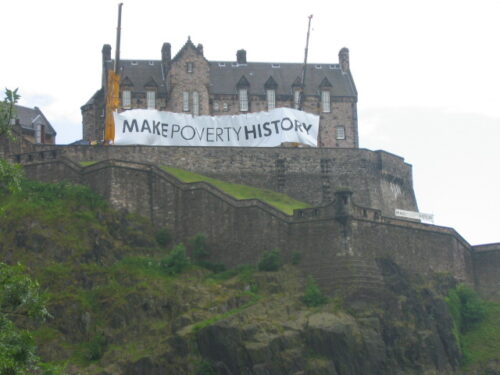
There are around a quarter of a million Scottish children living in relative poverty out of 4.3m in the UK as a whole, according to the Scottish Government.
John Swinney says “eradicating child poverty in Scotland is my top priority as First Minister” but he and his administration admit that current levels of relative poverty are little changed over the past five years when they’ve been in power.
The Scottish Government’s interim target is to reduce the level to 18% by March 2024 (outcome due next year) and 10% by 2030 but the Poverty & Inequality Commission says that, while some progress has been made via the £25 a week Child Payment (affecting 400,000 elighible families): “Progress in other areas is slow or not evident at all, and we are seeing the impact of budget cuts, or the failure to invest sufficient additional funding, in some of the key commitments in Best Start, Bright Futures, including in the areas of employability, childcare and affordable housing.”
The Commission concludes: “In view of recent statistics, and the scale and effects of actions taken over the last year, the Commission’s opinion is that it is unlikely that the interim targets will be met. Furthermore, without immediate and significant action, the Scottish Government will not meet the 2030 targets.” It continues: “The Scottish Government needs to restore faith and renew optimism in its commitment to the 2030 child poverty targets.”
That Commons vote
This sketches out some of the background against which we should judge the SNP amendment to the King’s Speech which urged removing the two-child benefit cap first imposed by George Oasborne seven years ago. Seven Labour MPs voted for the amendment and lost their party‘s whip as punishment; they were then suspended from their party for six months. This was a bovinely draconian move and not just because Keir Starmer has a huge majority and easily defeated the amendment.
The seven, plus independent MPs like Jeremy Corbyn who had already been expelled from Labour, are members of the Campaign Group, a “hard left” socialist groupuscule implacably opposed to Starmer-style centrism and social democracy. Their decision to back the SNP amendment was entirely predictable. They’re rebels with a cause: they hate Starmer.
But their decision was equally stupid. First, it comes ahead of, in all likelihood, an announcement by Chancellor Rachel Reeves to remove the cap in the Labour Government’s “dirst fiscal event” as some call it – aka an autumn statement or interim Budget.
Second, removing the cap is just one element of the wider child poverty strategy being drawn up by a government task force that includes many of then NGOs/charities campaigning against the cap. It’s hard to imagine it not being removed sooner rather than later though there are cost implications: £3bn according to ministers; £1.7bn according to charities.
Prof Jonathan Portes, an economist/social scientist, tweeted today:

Third, and politically most important, backing the SNP amendment right now boosts that party’s political profile just after it suffered a big electoral defeat that has shrunk its presence at Westminster to just nine MPs from 48 after a campaign in which it tried to position itself to the left of Labour and as Scotland’s socialist conscience.
Not one of Labour’s 37 Scottish MPs backed the amendment though one, Katrina Murray, didn’t vote/abstained. Why should they? The SNP is already campaigning for the 2026 Scottish election where it hopes to revive its fortunes and re-emerge as Scotland’s leading party on the back of popular disenchantment with a UK Labour Government reneging on promised change and delivering austerity instead.
Stephen Flynn, SNP leader in the Commons, has relentlessly seized upon the cap as a stick to beat Labour but one of his purposes is to raise his profile as would-be successor to Swinney at the head of the SNP, aided and abetted by a mooted party rule change allowing MPs after all to run for Holyrood. Another is to position himself well to the left of Kate Forbes, his most obvious rival. “Tonight, the Labour Party has failed its first major test in government. Labour MPs had the opportunity to deliver meaningful change from years of Tory misrule by immediately lifting thousands of children out of poverty – they have made a political choice not to do so.”
Here one might apply the Biblical “beam and mote” yardstick to SNP failings in government over the last 17 years, notably missing target after target. (“Only with independence”; “it’s all Westminster’s fault”…). The critical point for me is that Flynn is hypocritical and cynical in urging costly policies at Westminster without having to p;ay for them, in egging Labour MPs to defy their whips when the SNP leadership has ruled with a rod of iron and in opportunistically adopting left-wing stances it does not believe in in government.
Conclusion
Ending or at the very least mitigating child poverty in Scotland (and elsewhere) is or should be a common goal for all political forces and civil society. But immediately removing the two-child benefit cap will not remove poverty among children and it is naive or misleading to say the cap is the main driver of poverty.
The Poverty & Inequality Commission puts it well: “Meeting the 2030 targets will require transformational change in relation to all the drivers of poverty. While some good work is taking place, this is not at the scale necessary to deliver the transformation required. In addition, existing commitments, such as the expansion of early learning and school age childcare, employability support, and the Affordable Housing Supply Programme, have been put at risk by a lack of funding needed to deliver them, and in some cases funding reductions….
“There are hard choices to be made about revenue raising and spending. The child poverty targets are not just the Scottish Government’s targets, they are Scotland’s targets, voted for by all the parties in the Scottish Parliament. It is now time for all parties to demonstrate their commitment to the targets and participate in a cross-party conversation about making these hard choices in the interests of children in Scotland.”
Amen to that.
First published on the author’s Cosmopolitan Villager Substack
See also: Half-truth: SNP has powers to scrap two-child cap, The Ferret
Leave a Reply to David Gow Cancel reply