
The UK is a voluntary union but the Scottish parliament cannot call an independence referendum without Westminster’s approval.
The UK government and the main opposition party both refuse to countenance a referendum in the immediate future or even in the medium term nor will they say when or under what conditions they would agree to a second independence referendum: ‘Is this a voluntary union – discuss’.
What is clear about the UK union is that it is a union dominated by England. The Tory government is only in power because it got a majority of the 2019 vote in England – not in Scotland, Wales or Northern Ireland. A future Labour government may well get a majority in England and Wales, but it can only hope to increase its MPs in Scotland from one to perhaps, at best, a dozen. And Brexit went ahead due to the votes of England and Wales.
Currently, Labour looks set, according to the polls, to make it to a majority at the next general election without needing a big swing in seats in Scotland. Labour’s policies are focused on England – whether on Brexit (to be improved), constitution (Gordon Brown will tell us the answer), migration (control it more) or many other issues.
Of course, politics is a dynamic affair. Some Labour voices suggest sotto voce that in a second Labour term it could be possible to discuss rejoining the EU single market but that must be denied now. And Keir Starmer insists he wouldn’t do a deal with the Scottish National Party, but he might have little choice. And once Gordon Brown’s constitutional wisdom is delivered is that really going to be introduced with no choice in Scotland between the status quo, Brownian changes, or independence?
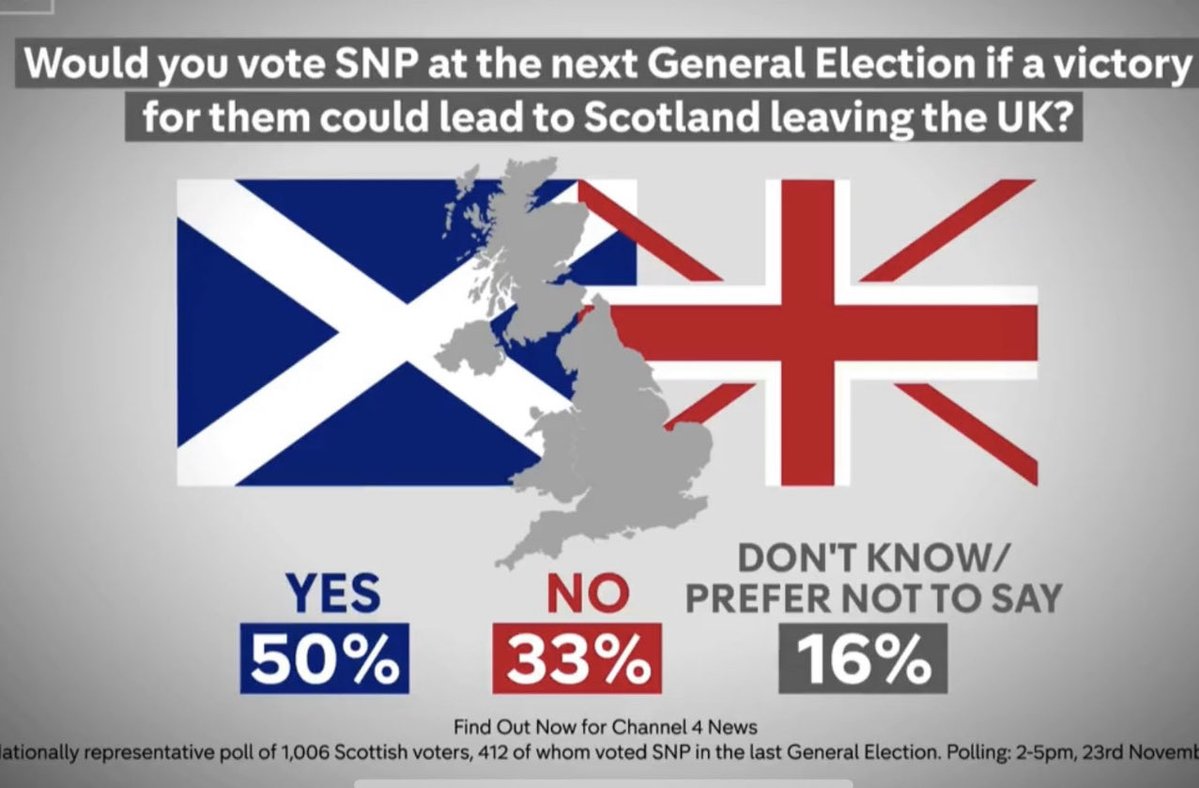
Nicola Sturgeon responded rapidly to the Supreme Court decision, doubling down on her June announcement of turning the next general election into a quasi-referendum, with a special SNP conference for (presumably early) next year to decide exactly what that means. Meanwhile, a Channel 4 news poll, on the afternoon of the decision, found 50% would vote for the SNP at the election if it was a vote for independence with 33% against and 16% don’t knows. That’s striking and it’s not in line with recent polls that hover around the 50:50 mark, so upcoming polls will be closely watched.
Beauty and the Beast: election as quasi-referendum
The beauty of the general election as quasi-referendum is that no-one can stop you – not the opposition parties in Scotland, not the UK government, not the Supreme Court. If that’s what your manifesto is going to say, that’s up to you.
The word ‘quasi’ here is doing a lot of work. What will the SNP or other parts of the independence movement say that means, what will voters decide it means, the media and the opposition? And what will observers, not least in the EU, think it means when they’ve been told repeatedly by the Scottish government that any move to independence will be legally and constitutionally sound.
The SNP has not, of course, suddenly decided it’s in the business of a unilateral declaration of independence. The election as quasi-referendum is a political strategy. How it’s meant to work is an open question. Will a 50.01% vote for pro-independence parties at the general election mean the SNP demands the opening of independence talks with the new UK government? Or would it demand another referendum since there is a demonstrated, democratic majority for independence?
The political clout of the result, if over 50%, will be higher, the bigger the majority. And if it’s under 50%, say 49.99%, the pro-union parties will say: ‘well see, there isn’t a majority for independence’. And the SNP will not have an obvious immediate strategy with which to respond to that. Still, nor is it obvious, despite the fears of many on the independence side, that a 49.9% for independence result means that independence is over for decades (as in the Quebec example). If, a few years later, there was sustained 60% support for independence is that really going to have no political traction?
Overall, in a voluntary union, where the exit door is shut for an indeterminate length of time, presenting an election as campaign for independence has a lot to recommend it: a quasi-referendum for a quasi-voluntary union.
But it’s also risky. And so, within hours of the Supreme Court decision, some in the independence movement were debating if it shouldn’t be the next Scottish parliament election, with its wider franchise (over-16s and EU citizens) that should be the quasi-referendum (with possible ways to provoke an early Holyrood election also under discussion). Others were debating whether, instead of the special SNP conference called by Sturgeon, there should be some form of Scottish constitutional convention, ensuring wider participation across the independence movement not just top down control – a good idea, but also thorny not least in terms of the very small but determined to be loud presence of Alex Salmond’s tiny Alba party. An election as quasi-referendum, with Westminster seats being contested, is not as easy to run as a grassroots campaign as the 2014 referendum was. There is much to consider.
Opposition parties inevitably, as is their right, insist that they will fight the election on UK domestic issues, especially the cost of living crisis while also underlining that votes at an election can be for a range of reasons and that interpreting a majority for the SNP (and Greens and perhaps Alba) would not be easy. That’s called getting your excuses in early. And is rather forgetting that a lot of people voted for Brexit in response to the Tory government’s imposition of austerity as much as for any urgent wish to leave the EU.
Ideas or process?
One of the striking things about the first couple of days of reaction to the Supreme Court judgement is the rapid, intense focus on the dynamics of the process of the quasi-referendum. It’s already created a sense of momentum that has been almost entirely absent from the three policy papers that the Scottish government has published since the summer, starting to set out their case for independence (several papers rather than one white paper as the goal).
There’s a warning in that. The political goal in getting to a really significant, high impact, shift-the-dial, pro-independence result at an election is surely to get support up to 55%-60% and keep it there (not impossible: independence was polling at those levels in the second half of 2020). But those levels of support are not likely to come in response to the SNP, and independence movement, either debating process or simply banging the absence of democracy drum.
Sustained support for independence means having, and communicating, a serious, dynamic, comprehensive and understandable case for independence – the benefits it will bring, the ways of dealing with the costs that will be there too in transition. Yet the Scottish government’s recent approach (hardly ‘strategy’) of publishing three policy papers, including on the economic case for independence, but then choosing not to follow up with a whole range of speeches and events using all their politicians and supporters, online debates, media articles and more, is a strange one. It may betoken lack of confidence in the arguments, a fear of headlines on the border or the euro or a Scottish currency devaluing against the British pound.
But this quiet, inactive approach may also be deliberate as well as fearful. Does the SNP really look at an independence referendum or quasi-referendum just as it looks at elections i.e. a 6 week campaign, energise the public, don’t get into too much detail, and fingers crossed? It seems it may do. And yet, building political momentum for independence both to take support substantially over 50% and to pressurise the UK government, and to make independence itself successful, surely needs the Scottish public to swing decisively towards it in a sustained way.
This is not to argue for introducing new thresholds for independence in any future referendum, should one be allowed. It’s about creating a genuine, engaged, energised, clear will (that “settled will”) of the Scottish people – and avoiding a divided Brexit-type outcome.
And while there’s much, inevitably, to criticise, in the Scottish government’s papers, there’s plenty to applaud too. A democratic, independent Scotland in the EU, with an economy that is green and sustainable, not least through its competitiveness in renewables, a society that chooses a tripartite – government, unions, business – approach to its economic strategy, has a persuasive ring to it. And it’s an approach that is not going to be proposed in any similar way in the UK by Tories or Labour. But it’s not been picked up and promoted by the SNP – the paper is published, then left virtually on the shelf.
An Opposition of denial
Even so, what is clear, for now, is that the discussion and debate is on the independence side. Labour and Tories both want to avoid the debate and avoid a vote. They both support/accept Brexit. They are both focused on England. And they both think they can continue to get away with a nod to the idea of a voluntary union while refusing to discuss what the route to ending the union could be.
This is surely living on borrowed time. The independence debate is not going away. And polls show sustained majorities for independence in the under-50s. The continued, sneering dismissal of those who think independence can deliver Scotland a better future is a shabby and self-defeating politics (not least from those who once campaigned against Brexit but now are contemptuous of the entirely reasonable idea of rejoining the EU whether as the UK or as an independent Scotland).
Scotland, the Supreme Court says, cannot have a referendum without Westminster’s approval. But what the SNP, and others, put in their election manifestos is up to them. We’re on a path to a quasi-referendum. And Scotland will have its say.
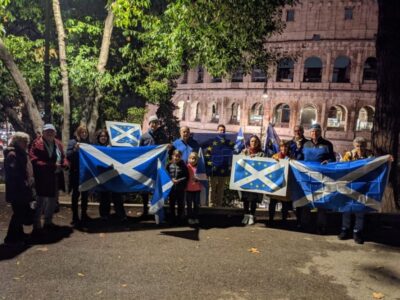
Featured image of Rome demo on evening of UK Supreme Court ruling on Scottish independence referendum via Europe for Scotland
Leave a Reply to Fay Young Cancel reply