
It could be said that in combating COVID-19 we microbiologists have not covered ourselves in glory. A big failing is that we haven’t jumped up and down vigorously enough in response to policy errors.
A sensitive and specific test – in other words a very good test – for the virus in the nose and throat (RT-PCR) was developed during the second week of January. It used technology that was already being employed in many NHS microbiology labs as well as many biomedical research labs throughout Scotland.
But we didn’t agitate enough about its rapid implementation for COVID-19 in these labs, or publicly reinforce strongly enough the WHO Director-General’s March 16 message of test, test, test. Or shout loudly enough when the then Chief Medical Officer announced on 2 April the abandonment of contact tracing, a system that we have successfully used to investigate and control outbreaks of infection ever since microbiology developed as a scientific discipline 150 years ago. Or refute with enough vigour her incorrect statement on that day that testing was only going to be positive when there were symptoms. Neither did we agitate enough to get the prevent, prevent, prevent, message across for care homes by insisting that all residents and staff going into them were virus-free; as microbiologists our experience over decades of influenza and E.coli O157 (commoner in Scotland than anywhere else in the world) in them has been that once the pathogens enter, outbreaks and mortality commonly follow.
It seems certain that there will be a public inquiry into the COVID catastrophe. Counsel to the inquiry will probe policy errors with forensic exactitude. But we microbiologists will have at least two excuses for our failings as a discipline. It is the diminution in our influence, and in our numbers, in recent decades. It is as though the much-quoted words allegedly said in the 1960s by a former US Surgeon General, William Stewart – “It is time to close the books on infectious diseases and declare the war on pestilence won” – were actually said, believed, and acted on. But he never uttered them. He said the opposite. Fake news, indeed. Nevertheless, there are many fewer of us now than in the past, and our habitats, laboratories, are diminished in number too.
Lab rat(s)
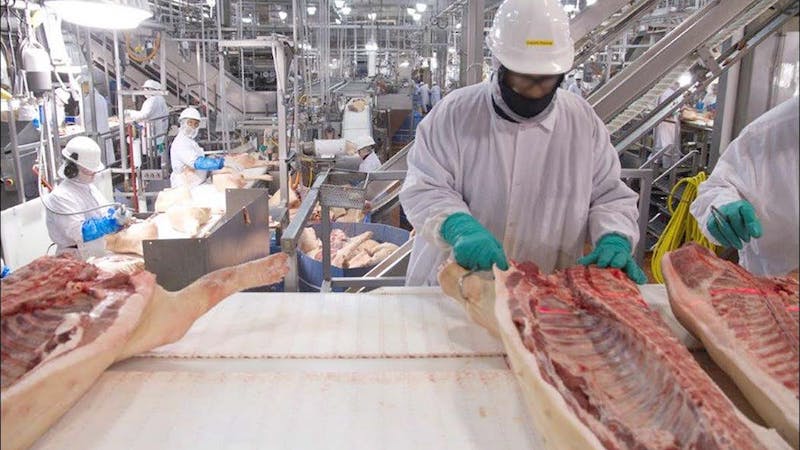
Certain occupations are high risk for contracting COVID-19 infections. As we discovered again this week at Millers of Speyside abattoir in Grantown. They have indeed occurred very commonly in meat plant workers who spread the virus to each other either in the cold working environment or in cramped living conditions, or both; many are migrant workers. The recent outbreak at the 2 Sisters Coupar Angus poultry plant means that Scotland has joined Wales, Ireland, Germany, the US and other countries in this regard.
Other microbes have also been associated with food processing. John Smith ran the City Laboratory in Aberdeen. His work on fish gutters and filleters in the 1930s is a microbiological classic. They caught leptospirosis, a bacterial infection mild in most but with measurable mortality in older workers, just like COVID-19, and, like that virus, having a gender bias, being significantly more lethal to men. The fish house workers (fortunately for them mostly local quines in their late teens and early twenties) contracted it from bacteria in slimy working surfaces contaminated with rat urine. Rats carry the organism in their kidneys. Smith told the fish house owners how to remedy the problem. They acted. The infections stopped.
But the excellence of work done at the laboratory did not prevent its closure in 1991, after a process called by managers “laboratory rationalisation”. We called it “lab rat”, and a very mild colleague called the negotiations “mangling meetings”.
In the mid-1990s I chaired a group that tried to prevent the closure of another laboratory in Aberdeen, the Torry Research Station, that worked on fish microbiology and preservation. For years its microbiology lab was run by James Shewan, held in such high regard internationally that a bacterial genus is named after him, Shewanella. But we failed.
Lest it be thought that only microbiologists in Scotland might have to defend themselves when the time comes, the dismemberment of Public Health England indicates that scapegoating south of the border is under way, and President Trump has already mounted massive attacks on the budget of the Centers for Disease Control and Prevention in Atlanta.
Image of pork processing plant via Wikimedia Commons
.jpg)
Leave a Reply