

Language is not neutral. Words convey meaning and prisms through which meaning is established. But words can also be prisons. And few terms confine us more than sovereignty.
Its origins are instructive. Like much political theory, sovereignty has roots in theology. The Sovereign was the Jealous One, the Indivisible, the Unlimited, the All Powerful in perpetuity. It is hardly surprising that this understanding of the deity would translate into politics. Monarchs saw themselves as sovereigns bounded only by territory, insisting that sovereign rule should not be challenged. It was unlimited, undivided, unaccountable. Over time, sovereignty passed from the monarch to the people in many places. It was still a fiction but a useful fiction.
Lacking a political crisis or rupture that might have democratised sovereignty, the UK ‘modernised’ monarchical rule with the oxymoron of the Crown in Parliament. But what happens when the Crown and Parliament disagree? We can be grateful to Boris Johnston for highlighting that possibility even in today’s politics.
There have, of course, been other attempts to ‘modernise’ sovereignty. Post-sovereignty essentially retains the term but abandons its meaning. As Don Herzog in his new book Sovereignty RIP notes:
It might sound logically confounding to say that sovereignty is unlimited, undivided, and unaccountable authority, and then talk about campaigns to limit it, divide it, and hold it accountable. It would perhaps be clearer to think of sovereignty as a theory of state authority and then talk about limiting, dividing, and holding accountable state authority. But what can I do? That’s overwhelmingly not the way my sources talk and I am cheerfully at their mercy.
Needless to say, better to abandon the meaning and retain the word but better still abandon the idea altogether. But, as Herzog notes, ‘subjects and others must not peek behind the curtain. Instead they must be dazzled by the image on the screen.’
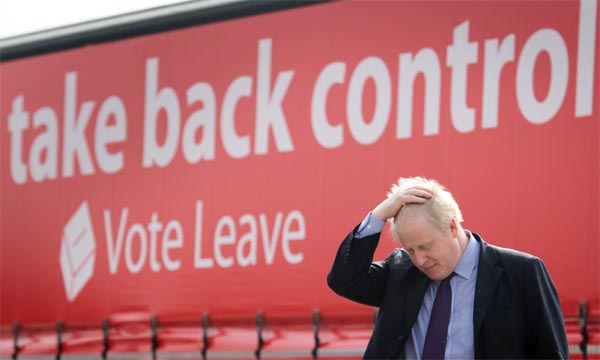
This is not to dismiss the power of the sovereignty myth. The idea can and has mobilised people. ‘Take back control’ is one of the most potent. This is sovereignty at its most pernicious.
Sovereignty and binary traps
Sovereignty traps us into thinking that constitutional power must be indivisible and unlimited, if not unaccountable. Enoch Powell, the late twentieth century high priest of sovereignty, saw threats to Parliamentary sovereignty coming from sources he opposed – devolution and the European Community. Powell found it ‘very reassuring’ during debates in the 1970s ‘to find that the House of Commons still has its old sense of its jealous, exclusive, overall, omnicompetent jurisdiction and sovereignty in the United Kingdom.’

Powell was resurrecting Dicey’s arguments against Irish home rule from the previous century. For Dicey, Parliamentary sovereignty was the ‘dominant characteristic of our political institutions’ and therefore the choice was binary. Ireland could be an independent state but it could not have home rule. Powell’s argument was based on a simple premiss: sovereignty was indivisible and unlimited in perpetuity. Devolution and European Community membership were incompatible with Parliamentary sovereignty. The argument was logical so long as the premiss was accepted. By accepting the sovereignty premiss, as many have done, makes it difficult to imagine shared power.
But Dicey and Powell were inconsistent sovereigntists. Both supported a referendum when it suited. So too their disciplines today. Brexiteers invoke Parliamentary sovereignty when it suits but not when they fear Parliament might overrule the results of the 2016 referendum.
It is time to take the old biblical exhortation seriously, Render unto Caesar the things that are Caesar’s, and unto God the things that are God’s (Matthew 22:21). We should render sovereignty unto God and find more appropriate earthly language and ideas.
Back in the real world
There is far better language to conduct constitutional debate and there are few better conceptual tools than power, albeit it is a highly contested idea. The notion that power cannot be shared or that there is an ultimate resting place of power is easily disproved. But first it is important to note that what sovereigntists are really referring to is only one form of power – legal constitutional power. The weakness of the sovereigntist position is not only that it is based on a fable but that it misses so much.
Economic interdependence can enhance autonomy, welfare and indeed state power. The UK has devolved government but that has addressed only part of the problem. Stein Rokkan, the great Norwegian political scientist (frequently quoted but sadly rarely read), defined ‘centres’ as ‘privileged locations within territory’ and noted that such privileged locations might be political, economic, cultural and military. Not only do polities need to address devolving constitutional/political power but they need to consider other privileged locations of power. The political/constitutional focus is understandable but much constitutional debate has neglected the concentration of economic power in these islands. There is a strand of Scottish nationalism, currently in the ascendancy, that seems at ease with the concentration of economic power. It may imagine that becoming a ‘sovereign state’ will magically shift economic power northwards. Constitutional independence would be no guarantee that this would change.
There are other sources of constitutional power including economic power. The notion that a ‘sovereign state’ has unlimited, undivided, and unaccountable power is at best absurd, at worst dangerous. A polity may have abundant sovereignty but this does not translate into power.
We also know that power can be divided. It is not difficult to imagine what this might look like – not least as there are ample examples from history and in our own time. And it need not be a choice between different variants of federalism or for a confederal arrangement. Some hybrid arrangement is not only conceivable but almost unavoidable. Even the constitutionally weak institutions may have considerable power. Local government power has been eroded and, from a sovereigntist perspective, could even be abolished altogether. But try delivering public services with only a central government. It cannot be done. Central government is dependent on local authorities to a far greater degree than is often appreciated. This dependence is a form of power.
World of possibilities
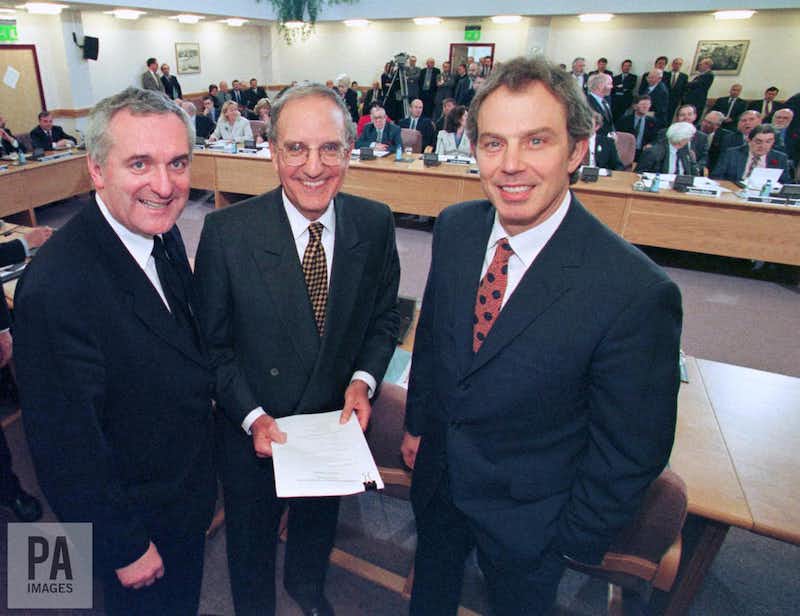
Endless possibilities open up when sovereignty is buried. The Good Friday Agreement (GFA) where binary sovereignty claims had been dominant involves a remarkable hybrid with (quasi-)federal, confederal and consociational elements:
- The creation of the Northern Ireland Assembly and Executive based on power-sharing
- North-South relations involving a voice for the Republic, a foreign state, in the affairs of Northern Ireland
- East-West relations bringing together ‘these islands’ in fora to cooperate on common interests.
It would challenge the most devout sovereigntist to explain the ‘interlocking and interdependent’ GFA. While it would be inappropriate to ‘lift and paste’ elsewhere in the UK, it undermines any notion that power or authority must be unlimited, undivided, unaccountable. The GFA is an example of the ‘art of the possible’ turning that dreary, conservative phrase into something imaginative and inspirational.
And there are other examples to draw inspiration from. Consider the relations between Greenland or the Faroes, Denmark and the European Union. Denmark is part of the European Economic Area and in the Single European Market but Greenland and the Faroes are not despite intimate relationships with Denmark. In discussing Scotland’s relations with the EU, the Scottish Government referred to the ‘range of asymmetric and differentiated arrangements within the EU and single market framework’ but it seems incapable of imagining something similar within the UK. Consider also the status of the Isle of Man and the Channel Islands which again highlight the diversities of relationships within these islands, even though few would see these as directly appropriate for Scotland.
Lumping together ‘sovereign states’ as if one uniform, undifferentiated and unexamined group is absurd. The attributes that provide relative levels of autonomy include much more than legal status. But beyond such states, there are various other polities conjuring up an array of possibilities.
The EU, of course, makes a mockery of sovereignty. It might be argued that Brexit is evidence of its enduring relevance. But what it really shows is the pernicious legacy of the myth. The UK is losing control of its affairs. The hope that a second Trump Administration would ensure a good trade deal with the US has been shattered but even had this happened it spoke of the UK as limited and accountable, more as the 51st state than having ‘taken back control’.
When we start to consider relations between different polities and abandon make-believe we start to appreciate that it is possible to enhance autonomy in different ways. The variety of variables, not least complex economic relations, mean that it is possible to have greater autonomy with less ‘sovereignty’. In other words, real autonomy does not always require constitutional independence and certainly does not require autarky and seeking to be self-sufficient.
These matters are discussed at length in Prof Mitchell’s Jimmy Reid Foundation pamphlet, ‘The Scottish Question Revisited’, available here
Image of Enoch Powell by Allen Warren via Wikimedia Commons CC BY-SA 3.0;

Leave a Reply to Peter Ashby Cancel reply