
Scottish politics is stuck in a constitutional rut in which issues are viewed through a narrow independence/union prism.
Relations between London and Edinburgh are assumed to be part of the constitutional battle ground, leaving little room for serious policy debate. We have become obsessed with whether devolved policies diverge or converge with those south of the border and/or whether policies are designed to undermine or sustain the union and have lost sight of some basic policy making questions and issues.
COVID-19 has proved a test of decision making at all levels and, crucially, the interaction of decision makers in the face of the most significant crisis since the establishment of devolution in 1999. But it also highlights the role of the wider community involved in making policy. The interaction between specialists, evidence and decision makers needs to be unpacked and lessons learned.
Niagara of information and advice
Politicians, the formal key decision makers, are not expert in pandemics. They rely on others for advice and guidance. The relationship between experts, advisors and politicians requires at least as much scrutiny as that between Edinburgh and London. Leadership today is challenging: information flows rapidly and demands for immediate responses are high. Fred Greenstein, the late leading scholar of political leadership, six key skills required.
Fred Greenstein’s list of leadership qualities
∙ Communication skills: getting message across
∙ Organizational capacity: harnessing vast machinery of govt
∙ Political skill: leading within dispersed, divided democratic institutions
∙ Policy vision: articulation of beliefs and ideals
∙ Cognitive style: processing information and advice to form beliefs and decisions
∙ Emotional intelligence: engagement with other people
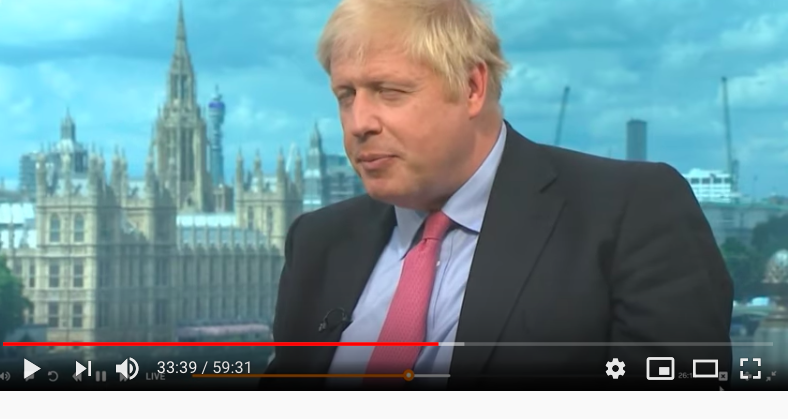
Greenstein noted that politicians should be able to process the ‘Niagara of advice and information’ that comes their way. Cognitive style – the way in which a leader processes information and advice to form beliefs and decisions – is crucial. What has become ever clearer during this crisis is that Prime Minister Johnson lacks skills (or interest) in this part of the job. Despite her claim to being a conviction politician, Margaret Thatcher combined her convictions with engagement with copious amounts of detailed information. Politicians tend to come to office with a very narrow band of expertise and experiences but a skill which has become of paramount importance is communication. Lacking clear convictions and with little appetite for hard work, Boris Johnson’s communication skills – such as they are – also failed to fill the gap left by his cognitive style. His (temporary) departure from the scene may have saved his premiership.
Nicola Sturgeon, in contrast, has exceptional communication skills, a capacity for hard work and is almost invariably on top of her brief. However, she prefers to surround herself with acolytes. This speaks of an insecurity hidden by her formidable communication skills. She does not like or tolerate dissent and her party has become more centrally controlled than at any time in its history. This is also how she runs government. This creates problems in policy vision and the political skills required to deal with the variety of views she needs to take into account that became evident during this crisis.
Questions need to be asked about the flow of information to the First Minister, especially in the early weeks of the crisis. The issue was not that she did not listen to or process information from specialist advisers but this raises questions about the information she was receiving. Nicola Sturgeon is a very cautious politician, all the more remarkable given her party’s radical constitutional platform. This innate caution may explain why the Scottish Government followed UK policy in the early days (despite evidence from outside the UK of alternative paths). It may reflect a fear that following a different path would have provoked the knee-jerk reaction that has become all too familiar, focused on the constitutional lens, in the rut in which Scottish politics has landed.
But accepting that the First Minister was simply following advice then serious questions need to be asked about what Greenstein referred to as organizational capacity. Did the Scottish Government have sufficient expertise to draw on, the capacity and indeed confidence to consider a wider range of expert advice or did it feel it had no choice but to fall back on the advice of London?
Evidence and knowledge
Recent years have witnessed some bizarre claims and assumptions about evidence and knowledge in policy making. Evidence-based public policy became a watchword though this often assumed that perfect evidence existed. Part of the challenge in the early days of the spread of COVID-19 was not so much the lack of evidence but the plurality of expert opinion. The question was which advice should be followed and whether a range of expert advice was provided, whether the cognitive skills of leadership matched the organizational capacity for governing. It should be stressed that this is not easy.
Many will alight on warnings from Richard Horton, Lancet editor, as someone who ought to have been heeded. Horton was early in identifying a potential pandemic. He published a paper on January 24 reporting on a recent cluster of pneumonia cases in Wuhan caused by a novel virus (then referred to as 2019-nCOV). He has since become a vocal critic of UK Government policy. But it is worth remembering that Horton had a major credibility problem. He might easily have been dismissed like the little boy who cried wolf. His reputation had been damaged when he published a paper by Andrew Wakefield, later discredited and struck off the UK medical register, back in 1998 which falsely purported to show a link between the MMR vaccine and autism. Horton’s association with the MMR publication was not dishonest, only mistaken but had significant negative consequences. It is too easy, too comfortable to say that his voice ought to have been inside government.
We should be examining the role of expert advice and acknowledging that a variety of interpretations of evidence will often exist. Evidence is political, often plural, partial, contested and contradictory. The organisational capacity of government needs to reflect this and our leaders need to have cognitive skills to address this.
Politicians and advisers
What is unclear is whether alternative voices were ignored, excluded or simply not heard. More important is what we need to learn from this while taking account of the old legal adage that hard cases make bad law or, to mix metaphors, avoid throwing the baby out with the bathwater. This takes us back to the contested nature of evidence. Who should have a seat at the advisory table? And how should advice be processed, or filtered, to politicians who have to make the final decisions?
In a crisis, it is not surprising that leaders will follow advice that appears to be uniform and sourced by established experts. This is no excuse for passing the buck but COVID-19 raises crucial questions about advice and advisers. Networks of knowledge-based experts exist at international, state and sub-state levels in the field of health as other areas. It would be odd to expect that these experts would agree on everything. This adds to the challenge for politicians but that is why Greenstein’s appropriate cognitive style in leadership is vital. Cognitive style and emotional intelligence – an ability to empathise as much as criticise – is also essential in the scrutiny provided by opposition politicians, backbenchers, parliamentary committees and the like which has, frankly, been poor during this crisis.
Whenever something goes wrong, we always look to attribute blame. Blame should be apportioned appropriately but we also need to learn and that requires openness. Blame games close down honesty, make people hide things as well as themselves. What we require, but is in danger of being lost as crass party and constitutional politics kick in, is a willingness to be open and reflective.
Not everything is about the constitution. We need to find a way out of the lazy constitutional rut Scottish politics has descended into. This is not to suggest that the constitutional question or relations between London and Edinburgh are unimportant, only that there are other ways of looking at politics and policy. Even in the midst of this crisis, this needs to be a learning exercise and not only when we look back and seek to learn lessons retrospectively.
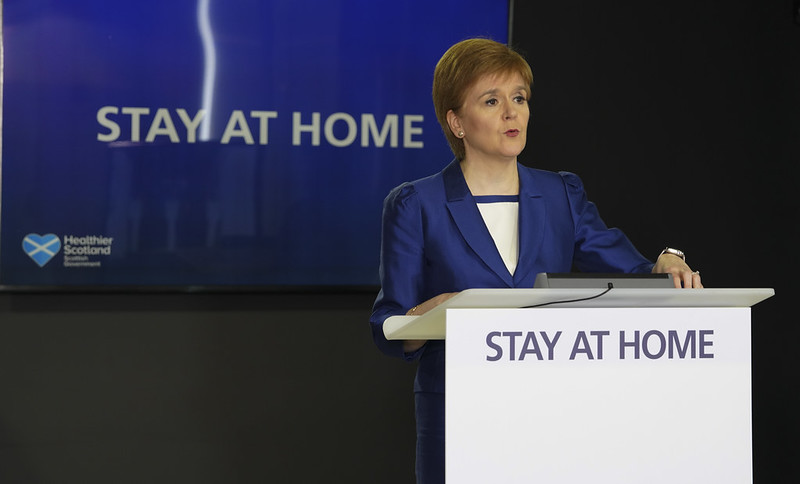
Main image: Nicola Sturgeon First Minister daily briefing 11 May via Scottish Government flickr CC BY-NC 2.0
Further reading: A four-nation exit strategy, Institute for Government, 6 May; Why have the UK’s governments diverged on easing lockdown, Centre on Constitutional Change, 11 May; Spurring the cause of a united Ireland, Una Mulally, The Guardian, 2 May
Leave a Reply