

Music Education is having a bad time of it. In some counties it has all but disappeared from primary schools. A crisis can bring an opportunity.
At times like this something valuable and innovative can happen. It can be a time to take stock and reimagine what music education could look like in the 21st century. The music industry contributes greatly to the British economy. Not only in terms of GDP, but also in terms of GNH (Gross National Happiness,) so it is vital in many ways. What the musical education could be for the musicians and people of tomorrow can be revisioned in this time of uncertainty.
Music education can sometimes seem like the last bastion of Victorianism. Or a free form sound experiment exploring momentary creativity, but garnering no lasting skills. I propose a total rethink. Here are my humble suggestions, five principles for music education which could benefit everyone:
Is it fun?
Music is not just about skill or technique – it is joy, feeling and spirit expressed in a way that we can all relate to. It also symbolises “culture”. The very first maxim of music education should be: ‘Is this a joyful or growing experience? Are the children engaged and actively exploring in some way?’ The creation of joy needs to be the very first learning objective and this creates a ground base upon which everything else can grow.
Summation One: is learning an enjoyable experience?
Create the right environment
The second maxim is, again, not directly related to music. It’s all about rapport. Do the children have a good, trusting, and warm relationship with their teacher? A child able to explore creativity and be a risk taker needs to feel lovingly held, safe and above all, not judged or scared of making a mistake. Steiner, in the early part of the twentieth century, created a unique person centred and holistic education. One of his repeated concerns was: ‘That the child should feel “loved” by the teacher.’ Today, we would perhaps say ‘be held with deep and positive regard’, but the meaning would be the same.
Music is a place where the soul meets the intellect and our creative interpretation melds with that of others. It is therefore a matter of conscious importance that the music teacher creates warmth, confidence, love and patience as a feeling backdrop in the learning environment.
Summation Two: the teacher needs to create a learning environment that has kindness, patience and acceptance as its modus operandi.
Children learn through play…not practice
We need to consider how children learn. Understanding age related brain development is crucial to how we structure a music curriculum. Learning musicality and musicianship needs the same level of care and graduated approach as learning to read. Music is a highly complex art form. It needs careful, gradual and progressive teaching which responds to the stages of brain development. Expecting a young child, for instance, to learn piano or violin and also practice is often a recipe for failure. Or, at very least, lack of enjoyment. (Practice is a concept that does not sit well with children – they learn through play. Practice should be banned until they reach for it naturally!)
The Hungarian composer Zoltán Kodály was a musical educationalist who studied how we learn. In the mid-20th century, he created a highly social and integrated music curriculum which fits the development phases of the growing mind. Our music curriculum therefore needs to be progressive in a gentle spiral way revisiting topics with increasing sophistication.
Music making should grow and flow gradually, from concrete physical-based learning to eventual intellectual abstract learning. Diving into head based learning is often off-putting and difficult for a child who is not yet ready for that experience. Music is a bit like a jigsaw puzzle – there are many parts: pitch, pulse, rhythm, note reading, solfege (or solfa), inner hearing, harmony, composition. Each part can be considered at first in isolation and then slowly merged to create a more complex picture. Visual, auditory and kinaesthetic methods mean that all learning styles are catered for. (Kodaly and Dalcroze are two such educators whose work can be drawn on to create a musically progressive yet child centred learning scheme.)
The voice – and the use of our own bodies – is all we need until a natural musicality has been absorbed. (Cheaper too!) Only then is it appropriate to introduce instruments.
The recorder is an excellent first instrument. It can work as an extension of the child’s breath, it is small, easy to use, and can be seen by the child using it. Secondary instruments can later be chosen to suit that particular child.
Summation Three: a progressive, carefully graded child centred curriculum needs to be adopted so learning is ensured for all.
Allow time and space for listening
It is not surprising that music is often considered to run in families. There is no magic to this. A child with musical parents is exposed to music like a language, a “sound surround” which is naturally absorbed to become just a part of itself.
Creating a curriculum that also allows space and time for listening would encourage the development of musicality by osmosis. This could also allow for cultural and musical diversity.
Children could listen to Indian ragas, lute fantasias, the drummers of Burundi, alongside pop songs, jazz and orchestral works. Different things may well suit different ages or moods and other lessons such as art or creative writing, or even maths could be utilised as a time when this learning by listening could take place.
Summation Four: extensive listening encourages a deeper learning which creates musicality and later creativity.
Meet the wider world of working musicians
Schools could hold frequent residencies for different genres of working musicians/people in the music industry to come in to schools, work with the children and also give them access to live performance. In this way creativity, inspiration and diversity is encouraged. Children could also get to see what it is like working within the music industry and try developing their own performing, mixing, producing skills as they gain in age and experience.
It might possibly help children who are disaffected or have difficulties with more academic subjects. It would also be valuable and enriching work for the musicians and music industry professionals themselves.
Summation Five: residencies would allow a valuable interface between schools and the music industry, increasing knowledge, skills and motivation.
Joy of learning
Overall, if this loose model was implemented then primary music education would take the child from “ground zero” to musical independence where they could confidently make music, read music, sing in pitch, understand the basis of musicianship, sight read, sing rounds and duets, improvise a little through voice and the recorder. They would have an active, joyful appreciation, knowledge and love of music.
Their “soft skills” of confidence, language expression, speaking and listening skills, concentration, teamwork, solo work, problem solving and creativity would all be enhanced. Their joy of learning would naturally spill into other subjects and behaviour and motivation would also improve. A happy, learning child is too absorbed and enjoying its achievements to be disaffected and unmotivated.
Let’s bring in an intelligent modern, child centred and diverse music education for the betterment of all subjects and all children.
This is the first of four articles on music education. In Part Two Abi Rooley-Towle looks more closely at music education in early years and primary school.
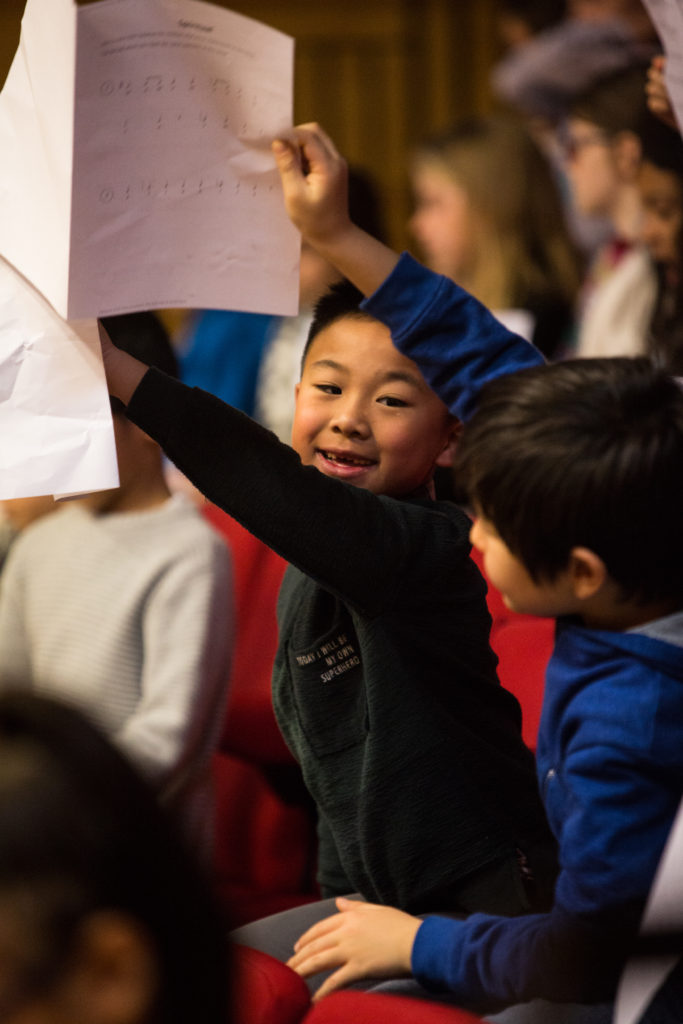
Featured image: Juniors of Royal Conservatoire Scotland. Photo Robert McFadzean courtesy RCS
Leave a Reply