

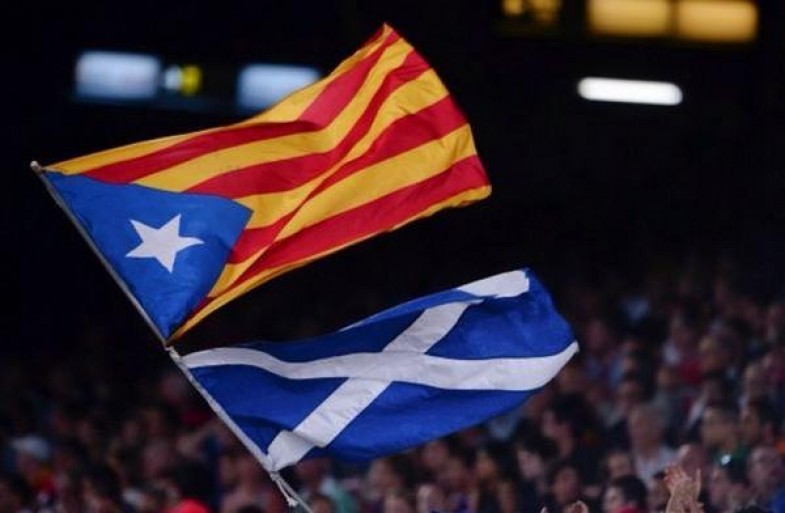
I was in the Scottish capital Edinburgh, an elegant, relaxed , welcoming world heritage city, earlier this week and was struck by the peacefulness and civility of Scotland’s devolutionary process compared to the shambles that has come to characterize the Catalan issue in Spain.
In the impressively located and historic Edinburgh Castle, one of Scotland’s most popular tourist attractions, there endures a sense of cultural identity that is both British and Scots.
Visiting it I was reminded of the “Better Together” slogan which unionists used successfully to win the ‘no’ vote in the (legal) 2014 referendum on Scottish independence .
Fresh tensions between the governing Scottish National Party and the central government’s ruling British Conservative have been sown by the UK’s majority vote in favor of Brexit.
But Scottish nationalist demands remain conducted within the law and channeled through political discourse and negotiation , not characterised by civil disobedience, unilateralism and repression..
Multi-faceted identity
While the figures of two of Scotland’s most famous national heroes and once outlawed rebels ,William Wallace and Robert Bruce, straddle the entrance to Edinburgh Castle, (even though neither actually ever lived there), huge reverence is also given to the more recent memory of Scottish soldiers in Royal regiments who died for King and country in two World Wars.
Again I couldn’t help reflecting on how at the root of Catalan and Spain’s problems is the absence of a consensual, shared and binding historical narrative and how distant seem Scotland’s wars with England compared to the opening in Catalonia of old wounds and prejudices from the Spanish Civil war and Francoism..
In Edinburgh, our guide spoke English with a distinctive Scottish accent ( in Scotland unlike Catalonia where a majority speak Catalan, only a small minority of Scots – less than 2 per cent of the population – speak Gaelic. ) .
He was nonetheless showing his distinct Scottish roots dressed in a kilt and showing a mischievous glint in his eye as he gave us graphic accounts of the violence Scots used on the English and vice-versa in past battles for the Castle dating back to medieval times. .
Present-day political reality remains defined by the ‘no’ result of a referendum on independence, the terms of which were democratically and peacefully discussed and agreed to by the British prime minister David Cameron and the then SNP leader and First Minister Alex Salmond.
The Scots, who voted by a majority to remain inside the EU, now are uneasy with Brexit but they are not pushing for another independence referendum as yet nor is London in a hurry to grant them the privilege.
Shared narratives
Meanwhile a consensual historical narrative is to be found in the Royal Palace within Edinburgh Castle where lies the Stone of Destiny. Lest we forget, before the mythical stone’s return to its natural resting place, this ancient symbol of Scottish national identity was taken by King Edward Ist of England and built into his own throne, much to the fury of Scots.
From then onwards it was used in the coronation ceremonies for the monarchs of England and Great Britain. But in 1996 Queen Elizabeth, as an act of reconciliation, agreed to have the Stone returned to Scotland, with the agreement that it be temporarily returned to London to be used when crowning her successor.
For now Queen Elizabeth, thanks to this and other gestures of friendship, remains a highly respected figure in Scotland across a broad spectrum of political opinion as in England, in contrast to the challenge Spain’s King Felipe is facing in winning the respect and loyalty of pro-independence Republican Catalans who want nothing to do with a Bourbon monarchy.
Not to say that the Scots have not had to be won over to their current accommodation with the British state. On her coronation in 1952, there were Scots who objected to her being crowned Elizabeth II as no Elizabeth before her had ruled as Queen of the Scots. If many Scots retain a certain ambivalence towards the British monarchy, they have not rebelled against it nor do they have any plans to declare any unilateral declaration of independence. The monarchy was not an issue in Scotland’s lawful referendum despite the Scottish Nationalist Party (SNP) having many supporters in favour of a Republic, particularly among working class Catholics.
The SNP’s current policy is that the Queen would remain head of state in an independent Scotland although she would be probably be called Queen of the Scots to underline the idea that sovereignty belongs to the Scottish people. Significantly, the singing of the Burns ode to brotherhood counted on the agreement of the Queen, and took place at her inauguration of the Scottish Parliament in 1999.
No pomp and circumstance
“The great thing about not having a written constitution is that we muddle along, we compromise and adapt,” a friend in Scotland, the journalist Robert Powell told me. In other words political give and take and statesmanship are what matters in a decent democracy.
Together Robert and I visited the new Scottish Parliament building . It was designed as a democratic “space open to ideas and growing out of the land”, by the Catalan Enric Miralles who died of a brain tumor in 2000 four years before the inauguration of his masterpiece.
Constructed from a mixture of steel, oak, and granite, and drawing its inspiration from the local landscape and upturned boats of Scotland’s coastline, the complex building was hailed on opening as one of the most innovative designs in Britain.
Although the threat of terrorism has since meant security being stepped up, it is more accessible to the public than the traditional Houses of Parliament in Westminster, its members less stuffy.
The Scottish Parliament was half empty and immersed in a relatively uncontroversial debate over an issue of equal pay when we visited it, in stark contrast to the volatile atmosphere that has characterized the Catalan parliament of late, where pro-independence parties in the regional government have openly defied the Spanish Constitution. The Scots like to see themselves as more egalitarian than the English and nationalists believe they could build a better and more just society were they to become independent.
But there is no hint of insurrection against the British state as some of the more radical elements in Catalonia are demonstrating in their confrontation with Madrid.
The devolved Scottish Parliament is located at the end of the street known as the Royal Mile and next to The Palace of Holyrood where the Queen takes up residence every year, hosting dinners and a garden party as a way of maintaining closer contact with all her subjects.
Quite a lot of pomp and circumstance surrounds Scotland’s Royal presence from kilted military regiments to the Company of Archers (the Queen’s official bodyguard in Scotland,) but the important point is that the British Royal family in its modern phase has developed an important political, cultural and social engagement with the Scottish people which seems to have defused historic antagonisms between London and Scotland rather than inflaming them. For its part the SNP and the UK governments have behaved with a democratic ethos which is struggling to prevail in Catalonia.
This is an abridged/edited version of a blog first published on the author’s site
Main image by byronv2 CC BY-SA 2.0
Leave a Reply