
Celts could be weird and scary. They were mad for the drink and when they had it, you had to watch out for them: they saw things and became aggressive.
They were radge fighters, absolutely mental, they dressed up to go into battle and they played great big war horns so loudly they would scare the living daylights out of you.
And they liked bling, loved it actually: gold, bronze, iron, glass, precious stones. They wore chunky jewellery decorated with abstract patterns and symbols. They were skilled at metalwork, leatherwork, pottery and weaving and if something precious was broken, they would mend it – a bronze flagon with a broken handle would get a different handle, or a hole would be fixed with a decorated patch, and made as good as new – better in fact.
Oh and they loved parties and feasting; the women were great hosts and they were buried with their special pots and flagons, probably so they could use them for a big after-party on the other side.
The treasures assembled in the monumental exhibition of Celtic art which opens at the National Museum of Scotland this week painted, for me, a tremendously vivid picture of the peoples who left these precious things behind, buried in graves, hidden in hordes, stuck in the mud of tidal waterways.
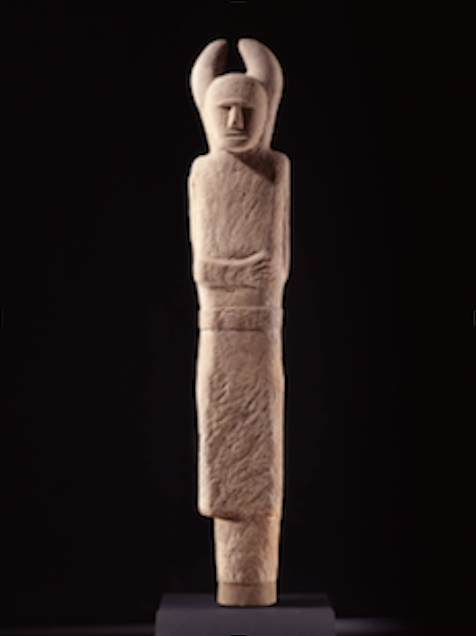
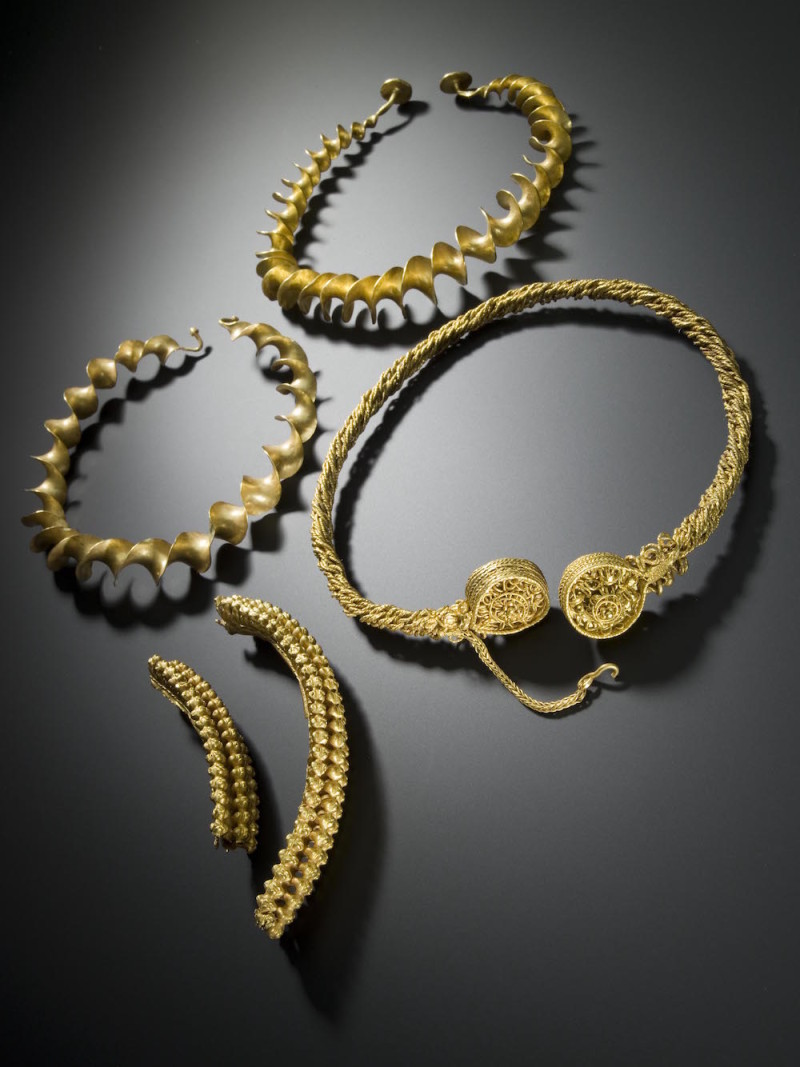
There are pieces from all over Europe here: a marble statue of a naked, hairy Celt from Rome; a life size representation of a grave and well-dressed Celtic warrior from Germany; the complex twisted kilo of gold that is the Snettisham Great Torc; the delicate double helixes of the Blair Drummond torcs. So many important objects: weapons, jewellery, drinking vessels, engraved stones and statues.
The written text of the exhibition – “Celts: Art and Identity” – is careful and academic and almost undercuts the power of the objects with its non-committal scholarship. Who were the Celts? Not sure. Did they even exist? A moot point. What was their importance? A source of cod identity for modern-day nationalists, mainly. What did their writing say? We don’t know. It concludes that the most we can safely say about the Celts is that they are identified with a particular style of art, richly symbolic, decorative, animist, and that the term loosely describes a non-Greek and non-Roman way of being in the ancient world.
History is famously written by the victors and their heirs. Edward Gibbon wrote in his “Decline and Fall of the Roman Empire” that the Romans did not remain in Scotland long because “they found little to detain them.” To the Romans, the tribes of the north were mere barbarians, and Gibbon agreed.
Celtic origins
It was actually the 16th century Scottish historian and philosopher George Buchanan who rediscovered the term Celts, which appears in Roman writings as a word that native tribes called themselves. In the ‘Rerum Scoticarum Historia’ published in 1582, Buchanan drew on place names and classical writings to make the claim that the Scots and Irish were descended from the Celts, a tribe originating in France around Lyons which then travelled through Spain and along the Atlantic coast to Scotland and Ireland.
In later times this gave rise to a division between “Celtomaniacs’ and ‘Celtosceptics’, divided on the interpretations of history, a debate that it is still raging today.
But whichever position the viewer takes, the sheer magic of the extraordinary things – in many cases unimaginably old – is hard to resist. Seeing them all together at once is a rare opportunity.
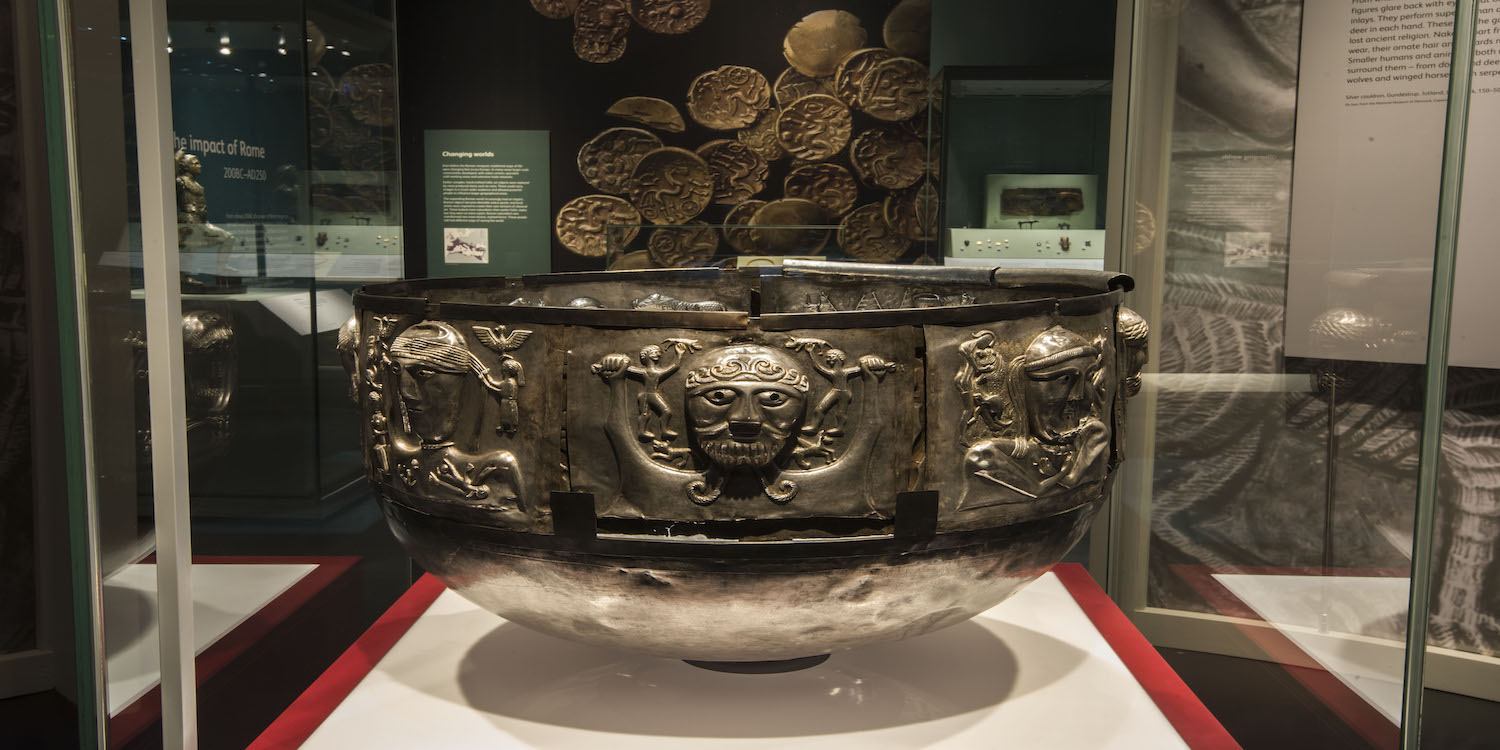
There is the massive silver cauldron discovered in Denmark in 1891, the Gundestrup cauldron dating from 150 to 50 BC, brought from its usual pride of place in Copenhagen’s Nationalmuseet. It is engraved with images of what appear to be jumping female warriors and is an iconic piece of Celtic art.
It is not much of a surprise to find that, according to the exhibition, which was put together by the British Museum and the National Museum of Scotland, modern scholarship agrees that it is almost certainly not Celtic. Probably manufactured in in either Romania or Bulgaria, it is made out of silver which would have been an unusual choice for an Iron Age Celtic object and it is more likely Thracian. (The Thracians were loosely allied to the Trojans and are mentioned in Greek writings). How it got to Denmark is unknown.
Even within the British Isles, provenance and influence are disputed. The Roman invasion created fault lines. Beyond the pale, the Celts flourished but the rest of the country was Romanised to various degrees. But, even for a Roman legion, living in southern Britain was very different from living in Rome and the Roman-commissioned art made in England shows various degrees of Celtic design. The things left behind show that it was a melting pot of shifting influences. Roman mirrors of polished silver bear Celtic symbols; Roman-style finger rings were made in Ireland and Scotland with local motifs and styles.
The exhibition demonstrates that then, as now, people moved fairly freely around Europe and that influences blended and shifted. It is not always easy to say where one group ends and another begins.
In the absence of a written record left by the Celts themselves, their history is opaque. There is an absence of fact or certainty about how they saw themselves or how their society worked, and as far as text goes, we are left with the impression they made on others.
But the opportunity to see in person so many of the awesome objects they created must lead to a richer and deeper understanding of the art and culture of the inhabitants of the non-Classical ancient world, those whom we call the Celts.
Main image: by Phil Wilkinson of the Gundestrup cauldron courtesy of the National Museum of Denmark
Images: the Glauberg Statue, courtesy of Keltenwelt am Glauberg; Blair Drummond torcs courtesy of National Museums of Scotland
Leave a Reply