

Umberto Eco is dead. His body was buried at Milan’s Castello Sforzesco on 24 February 2016.
Eco’s novel about the murder of monks in a 14th century abbey, “The Name of the Rose”, has sold 10m copies so far. The film adaptation starring Sean Connery as its central character, the Franciscan monk William of Baskerville, brought it to places not reached by the book, but wasn’t as good.
Eco said: “Books are not made to be believed, but to be subjected to inquiry”. “The Name” is fiction. But I don’t believe that Baskerville was; Eco leaves too many clues. Baskerville was William of Ockham. Like the fictional character, the real Ockham was English, was a Franciscan, studied at Oxford, considered that the Avignon Pope John XXII had incurred heretical irregularity, went to Munich with the master of his order, Michael of Cesena, stayed there under the protection of Lewis of Bavaria, and died of the Black Death. Most important of all, he was a nominalist.
The nominalists fought the realists. Their battles dominated medieval intellectual life. The arguments started with the words of the 4th century Greek philosopher, Porphyry:
As regards ‘families’ and ‘species’ I will refrain from saying whether they have any independent reality or exist as mere notions…
Ockham said that these terms (‘universals’) were nothing more than labels. They brought order into classification systems, but had no reality outside our thought processes. Only individuals had any reality.
John Duns Scotus (born in Duns in about 1226) was the arch realist. He held that all the members of a group like a species or a genus shared an innate essence, which he called haecceitas. That haecceitas was real, and was all-pervasive, was to him intuitively obvious (dicimur intueri rem sicut est in se) (we look at a thing as it is in itself).
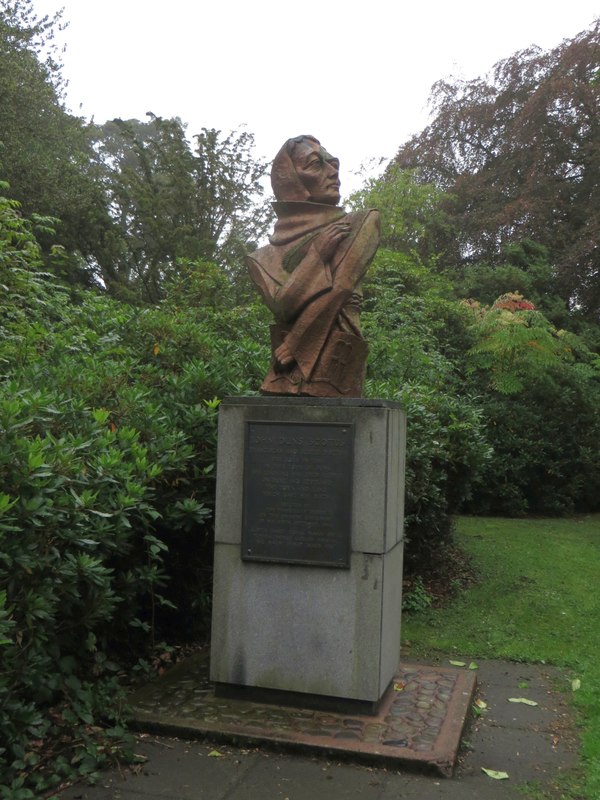
Scotus’ ideas were rubbished by Rabelais. Their failure is commemorated by the word “dunce”. But nationalists are all Scotists. They still believe in haecceitas. Possessing a particular kind of it is a prerequisite for membership of the nation.
It is fashionable to say that the official face of modern Scottish nationalism is civic, not ethnic. Sir Neil MacCormick, the only public intellectual that the SNP has ever had, was very influential in this regard. But he accepted that nationalism has a dark side. It could be said that his enthusiasm for the European Union as a Commonwealth of which an independent Scotland would be a full member, albeit with significant limits on its sovereignty, was his way of coping with its powerful forces.
But ethnic tartan haecceitas is alive and well. In her 2015 SNP conference speech Nicola Sturgeon said:
Let’s make sure that the names of the innovators, entrepreneurs and inventors working across our country today will be just as familiar to future generations as Alexander Graham Bell, John Logie Baird, Alexander Fleming and James Watt are to ours.
All true-born Scots. But Bell did his telephone work in the USA, Baird developed his TV system in England, Fleming discovered penicillin at St Mary’s Hospital, London where he spent all his career, and Watt became an entrepreneur only after joining with Matthew Boulton in Birmingham.
Some call Ockham “the father of modern science”. As a pioneer of rational thought and justified scepticism he has won, hands down. When writing “The Origin of Species”, Charles Darwin would have found his task easier easier if a test for haecceitas had been discovered. There isn’t one. Darwin settled for a nominalist definition. It has never been bettered.
In determining whether a form should be ranked as a species or a variety, the opinion of naturalists having sound judgement and wide experience seems the only guide to follow.
Science and nationalism make very uneasy bedfellows. The classical example is die deutsche Physik (German physics) vigorously promoted by extreme nationalist physicists at the beginning of the Third Reich. To them quantum physics was not “Aryan” and they published articles calling Werner Heisenberg, one of its founders, a “White Jew” in the SS weekly newspaper. But by the end of 1942 even Himmler had turned against deutsche Physik because of military necessity.
Anton Chekov said: “There is no national science just as there is no national multiplication table; what is national is no longer science.” Perhaps there should be no surprise that direct access to the SNP First Minister by the Scottish Government’s Chief Scientific Adviser stopped in 2012, and that the post has been unfilled for more than a year.
Main image of Umberto Eco: via Wikimedia Commons 1.0
Scotus image: © Graham Robson CC BY-SA 2.0
Leave a Reply to Allan Sutherland Cancel reply