
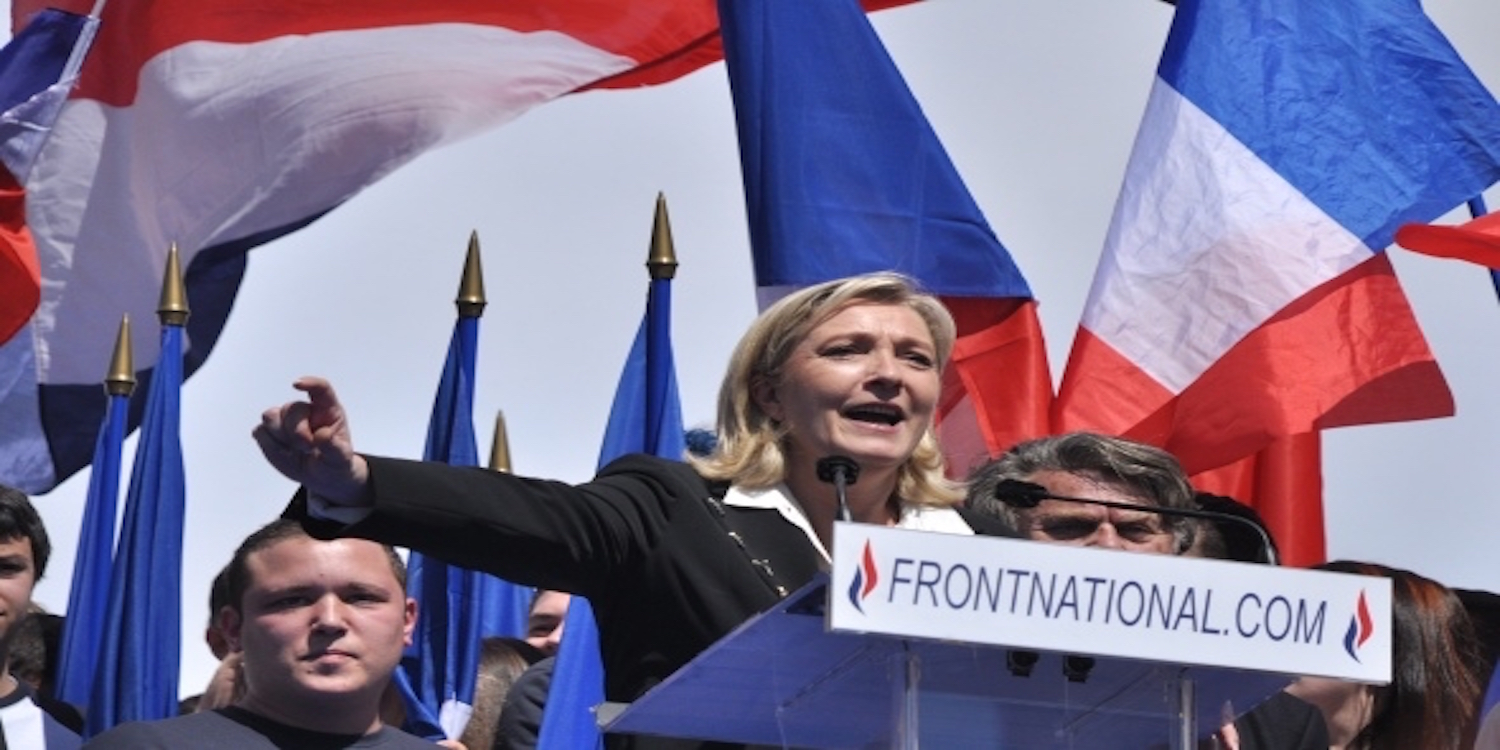
On 28-29 January, the leaders of the European Parliament Group Europe of Nations and Freedom (ENF) met in Milan. Greeted by a sold out venue inside, and attacks from the far left outside, this was the first time the ENF, composed of the most prominent leaders of the European far right, had gathered outside Strasbourg.
Under the slogan ‘Freer, stronger: another Europe is possible’ Marine Le Pen (Front National, France), Matteo Salvini (Lega Nord, Italy), Heinz-Christian Strache (Freiheitliche Partei Österreichs, Austria), Tom Van Grieken (Vlaams Belang, Belgium) and Geert Wilders (Partij voor de Vrijheid, Netherlands) among others, presented their project for a different Europe.
The problems: Schengen, Islam, and the EU
Perhaps unsurprisingly, the migration crisis dominated the agenda. The various members of the ENF predicted (and welcomed) the ‘death of Schengen’ and the necessary return to border controls. Following attacks in Paris and Cologne, in particular, open borders were presented as a danger for western democratic values and as a source of unrest for the people of Europe. During the conference, Schengen was accused of pitting Europeans against one another, thus betraying the original spirit of European cooperation, which was meant to foster peace between its peoples.
Closely linked to the migration crisis, several leaders addressed the ‘Islamic threat’. Following an increasingly common trend among the European far right (and not only), Islam was presented as incompatible and indeed dangerous for western democracies. No leader has insisted on this point as much as Geert Wilders, who for years has claimed that Wahabbism and Salafism are not compatible with freedom and pose an ‘existential threat’ to western civilisation. Salvini echoed him, suggesting that interpreting the Qur’an ‘fanatically’ is ‘incompatible’ with rights in western Europe.
Islam and migration, however, would not be problems if it wasn’t for the one true responsible of the crisis of Europe: the EU and the national political classes which fail to stand up to Brussels. Accused of ‘incompetence’ and ‘political correctness’, as Van Krieken put it, the European Union was criticised on all fronts: from its participation in bail outs via the creation of the euro to the introduction of Schengen.
The solution: No Schengen, less EU, and the return to sovereignty
Concretely, what emerged from the various speeches was the idea that if Europe is to have a future, the EU will have to either change radically, or disappear completely. The ENF politicians in attendance advocated a return to what in their view was the initial spirit of Europe: a project of collaboration in the name of peace and prosperity, where sovereign peoples could decide to cooperate on given projects and not have collaboration ‘forcibly’ imposed on them by Brussels.
They suggested that this goal is not out of reach, and that there are good reasons to hope that change is just around the corner. Firstly, the migration crisis could lead to the reintroduction of border controls and limitation of inflows from non-EU countries. Secondly, they expressed a firm belief in the fact that ‘the people’, seeing that the EU does not work, will start rebelling against the elites and start a ‘democratic revolution’, which will topple the old system and allow a return to the status quo ante. In short, a ‘Patriot Spring’, aimed at bringing about a new Europe, with fewer asylum seekers, more border controls and sovereign nations.
A (successful) case of cooperation between the far right?
There is nothing new in the project the ENF presented. Most of the speeches were yet another rehearsal of the parties’ regular programmes and interventions, and little that is genuinely new was brought to the table. What appears most striking is their will and ability to collaborate outside the European institutions. Transnational cooperation of far right parties is not unheard of, but it has never been particularly successful and has rarely moved outside the European Parliament. The real story of the meeting wasn’t really what was said, but the format of the gathering: a convention, with exchanges and speeches, closely resembling a ‘regular’ party congress.
It may be too soon to speak of a successful case of transnational cooperation, but what the convention showed is that the ENF group, while recognising quite openly the differences between its members, seems to have converged on a single goal. Both those who advocate a ‘Europe of Nations’ such as the Front National, and the advocates of a Europe of Regions, such as Vlaams Belang, appeared to agree on the need to retrieve their own sovereignty and oppose the EU’s ‘one size fits all’ model. The key word to remember here is diversity. Europe, for them, is not about unity: it’s about the diverse cultures and nations of Europe which the EU is attempting to harmonise and transform (in their vision) into a unitary superstate. To protect this diversity, they stand ready to set aside their differences and join in the collective project of wrecking the EU in the name of ‘another Europe’.
See also: politico.eu
This blog first appeared on the LSE Europp site and is reproduced with permission
Photo: Blandine Le Cain CC BY 3.0 (Creative Commons licence)
Leave a Reply