
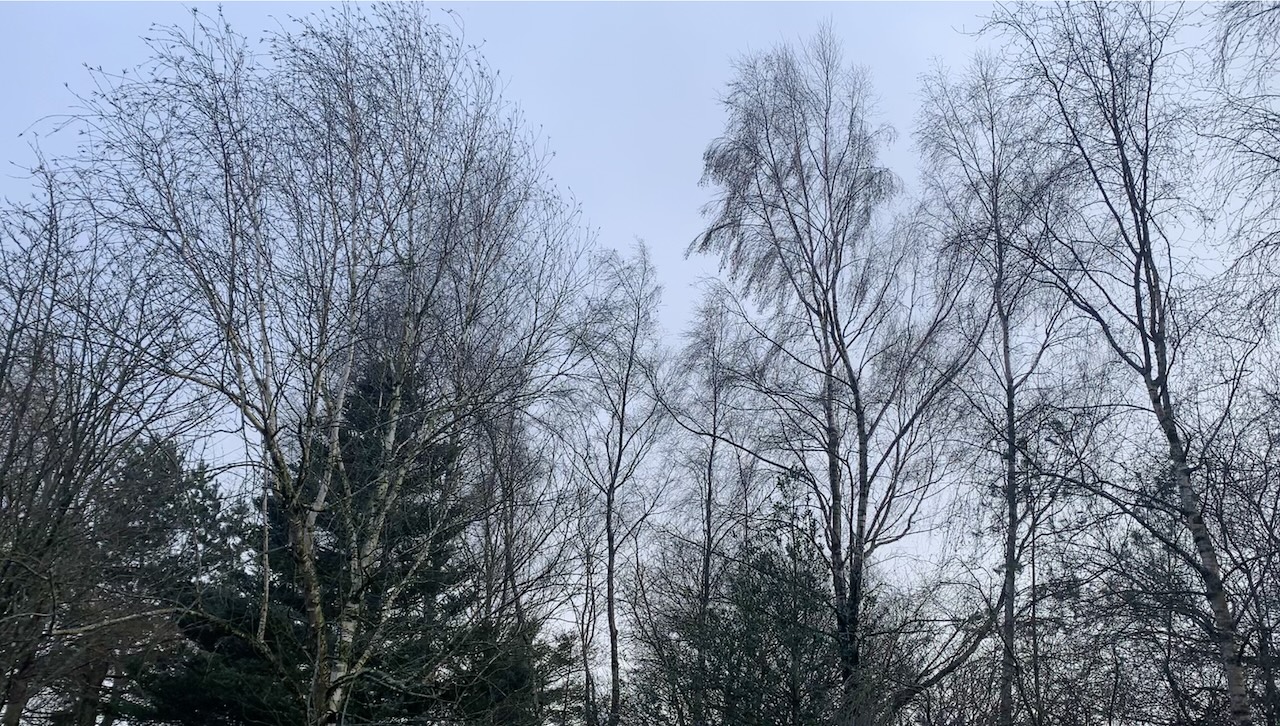
What can poetry give us in this sorry mess of Spring 2026? Waiting for Dave (another daft name for a storm) while Donald beats his war chest, I was searching for answers.
Here we are, between Donald and Dave, two man-made malevolencies blowing in from the west ‘and there’s naethin ye can dae, said the old boys’ as a canny Kathleen Jamie notes in her poem, Springs, written in 2011 (when Obama was in the White House and storms had yet to be named).
But poets do it for us all the same, whatever the old boys say.
Why is that? Each of us might find a different reason but perhaps if nothing else it reminds us we are not alone. Poets reach into us, rearrange feelings, give words to emotions. In times of war, poetry is a kind of defiance, a resistance. Humanity reclaimed?
So I find, by one means and another, this Sceptical selection for a turbulent Easter bringing together four poets, each with their own distinctive perceptions of life, death and renewal: Dalia Taha from the West Bank, Palestine; Ilya Kaminsky, from Odessa now in Atlanta, USA; Kathleen Jamie, Scotland’s fourth Makar, from Fife; and her Gaelic speaking successor, Peter MacKay, from Lewis and St Andrews.
1 Enter Tears: Dalia Taha
We all know what happens in war. As soon as it begins it strips a people of everything: their language, their homes, their songs, their trees…
Dalia Taha, a Palestinian poet and playwright, lives and writes in Ramallah in the West Bank, around 50 miles from the unfolding horror in Gaza. She writes to keep sane, she told her translator Sarah Elkamer.
Her Enter World collection published in 2026 is profiled on the Poetry Foundation where she is quoted as saying ‘I wrote this collection partly so I would not go mad, and partly so one can hold onto whatever has not been contaminated completely by this war.’
Enter Tears is prosaic, powerfully direct, but poetically haunting. The poet, scanning bookshelves – ‘for every book about a battle, there is a missing book about its tears’ – finds images of 17th century boats waiting for their cargos of slaves. She demands a book fair that presents only anthologies of tears: tears crushing the bookshelves.
Yet the poetry raises beauty from the rubble; olive trees, hills, writing on the walls. The Enter World collection includes Enter Shadows – and the changing shadows of the massive cypress tree that in early morning can split a queue of cars in two yet by afternoon is a little girl holding out her hand.
The trees have always known better—
they let strange winds rush into their arms;
they cast borders
and then they reverse them.
,2. We lived happily during the war: Ilya Kaminsky
And when they bombed other people’s houses, we protested
but not enough
Ilya Kaminsky cuts to the quick. The guilt of living peacefully, safely distant from the carnage we scroll through on handheld screens. America is very distant from the old Soviet Union city of Odessa where Ilya was born in 1977. He was a teenager when his parents were given political asylum and the family moved to New York in 1993. Far from Ukraine. But heart-close to home. The distant Russian invasion, the bombings of ‘invisible house, after invisible house, after invisible house’ produced this poem in 2013.
We lived happily during the war went viral 13 years ago. It throbs painfully again in 2026 in another ‘disastrous reign in the house of money.’
Ilya Kaminsky is not just a poet. A brief biographical search presents a a multi-talented, constantly active soul: a pioneer of poetry for the deaf (he lost most of his hearing at the age of four), a co-founder of Poets for Peace supporting relief work round the world – the BBC has named him one of 12 artists who changed the world.
We need such poets in a world where war mongers glorify the destruction of homes, hospitals, schools, libraries, civilisations of other human lives.
And all the while
In the street of money in the city of money in the country of money,
our great country of money, we (forgive us)
lived happily during the war.
3 Springs: Kathleen Jamie
the dykes failed, the town’s last fishing boat
raved at the pier-head, then went down;
Our latest storm Dave doesn’t seem to have made the impact of Kathleen Jamie’s spring storm of 2011. But her poem surges with the life and death force of the gathering extremes climate change is bringing us.
I chose Springs because it feels so much like the present. The rivers spilling their ‘inner lives’, the ‘diesel-corrupted water’ the swing-parks, strewn with ‘plastic trash, driftwood…bust tvs’
It feels personal and it is. Kathleen Jamie lives by the river, by the River Tay in Newburgh. When she was appointed Scotland’s fourth Makar in 2021 a Sceptical Scot profile by Asif Khan described a poet of natural resistance ending with What the Clyde said after COP 26
“and, sure, I’m a river, but I can take a side.”
Oddly, despite the raging destruction of Springs, there’s also that rousing energy we all recognise in a roaring gale. Maybe I’m being too optimistic, but I see a kind of defiant life force in the last image. That dead salmon – flung against the see-saw in the swing park. “The crows are on to it at once.”
4 Am bùrach: Peter MacKay
Wheesht: the bourach was never spoken here.
Peter MacKay writes in Gaelic which (I apologise) I cannot read but from womenfolk in my family I know the Scots word bourach well – a mess, a muddle, a confusion, a fuss – and MacKay has kindly translated his poem Bourach into English.
The fifth Scottish Makar (he follows Edwin Morgan, Liz Lochhead, Jackie Kay, Kathleen Jamie) is the first Gaelic speaker. He comes from Lewis and he is also Professor in Literature at St Andrews University, an expert in Irish, Scottish, and Scottish Gaelic literature. In short, he is at home with words.
And you can feel it in the romping Bourach. The words bounce off the page, a satisfying read. Say it aloud. It’s a good way to end this Sceptical spring selection, with a knowing wink and a nod to often stormy history, and the gaps in it. There is, says the poet, a kind of enchantment walking down George 1V bridge – bourach drips through the stones to Cowgate ‘like coffee through ice cream.’
We’ve been here before. The Romans ‘call it peace’ but left a bourach. And on we go past the bourach of knowledge ‘untranslated’ in the National Library.
This, as the BBC noted, was the first poem the Gaelic-speaking Makar performed in 2024. Not yet published, it was written for Push the Boat out Poetry Mile Project in Edinburgh. I can’t help imagining all the pubs we would pass and thinking what a great performance that would be. With a dram…as indeed the Makar suggests in his wrap up toast.
We left you a country, and you made a bourach of it.
Or we left you a bourach and you made a country of it –
ach, it doesn’t matter…Slanj va! Land of hills and bourachs
Slàinte!
Leave a Reply