
Boris Johnson has gone but cakeism is alive and well as was all too obvious in the Caird Hall, Dundee.
Humza Yousaf’s speech at the SNP rally was an artless effort to have his cake and eat it. He needed to satisfy impatient activists hungry for evidence of a clear strategy to win independence while showing that any such strategy was rooted in a process that would be legitimate in the eyes of opponents in the UK and the wider world – as he said: ‘There is no route to independence other than through a lawful, democratic process’.
His biggest problem is that he took over the reins in very difficult circumstances – he will soon realise that it hasn’t just been the ‘last few months’ that haven’t been easy. The immediate post-referendum enthusiasm and excitement has gone. It’s back to the politics of ‘auld claes and cauld porritch’, as Margo MacDonald once famously put it.
The Caird Hall rally pales in comparison to the one in the SSE Hydro arena in December 2014. The SNP has not only lost momentum but is fast losing its reputation for governing competence that gave it the overall majority in 2011 that provided a mandate for an independence referendum. And its ongoing internal problems are hardly a great advert for a party trying to convince the public it believes in accountable and responsible government.
Putting all that to one side, the SNP leader’s message was still deeply confused. The SNP ‘will absolutely fight the next election with independence front and centre of our campaign’. The first line in its manifesto next year will declare: ‘VOTE SNP FOR SCOTLAND TO BECOME AN INDEPENDENT SCOTLAND’. This seems, at first sight, a rehash of Sturgeon’s de facto referendum. But he then went on to say that ‘If we win the General Election, we will take that mandate from the people and ensure we as a government are ready to negotiate our independence’ in comments steeped in ambiguity and incoherence.
Sturgeon’s de facto referendum would have involved the SNP winning 50% of the vote, though there was initially some confusion even on that too. Does Yousaf mean: if the SNP has more votes and/or seats than any other party, not necessarily 50% of either or both? If the SNP remains the largest party but with say 35% of the vote and a consequent loss of several seats, would that constitute a mandate and for what exactly?
An absence of answers
And what does ‘we as a government are ready to negotiate our independence’ mean? Being ready is quite different from actually entering negotiations. We might expect the SNP to be ready to start negotiations if they seriously expected that Scotland was on the cusp of independence but that doesn’t mean negotiations will happen. It takes two (at least) to negotiate.
Hints of the way the SNP intends to campaign in the coming months were evident as much in what Yousaf didn’t say as what he said. Despite the rhetoric that there is work to be done, the SNP still lacks coherent, consistent and convincing answers on currency, the economy, borders and, crucially, how it will deliver the healthy, wealthy Scotland that all want. He argued that independence would provide powers to build an economy, tackle the cost of living crisis, build a welfare system etc. But all such powers exist in the UK. It is not the absence of powers but the absence of answers as to how this will be done that needs to be answered.
Most people want a strong economy and fair society – proclaiming that is easy; delivering it, as the SNP has demonstrated in office, is the difficult bit. And not a word was offered on that. The SNP continues to pretend that an independent Scotland can have its cake and eat it: low taxes and high levels of spending that can only lead to disillusionment and disappointment. It is not the what that is in dispute but the how. We can be sure that such evasion will be fully exposed to the SNP’s detriment in any election or referendum.
The difficulty in regaining the SNP’s reputation for competence was exposed in a passing comment, ‘campaigning for independence must be at the heart of everything we do as a party’. But campaigning is not the same as governing and what has become abundantly clear is that this incessant, though not entirely successful, campaigning neither delivers good government nor increases support for independence.
There will be a ‘summer campaign on the opportunities of independence’ but we have heard this before. The only difference appears to be that this will culminate on September 2nd with Yousaf and the SNP joining Believe in Scotland to ‘fill the streets of Edinburgh with a march and rally for an independent Scotland within the EU’. All fine and good but then what? Marches and rallies might be good for the nationalist soul but will change little, if anything, and ultimately are evasive.
Three painful challenges
The problem confronting the SNP is broadly threefold and each issue it faces is very challenging but unless and until they are overcome, the SNP will make no progress. Equally, as the SNP leadership knows all too well – which explains why it fails to face up to these challenges – this will be painful, likely divide the party and wider movement and would not be very popular.
First, its easiest task is to get its own house in order. The SNP espouses the case for a legal constitution and is making this a major selling point but it has operated its own version of the UK’s political constitution. The party leadership’s power-hoarding, lack of accountability and secrecy does not augur well for the kind of independent state they wish to achieve. The SNP has become a very British party.
Second, it needs to regain a reputation for governing competence. It may not be impossible for a party to campaign for independence and simultaneously govern competently but the SNP has evidently been unable to do so in recent years. If it wants to showcase what independence might achieve it needs to do this not by placing campaigning for independence ‘at the heart of everything we do’ but get by getting the ferries to run on time, deal with Scotland’s shameful record of drug deaths, do more than make speeches on closing educational attainment gaps, truly deliver sustainable economic growth, and take delivery and implementation seriously … The SNP in government has hardly been a great advert for independence.
And third, it must offer clear, consistent and convincing answers on key issues around the process and transition to independence, achieving economic growth in an environmentally responsible and fair way.
For the last eight years, the SNP has been swept along on a wave of post-independence referendum enthusiasm. But waves ebb and flow. The key lesson is that Scotland will not be taken to independence on an emotional wave. Hard questions require answers. There is simply no alternative.
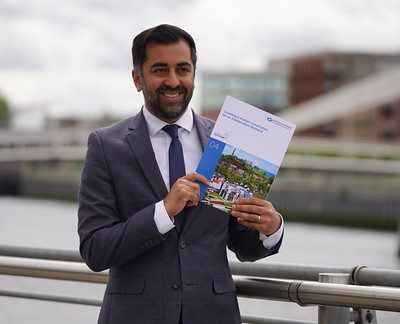
Featured image: First Minister Humza Yousaf, via Scottish Government flickr, CC BY 2.0
Further reading: Tom Gordon, Yousaf appears to admit his 1-day-old plan won’t work, The Herald; Wishart throws plan in to confusion, The Herald; Rhetorical catnip with little substance, The Scotsman (£);
Leave a Reply