
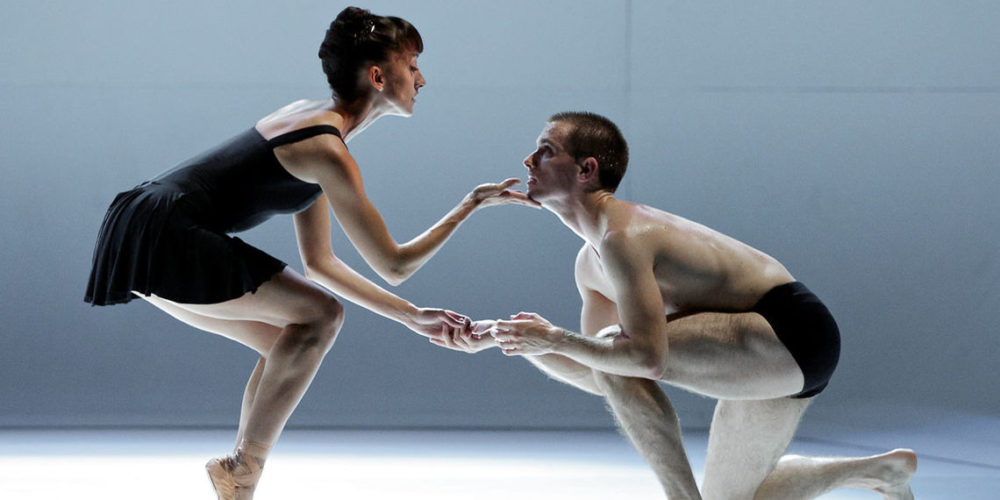
Here’s the Rite of Spring playing in front of me. Close up and breathtakingly personal. The Scottish Ballet’s raw reworking is not for casual viewing. How on earth did I think I could combine it with a spot of ironing?
This is a chance to catch again the sensational performance recorded live in Edinburgh last autumn. Re-released on 20 February, it is available on Livestream through the Inner Ear channel.
We first saw Christopher Hampson’s reinterpretation of Stravinsky’s 1913 ballet at the Edinburgh International Festival in 2013. It was a mesmerising experience in the Festival Theatre. Just three dancers in a stark white set, nothing to distract the eye from relentless, hypnotic, muscular movement.
At home, after the first few notes of the bassoon I am frozen to the spot. I abandon the hot iron for fear of setting fire to the board. It’s a curious benefit of the digitally recorded performance – and one which must be felt by audiences watching distant National Theatre or Royal Shakespeare Company productions from the comfort of their local cinema seat: the camera takes you so much closer to the action.
My laptop screen inveigles me on to the stage, into the streamlined white set, right up to the dancers – Christopher Harrison, Constant Vigier, Sophie Martin – chests heaving, bodies glistening with sweat, faces alternately expressive and expressionless.
And all the time the music is playing. I have loved the Rite of Spring since I first heard it, more than 30 years ago. Visceral, violent stuff. Spring, like human birth, does not deliver easily. Stravinsky delighted in the cracking ice that signalled the bursting of new life into Russia’s frozen landscape.
In 1913 Nijinsky shocked the audience with a core of heavy moving, ‘pigeon toed’ dancers enacting pagan ceremonies as they chose a sacrifice to ensure a good growing season. Hampson’s choreography and design strips the ancient ritual to the bone. No landscape. No pastoral scenes. Instead of sages and damsels, there’s simply two young brothers and a female figure symbolising faith and death. In place of the sacrificial virgin dancing herself to death there’s the brutalising of the dominant older brother (Harrison) as the younger man (Vigier) falls victim. Ultimately life and hope flutter into the darkness. Faith has become death.
As drama it is timeless and yet disturbingly contemporary. In the second half, the imprisoned younger brother’s head is covered with a black hood, the older brother has changed his tribal skirt for combat trousers. With minimalist props the production evokes the torture, power and abuse of current day horrors.
The dance is brutally and compelling beautiful. The Scottish Ballet orchestra performance is utterly gripping. Watch it over again. It’s available on Livestream until 27 February. Just don’t think you’ll be able to play it in the background.
Download/image via Scottish Ballet
First published on the author’s own site
Leave a Reply