

GERS again? Really? I know, it’s getting a bit ridiculous now, isn’t it?
Yet here we are again with the latest denial mechanism for those who simply don’t want to believe the inconvenient conclusions from their own government’s statistics.
I know it’s a generation ago now but some of you may remember that, before the last independence referendum in 2014, the GERS figures were used repeatedly by anti-union campaigners as evidence of Scotland’s superior fiscal position to the rest of the UK.
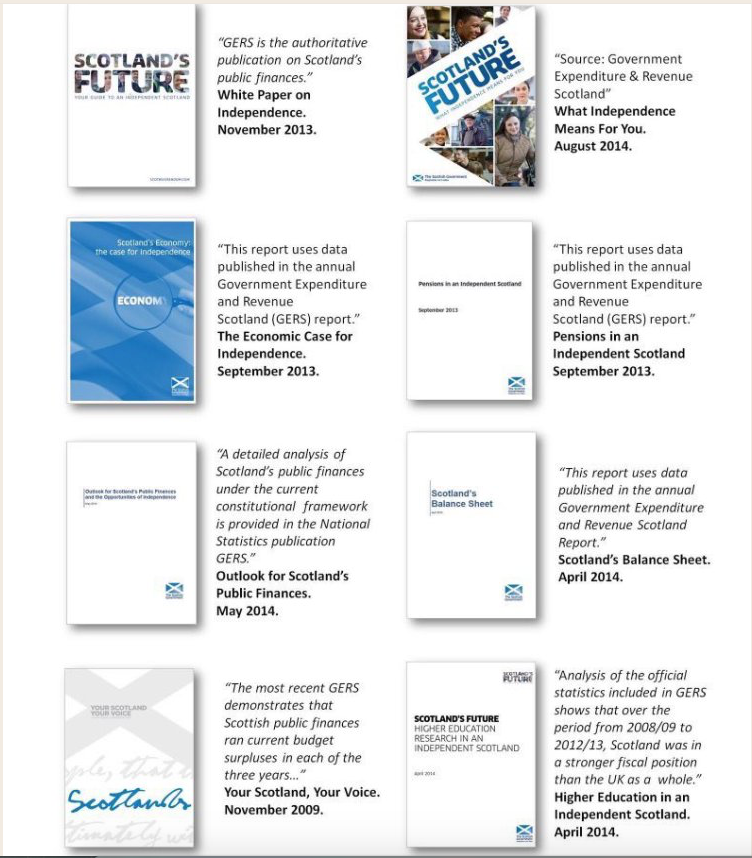
Cited on 15 occasions by the SNP’s white paper on independence, and by their Fiscal Commission Working Group, Business for Scotland, Yes Scotland and every SNP politician including Alex Salmond and Nicola Sturgeon (who incorrectly claimed they showed a surplus) there was absolutely no doubting their trustworthiness.
[See this from Blair McDougall for a full collection of GERS praise from the SNP]
As the campaign progressed, the spin imparted on the figures began to fray around the edges – particularly after the release of the 2012/13 version six months before the vote.
In response to this, the compliant online wing of the independence movement began to fabricate myths to bolster the figures. It started with the invention of taxes that simply didn’t exist – the infamous whisky export duty – and when that was proven for the lie it was [LINK] they progressed onto bizarre claims that first VAT and then corporation tax were assigned according to company headquarters and so missed from GERS – proven wrong [LINK]. After that, they claimed GERS didn’t include our appropriate share of oil revenues – also debunked [LINK].
Next, they claimed that GERS included billions of spending on English projects – Crossrail, London Sewers et al – that an independent Scotland wouldn’t pay for. Another lie. [LINK]
More recently there have been claims that an independent Scotland wouldn’t inherit any sovereign debt repayments or pay for state pensions which, whilst both stupendously wrong [LINK and LINK], at least accepted the current figures at face value.
Murphy’s Law
Myth after myth, meme after meme, those people who had been so full of praise for GERS when it suited them, now remained silent – refusing to publicly debunk when deliberate disinformation and public ignorance aided their constitutional obsession. Indeed, on occasion it was apparent that some of the looser cannons amongst the SNP-fold actually believed the lies.
Of late a new line has taken hold, fostered by Richard Murphy – Professor of Practice in International Political Economy at City University, London. The claim is that the data the Scottish Government’s statisticians use to produce GERS is not fit for purpose – a claim which seems to rest heavily on the assumption that because the data comes from ‘London’ then it must be biased against Scotland… it’s self-evident…
Professor Murphy also claims that because some of the revenue streams are estimates of Scotland’s share of total UK tax, they are therefore unsuitable. For the purposes of this blog, I will leave discussion on the suitability of the estimates to people better qualified than I am – such as Graeme Roy, Director of the Fraser of Allander Institute [LINK] or Professor Ronald MacDonald, Research Professor in Macroeconomics and International Finance at the Adam Smith Business School, and Professor Angus Armstrong, Director of Macroeconomics at the National Institute of Economic and Social Research [LINK].
Professor Murphy’s comments were shared online by several SNP politicians, more than happy to further muddy the waters of economic reality but it was noticeable that, when asked directly, the official line from the Scottish Government and Finance Secretary was to distance themselves from claims the current figures are inaccurate.
Derek Mackay, never a man to inspire confidence that he’s fully in charge of his brief, had the following to say:
“…I’ll take those statistics at face value… I accept the estimates as they are, but I think we could do so much better.
In terms of the statistics available between the UK government statistics, the ONS (Office for National Statistics) and what the Scottish government produces, yes, they are accurate. But they are an accurate assessment of estimates of where we are right now – not the starting position of an independent Scotland.”
This now appears to be the go-to line for those who find it just too inconvenient to answer questions on how an independent Scotland would deal with the near-£15bn deficit.
And this week, following a Radio Scotland debate between Richard Murphy and Kevin Hague, there was much crowing from nationalists when they thought someone on ‘the other side’ was saying the same thing:
Unionist blogger @kevverage concedes #GERS figures can’t tell us about finances of an independent Scotland on @BBCJohnBeattie show #ScotRef
— Joanna Cherry QC MP (@joannaccherry) April 12, 2017
The problem for Ms Cherry et al is this is not something that is, as she pejoratively claims, “conceded”. It’s simply the repetition of the very point Kevin (and the rest of us) have been making for years now.
In fact, it’s the very same argument made by the SNP’s white paper for independence and everyone, including Ms Cherry, who backed it as the foundation of their case for separation. To quote:
This chapter sets out Scotland’s public finances and demonstrates that Scotland has the financial foundations to be a successful independent country.
It also provides an overview of the financial position that the Scottish Government expects an independent Scotland to inherit and this Government’s early priorities for public spending and revenue.
The starting point for this analysis is the National Statistics publication, Government Expenditure and Revenue Scotland (GERS). GERS is the authoritative publication on Scotland’s public finances…
…To enable an informed assessment of the financial position of an independent Scotland, the Scottish Government has prepared projections of Scotland’s public finances under the current constitutional framework
So, just three years ago, the SNP were telling us that GERS is “the authoritative publication on Scotland’s public finances”, shows a trend of Scotland’s fiscal position and that it provided the starting point for an informed assessment of an independent Scotland.
We agree. Why have they changed their mind?
(In)Convenient truth
If we were to become independent, the first government would face a multitude of choices on how to run the new country. One, albeit ludicrously implausible, scenario would see them run things in exactly the same manner as exists within the UK – this would result in, all other things being equal, the deficit shown within GERS.
Of course common sense dictates that this would never happen – the government would pursue different policies and these, along with both beneficial and detrimental external factors, would influence government revenue and spending.
All we’ve ever asked is for those seeking separation to tell us what these alternative policies are and what impact they would have from the starting point of GERS. If you think independence would be such a huge success for Scotland, it really shouldn’t be difficult to quantify the economic benefits. Should it?
Sadly, it seems that perhaps it is. The current tactic from the SNP is not just to ignore the economic questions posed by GERS but to deliberately undermine the work conducted by the statisticians of their own government, work which they had previously lauded as “authoritative”. Instead, their current argument appears to be “we can’t tell anything about the economics of independence so let’s just take a punt, eh?”
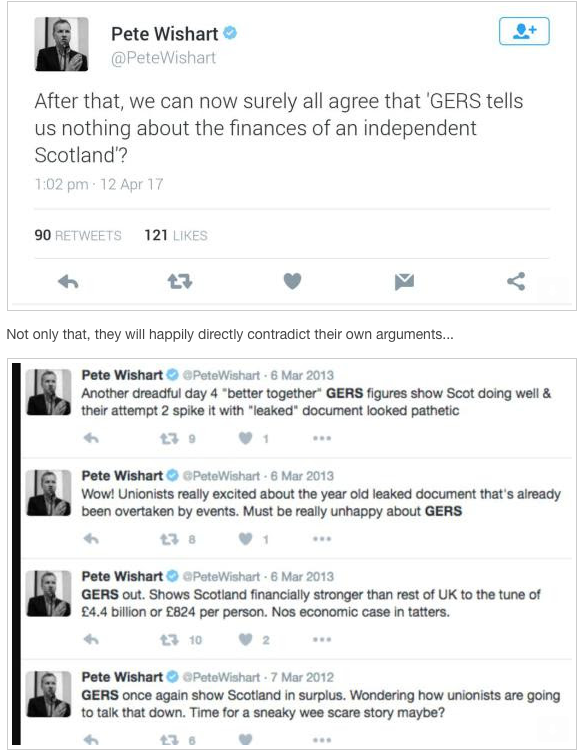
…and hope that no-one notices. Do they really think the Scottish public are that stupid? Do they really think we can’t see through it?
Frankly, I doubt the Scottish public will take kindly to being treated with such utter contempt.
First published on the author’s own site
Leave a Reply